
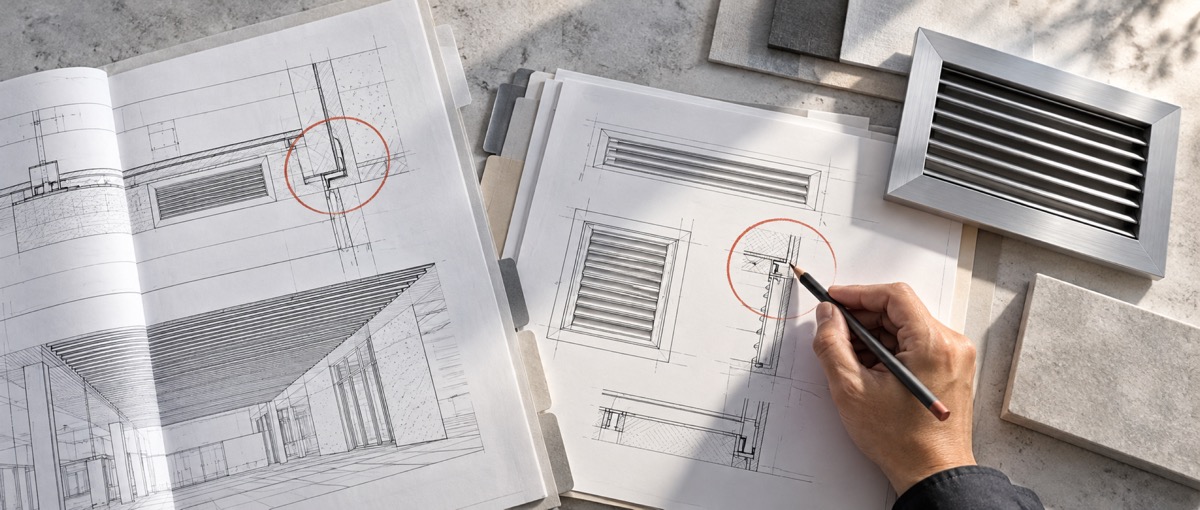
Employees at IDEA, a Canadian architecture firm, used to open files submitted by contractors, compare them with the project’s technical specifications, and work out what was missing. Finishing the drawings did not eliminate this review work. Construction generated another stream of documents that still required a professional to read and answer them.
The firm later adopted Part3’s AI Submittal Assistant. According to a customer case study published by Part3, the tool can save up to one hour on some submittal reviews. The figure refers to time spent reading, comparing, and reviewing a submission. It does not mean that Part3 saves an hour on every submittal, and it does not measure architectural design time. IDEA customer case study
This is software sold to architects, but it does not begin by promising to generate a building. It focuses on a less glamorous task that starts after construction documentation: reviewing the individual packages that contractors must send, checking them against project requirements, and preparing a response.
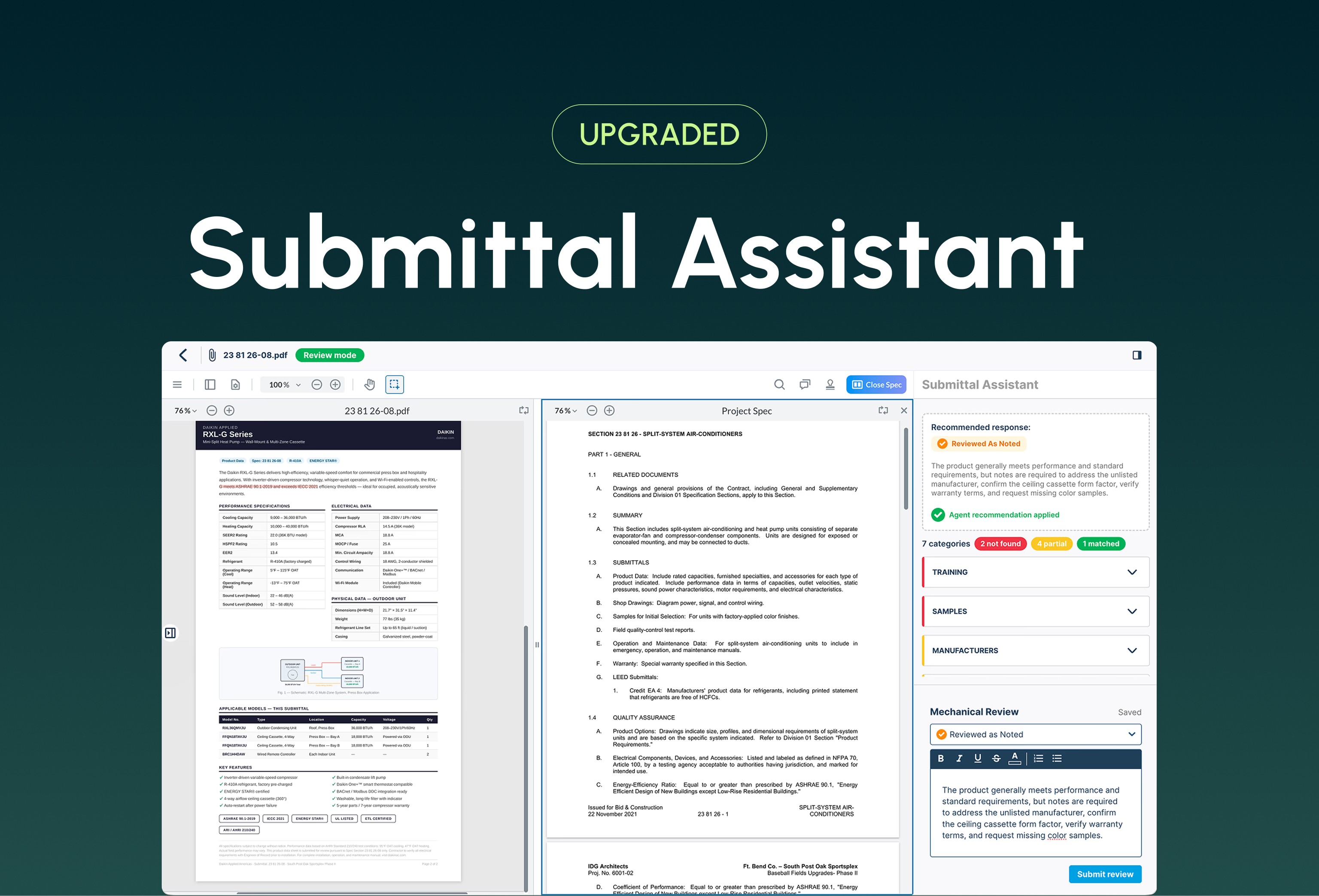
The submitted document, specification, and review guidance appear in the same workspace. Source: Part3’s official product material.
Having all the files does not mean the requirements have been met
Suppose a contractor submits information about a piece of equipment. An architect cannot stop after confirming that the document looks complete. The reviewer may need to determine whether it is the model specified for the project, whether its warranty satisfies the requirement, and whether the installer has supplied the required evidence of experience.
Part3 compares the submittal with the relevant project specification and points to gaps. The product is not merely answering, “What does this PDF say?” It is trying to answer, “What is still missing under the requirements for this project?” Submittal Assistant product page
That distinction determines how close the software gets to the work that must actually be completed. A summary can shorten the first reading, but the architect may still need to repeat the entire compliance check. A specific missing item can become a review comment that is sent back to the contractor.
In the IDEA case, the AI is used to find missing information in contractor documents. Ryan Crowle, one of the firm’s leaders, describes the benefit as more than reading faster. Reducing repetitive paperwork lets the team spend more time on work that needs professional attention. Customer workflow
The product therefore packages a relationship among three things: the contractor’s submission, the architect’s project specification, and the response that moves the construction process forward. A general-purpose document assistant may handle the first file. A vertical product becomes more useful when it also knows which second document governs the answer and where the result must go next.
From a broad hint to evidence that can be checked
Part3 upgraded the assistant in April 2026. The earlier version produced relatively broad prompts. The newer version brings the specification requirement, evidence found in the submitted material, and the specific gap into one review. It also provides locations in both source documents so an architect can open the original text and verify the recommendation instead of trusting an unsupported conclusion. April 2026 product update
One example in the official interface recommends a qualified response while asking the reviewer to verify an unspecified manufacturer and warranty terms and to request a missing color sample. Those are not generic observations about a document. They are items that can change whether the submission should be accepted, revised, or returned.
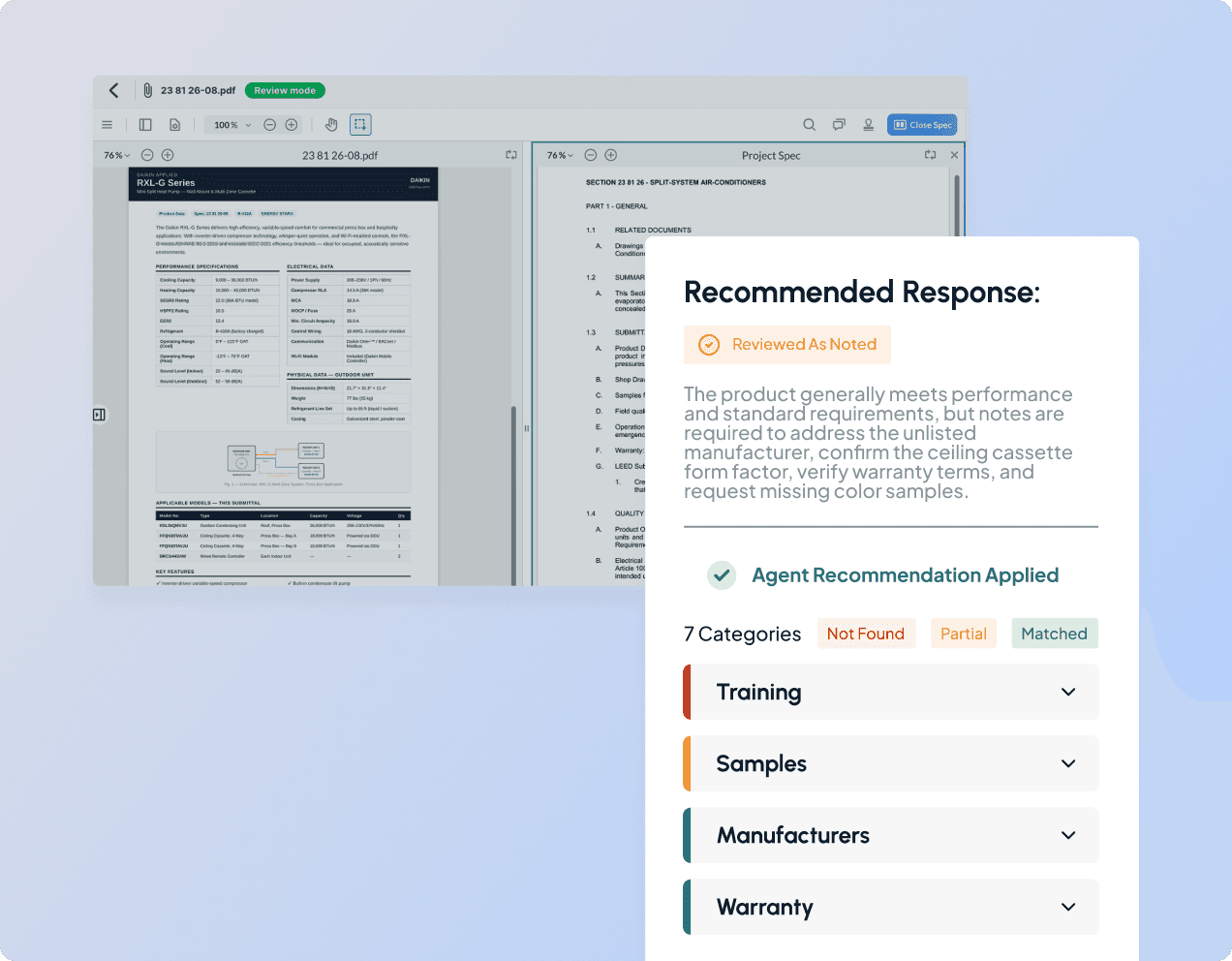
The AI suggests a status and lists the items that still need verification or resubmission. Source: Part3’s official product material.
When the recommendation is appropriate, the user can add it to the review, edit the language, and submit it through the workflow. The architect remains responsible for deciding whether the material is acceptable. The software moves the evidence search and first draft earlier in the process; it does not remove the professional sign-off. Review workflow
The update also changed which context the assistant receives. It no longer asks users to hand over an entire specification manual for every review. Instead, it works from the relevant specification section uploaded to the project. If that section is missing, Part3 asks the user to provide it before producing a recommendation.
That detail is easy to overlook, but it matters for document AI. Choosing the authoritative source is part of the product. A model can read a file accurately and still produce the wrong operational answer if the project is using a different section, version, or requirement.
The party responsible for the review is the buyer
Part3 says its software is typically purchased by the lead consultant responsible for construction-phase coordination and document control, most often the architect. Its public plans are billed annually. The pricing page lists Core at the equivalent of $150 per user per month and Complete at $200 per user per month, while the homepage separately says annual subscriptions start at $9,000. Those figures describe public offer surfaces, not IDEA’s actual contract or a guaranteed one-seat purchase price. Pricing page, Part3 homepage
The company also offers unlimited free collaborator seats. External project participants can take part in the same process without requiring the lead consultant to negotiate another paid license every time someone is added.
This makes the pricing structure follow the division of responsibility. The paying organization coordinates the review and controls the record, but the process depends on contractors and other consultants. Free collaboration does not make the lead consultant’s work free; it reduces the friction around bringing the other participants into the workflow.
Part3 did not sell the April AI upgrade as a separate add-on to existing customers. The product announcement says the updated assistant is available with no upgrade and no extra cost. AI is being used to increase the value of an existing construction administration platform rather than create another isolated tool that users must buy and switch into. Availability for existing customers
For vertical AI builders, the useful lesson is concrete. It is not always necessary to automate the most visible professional activity. Start with a required check that happens repeatedly and cannot simply be skipped. Identify the source that governs the decision, show the reviewer the evidence and the gap, and place the result in the document they already need to send. That is how a document-reading feature becomes part of a paid workflow.