

A salesperson finishes a product pitch, and the AI customer begins asking questions. When the practice ends, the system does more than flag a fast speaking pace. It checks whether the employee covered the company’s required messages and how well the person handled objections.
This is the form of training Yoodli now sells to businesses. The company began with public-speaking coaching, then moved toward AI characters that play customers, interviewers, and colleagues during realistic workplace conversations. In December 2025, Yoodli reported that revenue had grown 900% over the previous year. As of October 2026, founder Varun Puri still had not disclosed the company’s exact revenue or profitability. Yoodli’s company disclosure GeekWire interview on Yoodli’s enterprise training expansion
The more useful question is how a company that helps people speak found a place in enterprise training budgets.
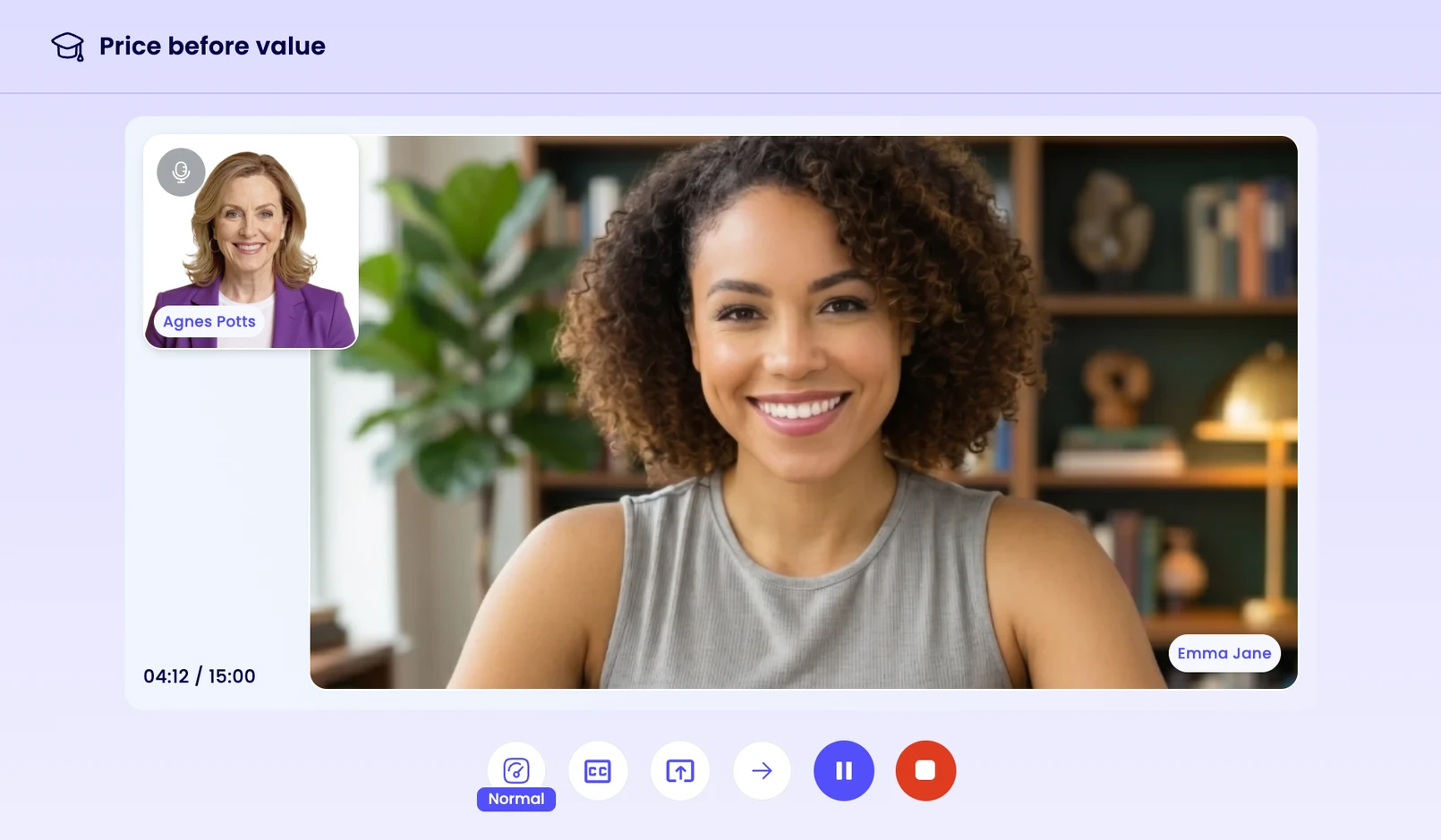
An official Yoodli roleplay example. AI plays the other person, and the learner must formulate a response.
Companies have course material but not enough people to run practice
Snowflake’s problem was not a lack of sales material. It was determining whether thousands of salespeople could actually deliver a newly introduced message.
In a customer case study published by Yoodli, 162 sales managers each spent an average of about 7.5 hours per quarter scoring pitches and roleplays. Together that amounted to roughly 1,215 hours. Judgment could vary across managers and regions, while employees did not always receive useful feedback immediately after submitting practice work. Yoodli’s Snowflake sales-training case study
Another slide deck cannot solve that constraint. Course material can be distributed to 3,000 people at once, but managers cannot listen to 3,000 people deliver the pitch at once.
Snowflake training leader Nathan Irby described the purchase process in unusually concrete terms. The company evaluated nine vendors, compared five of them across 25 criteria and sandbox tests, narrowed the field to two, and then ran pilots. It was not buying a chatbot demonstration. It was selecting a tool that would enter the sales-training process and face operational evaluation. Snowflake’s description of its vendor selection and scorecards
The AI is not there only to agree
Snowflake did not send everyone into a generic chat window.
One exercise focused on presenting the latest Why Snowflake message. A salesperson had to connect the product to a specific customer’s challenges, explain how it could help, and provide a relevant customer example. Another exercise made AI play different customer types and raise objections from a defined range, then checked whether the salesperson used the company’s own method to respond. The two exercises had separate scoring criteria. Snowflake’s training workflow
In storytelling terms, this is closer to a commercial conversation than asking whether a presentation has a beginning, middle, and end. A representative may offer a success story, but does it address the customer in front of them? If the customer rejects the explanation, can the representative continue?
Yoodli’s practice documentation says a user can give a presentation or pitch before entering AI follow-up questions, or begin directly with a character conversation. Screen sharing allows AI to respond to presented material. The product does not only draft a script, and it does not only count filler words after a recording ends. Yoodli practice documentation
The Snowflake case study published in August 2025 says nearly 3,000 salespeople and managers completed certification, representing 94% of the target population. The Why Snowflake exercise took an average of 14 minutes, while objection practice averaged eight minutes. The case study also estimates that the workflow eliminated about 1,215 hours of manager scoring each quarter. These are customer-case figures reported by Yoodli, not an independent audit. Yoodli’s Snowflake case study
The buyer also needs a management view
Selling practice to one person and selling it to an organization are separated by a layer of management work.
Who participated? Which messages are repeatedly omitted? Does one employee need help, or is an entire team stuck on the same objection? If the product only generates a report after each practice, a training leader still has to collect and organize those reports before deciding what to teach next.
Google Cloud’s case makes the requirement clearer. It needed to certify more than 15,000 employees on a new go-to-market strategy within one month. Yoodli did not only provide AI conversations. The team could define scenarios, customer objections, required messages, and scorecards, then track overall progress in a management dashboard. Employees entered through the existing Intellum learning-management system, received feedback after practice, and could share recordings for further peer review. Yoodli’s Google Cloud certification case study
The project reported 92% training satisfaction. Google Cloud later expanded Yoodli into onboarding, presentation preparation, and manager training. The reusable part was not the same AI comment delivered to more people. A team could configure a new business task with its own situation and evaluation criteria. Yoodli’s Google Cloud certification case study
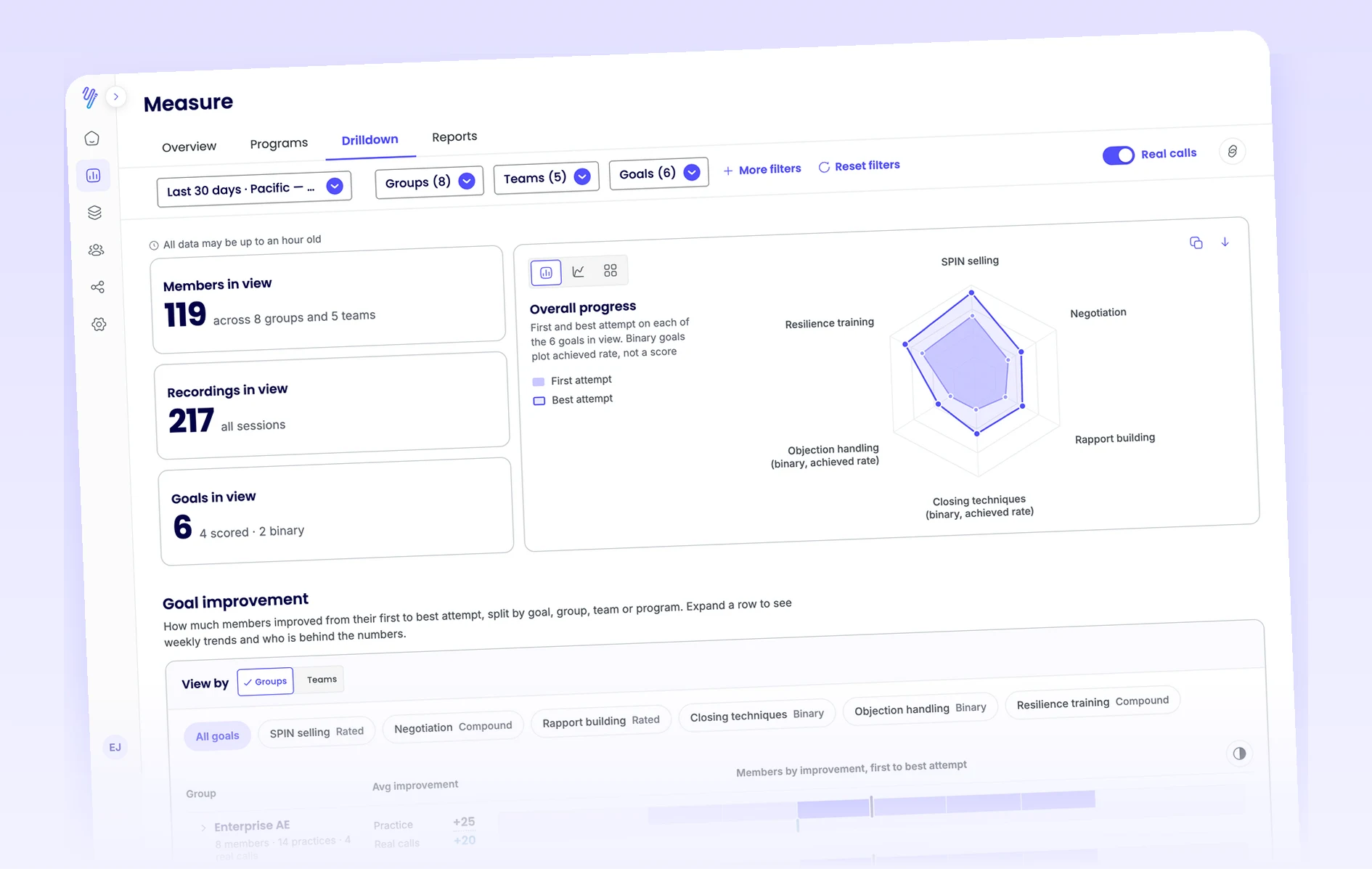
An official management-dashboard example. The displayed values are not real Snowflake or Google Cloud customer data.
From an individual subscription to an annual enterprise contract
Yoodli still offers an individual product. Its current public pricing page lists five lifetime practice sessions in the free tier. Pro costs the equivalent of $8 per month when paid annually and permits up to ten sessions each week. Advanced costs the equivalent of $20 per month annually and removes the practice limit. Interviews, public speaking, and pitches can all begin as individual use cases. Yoodli pricing
The enterprise offer is not simply a collection of premium individual accounts.
| User or buyer | Problem to solve | Product delivery |
|---|---|---|
| Individual | Can I communicate clearly in the next interview or pitch? | Repeated practice, follow-up questions, and feedback |
| Training leader | Has the team reached the company’s standard? | Custom scenarios, scorecards, and progress reporting |
| Enterprise procurement and IT | Can the product fit existing systems and access controls? | Annual per-seat contracts, integrations, and enterprise controls |
Yoodli prices organization plans per seat and per year, with the amount quoted according to team size and use. Custom scoring, management dashboards, learning-system integrations, and enterprise identity controls sit inside the organization product. An individual can begin with self-service practice; training at scale moves into an enterprise buying process. Yoodli pricing
By October 2026, Yoodli was extending into course creation, coaching inside work, and skill assessment. In a demonstration observed by GeekWire, a team entered a training requirement and the system generated a multi-step learning plan. Yoodli was beginning to connect preparation of the course itself to the same product. GeekWire report on Yoodli’s next product stage
For builders working on communication or storytelling products, Yoodli suggests a more concrete entry point than generating a better script. Find a conversation that cannot be learned from course material alone and that managers cannot rehearse with every employee. First make that conversation repeatable. Then let the organization see who is prepared and who still needs help. The purchase reason changes from wanting to speak better to needing this group ready for customers next week.