

Emergency veterinarian Lisa Branner does not consider herself a fast typist. She sees patients in a busy emergency and critical-care department during the day, then has to finish medical records after work. In a testimonial on Scribenote’s website, she says the product finally stopped so much of her personal time from disappearing into documentation. Scribenote’s job is specific: record the conversation between a veterinarian and a pet owner, organize it into a medical note, and hand the draft back to the doctor for review. Scribenote product workflow and veterinarian testimonial
This was originally a product that charged $249 per veterinarian each month. Scribenote cut the monthly price to $99 in January 2025. In June of the same year, it launched a free plan with unlimited basic medical notes. The paid plan did not disappear, but using AI to produce a basic record was no longer an ability that always required payment. Scribenote’s January 2025 price-cut announcement Scribenote’s June 2025 free-plan announcement
Once the most obvious benefit is free, what remains to sell?
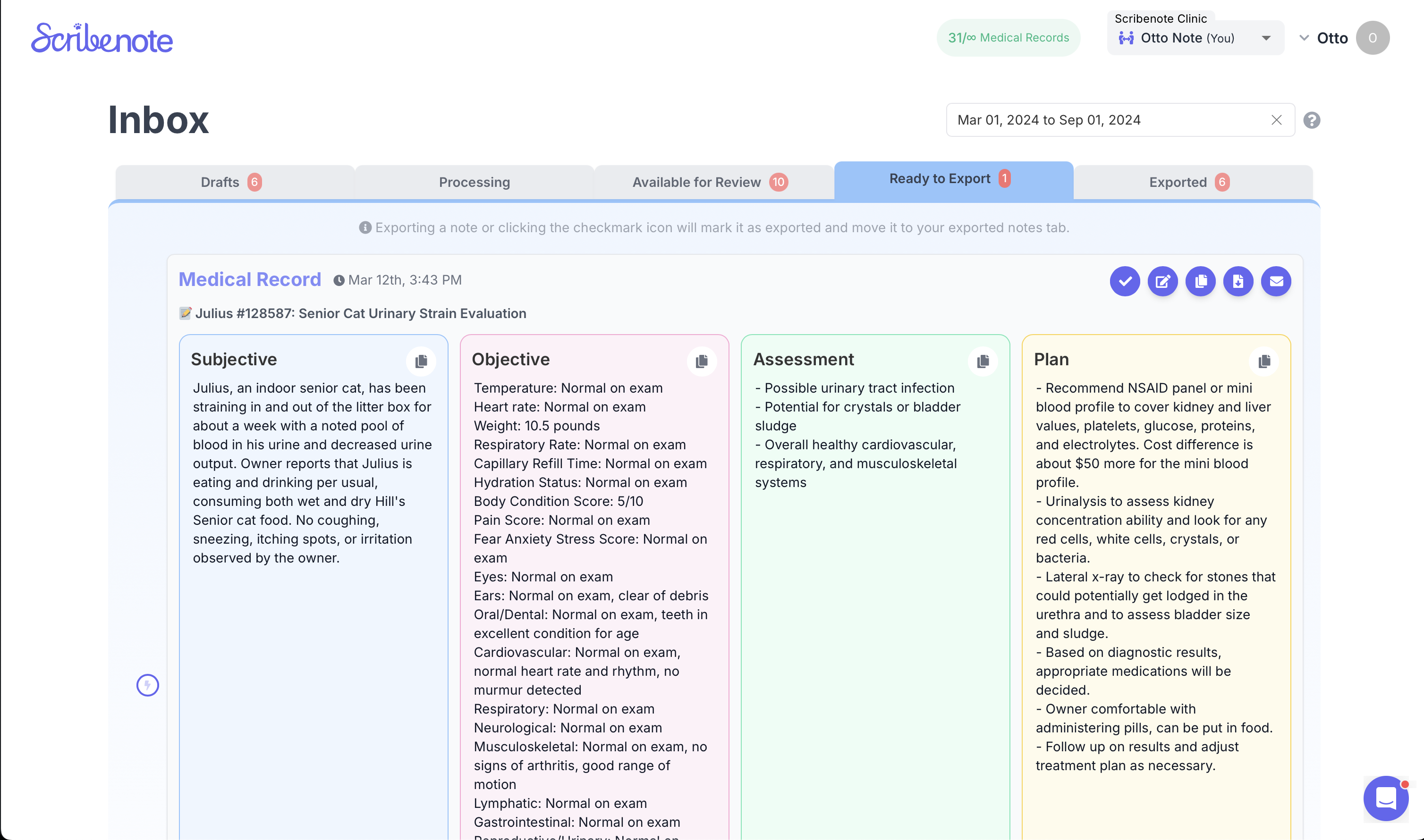
The official record inbox shows that generation is only one step; review and export still follow. Image source: Scribenote release material.
First, make basic note generation cheaper
Scribenote’s explanation for its first price reduction was straightforward: the work had become less expensive to provide.
In its January 2025 announcement, the company recalled that frontier AI was costly to run when it launched the fully automated product in 2023. The small technology team was also still learning how to build scalable infrastructure. According to Scribenote, subsequent technical and efficiency improvements made a lower price possible. Scribenote’s price-cut explanation
When the free plan arrived, it did not offer only a handful of trial notes. Standard models, default note templates, and team collaboration were included. Common cases such as routine visits, multi-pet consultations, and dental records were covered, allowing a lower-volume clinic to keep using the basic workflow. Scribenote’s free-plan scope
That changed the decision from whether a clinic should buy an AI scribe to whether it should try one. A free user did not receive only a restricted recorder; the person could complete the basic documentation flow.
In the press release announcing the free plan, Scribenote said its user base had tripled over the preceding year. The company was lowering the entry barrier after the product had already gained usage, rather than giving away capacity to revive a tool no one wanted. Scribenote’s June 2025 announcement
A free note is not necessarily the note a doctor wants
The paid boundary begins with a more difficult requirement: a clinician does not merely need correctly divided text.
For the same consultation, one veterinarian may organize examination findings by body system, another may use a fixed surgery-report structure, and both may need a separate explanation that a pet owner can understand. If every generated note has to be reformatted and rewritten, time saved during transcription returns as time spent in the editor.
Scribenote turns those differences into an explicit paid feature. The free plan uses default templates. Pro lets a veterinarian adjust sections, layout, and terminology, or upload an existing PDF template so the software can rebuild the record structure. It does not promise to reproduce every detail in the PDF. The documentation says tables cannot be recreated exactly. Default versus adaptive templates Template importing and formatting limits
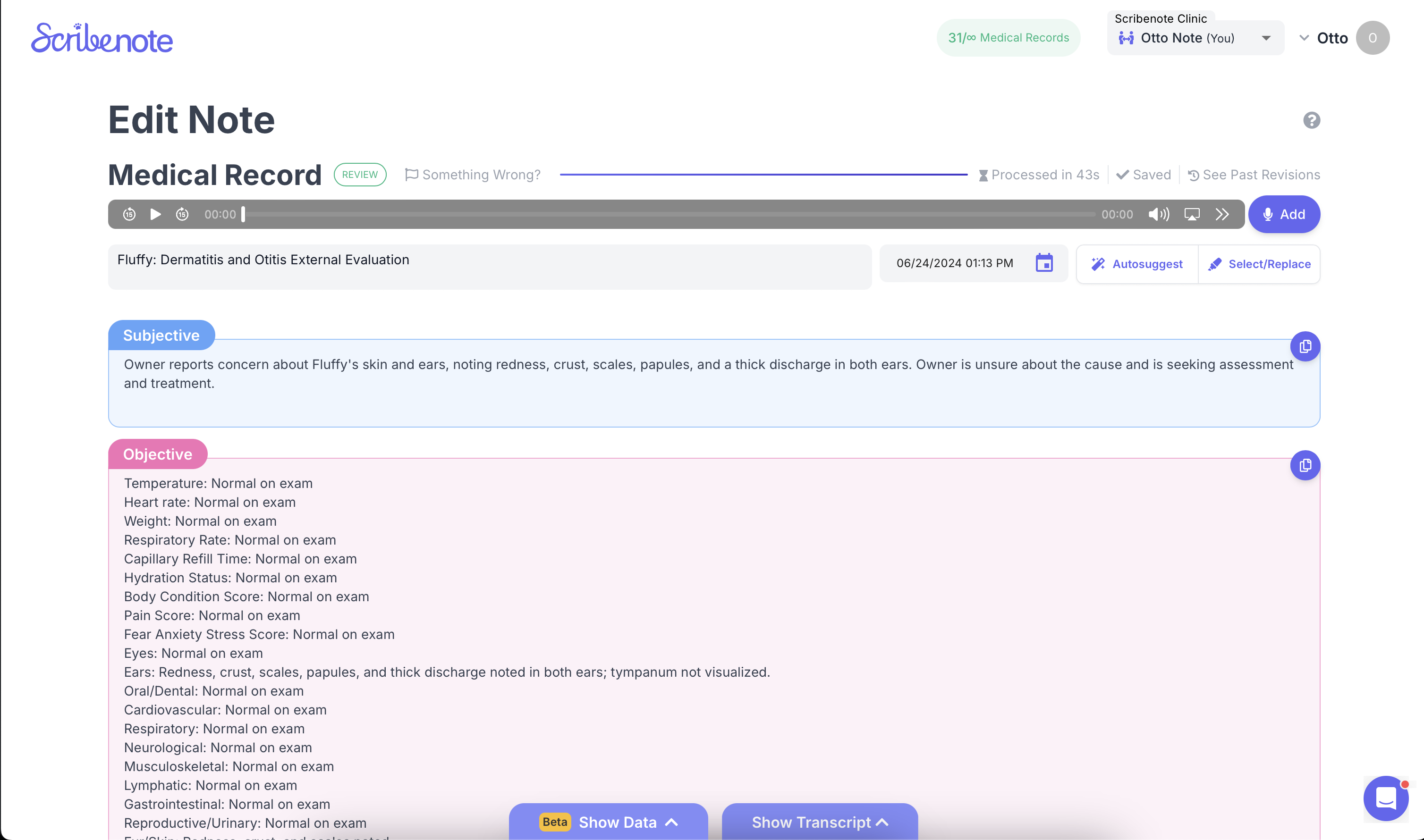
The record editor lets a clinician replay audio and revise the SOAP note. SOAP stands for subjective, objective, assessment, and plan. Image source: Scribenote release material.
Template Groups, introduced in April 2026, pushed the paid reason further into the workflow. One recording can generate as many as five records at once. A clinical note, client summary, and discharge instructions can each use a separate template and be reviewed and exported separately. The feature does not merely make one document longer; it reduces the need to rewrite the same visit for different recipients. Scribenote Template Groups
This is also where the product differs from a general transcription tool. Both begin with audio, but the deliverables are different. Transcription preserves a conversation. Scribenote tries to turn one consultation into the several documents a clinic actually uses.
According to pricing guidance updated in June 2026, Pro costs $99 per veterinarian per month, or $948 annually, equivalent to $79 per month. Nurses, technicians, and other non-veterinarian team members do not add separate seat charges. The company can let the whole team participate, then charge around the veterinarian’s professional documentation needs instead of selling another seat for every collaborator. Scribenote Pro pricing
The next payment is tied to a task
Once notes enter the system, more work appears. A veterinarian taking over a referred patient may need to read years of prior records. Explaining a condition to an owner may require rewriting technical material in clearer language.
Scribenote’s June 2026 Companion documentation shows that these tasks have their own pricing. The Medical Records Companion summarizes uploaded histories, finds information, and answers questions. The Writing Companion edits medical notes and client summaries. They can be used with any Scribenote plan, but their cost is not included in the Pro subscription. Scribenote Companions
| Charging model | Work it covers |
|---|---|
| Free | Generate basic records with the standard model and default templates |
| Pro subscription per veterinarian | Customize record structure and produce several documents from one recording |
| Separately purchased task credits | Summarize medical histories, find information, and revise writing |
Companions consume credits by task. A $35 monthly purchase includes 2,000 credits, while $150 includes 10,000. Users can also buy 500 credits once for $10. Monthly credits do not roll over; one-time credits do not expire. When the balance is exhausted, work pauses instead of automatically creating overage charges. A small rewrite and a complete medical-history summary consume different amounts. Scribenote Companion credits
The pricing sequence is useful beyond veterinary software. As basic generation becomes cheaper, a product does not have to rely only on selling more generations. Scribenote attaches price to two more concrete things: the documentation system a clinic wants to use every day, and the amount of work required to process a complicated record. The first is a per-person subscription; the second is task consumption. Making the basic note free did not remove the buyers for either one.