

New York State placed a robot that initiates conversation inside the homes of older adults. It is called ElliQ. One side of the tabletop device turns and lights up, while the other side provides a screen. A person can talk with it, play simple games, or use it to contact relatives. By May 2025, 834 older adults had joined the state-funded program and more than 3,500 had applied, according to the New York State Office for the Aging’s program report.
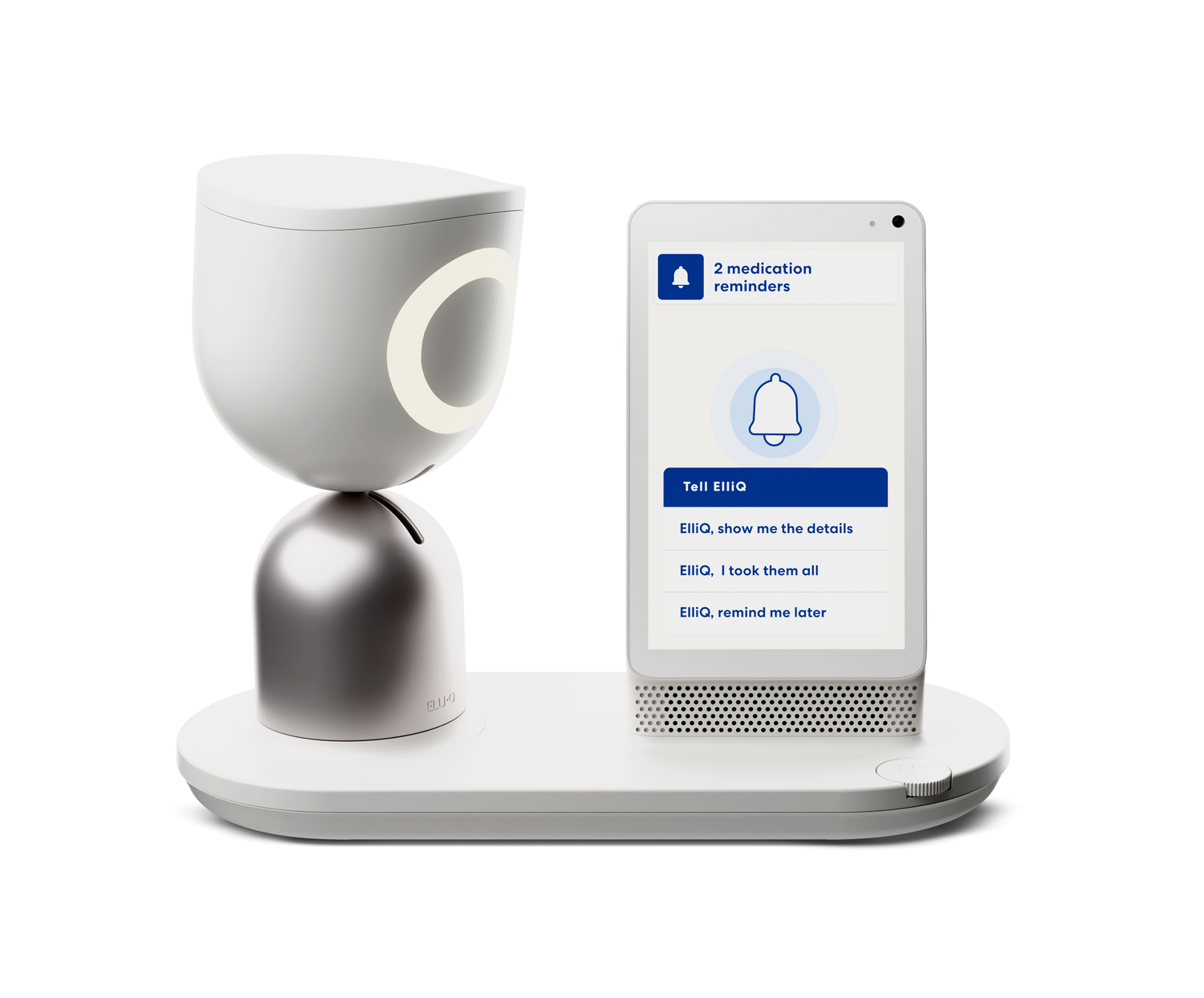
Image source: ElliQ.
The program does not simply ship a machine and expect recipients to discover how it works. Eligible participants do not provide payment information. A partner organization covers the cost, the device arrives at home, and the service includes setup guidance and continuing support. ElliQ describes the arrangement on its funded-program page.
The commercially important part of ElliQ is that the person using it is not necessarily the person paying for it.
Older Adults Do Not Have to Learn How to Prompt It
Many AI products begin with opening an application and typing a question. ElliQ first changes that step.
Its developer, Intuition Robotics, says the system combines conversation memory, the user’s goals, and whether the moment is suitable for interaction when deciding when to speak and which activity to suggest. The language model is not there only to answer an isolated question. It supports an ongoing relationship: remember an earlier exchange, then choose how to resume it later. Intuition Robotics outlines that approach in its product and technology description.
That turns the broad promise of “conversation” into a more specific daily service. ElliQ can share the weather and reminders in the morning, suggest games or virtual travel during the day, and offer a relaxation activity in the evening. The user can also place a video call by voice or view photographs sent by family members. ElliQ presents those examples on its how-it-works page.
None of those activities necessarily requires a dedicated robot when considered separately. Together, however, they remove the requirement to remember to open a phone, find the right application, and formulate a request every time. The product tries to replace a series of deliberate app sessions with a visible presence in the home that can initiate an exchange.
The third-year New York report recorded an average of 41 interactions per day. That figure covers use in the program from June 2024 through May 2025. It is not a worldwide average for every ElliQ customer, and it does not mean that each interaction was a long or emotionally deep conversation. The period and definition belong to the New York program report.
Why an Aging-Services Program Pays
If ElliQ is treated only as consumer electronics, the purchase question is immediate: why should an older adult spend hundreds of dollars and then continue paying a subscription for a tabletop device that talks?
Public funding changes the buying process.
An older adult submits an application. The information goes to a partner in the applicant’s state, where staff determine eligibility. An approved participant receives the device and support; when all places are filled, additional applicants join a waiting list. A participant who leaves the program can contact ElliQ support or the assigned case manager to arrange free return shipping. Those application and exit steps are documented on ElliQ’s program page.
For the user, the program removes more than the price. It also removes a sequence of uncertainties: whether the device is worth buying, who will help if it stops working, and what to do if setup is confusing. For the company, the buyer expands from an individual household to an organization that already has a population to serve, an eligibility process, and a way to coordinate delivery.
The remaining question is why an institution would classify a conversational robot as an aging service rather than direct the budget elsewhere.
The New York State Office for the Aging describes its role as helping older adults remain in their communities and avoid moving prematurely to a higher level of care. In that context, ElliQ supplies companionship and everyday support inside the home. It is not presented as a replacement for in-person care. The program’s role is explained in the state report.
A family buys a product; an aging-services program arranges a service that can keep reaching a home.
That is more than a difference in marketing language. Eligibility, setup assistance, support, and eventual device return all require an owner. ElliQ places those operational steps inside one delivery model.
The Hardware Is Rented, Not Purchased Outright
ElliQ has not abandoned individual customers and their families. The company still offers self-funded subscriptions, but it does not sell the experience as “buy the robot, then decide whether to add a membership.”
At the time of this review, the website showed three plans:
| Plan | Monthly price displayed by ElliQ | Important qualification |
|---|---|---|
| Monthly subscription | $59 | Month-to-month plan |
| Annual subscription | Equivalent to $49 per month | $588 paid at once, then renewed annually |
| 24-month plan | Equivalent to $39 per month | Long-term plan; not the price for cancellation at any time |
Each plan also carries a one-time $249 rental initiation fee. The example for the annual plan combines the $588 membership payment and $249 initiation fee for an initial subtotal of $837. ElliQ lists the plans and example on its membership page.
Membership includes the hardware, software, updates, warranty, and customer support. The customer must return the device after cancellation, and ElliQ does not continue operating after the subscription ends. Those conditions are stated in the company’s subscription and return FAQ.
The company therefore has to keep providing more than generated answers. It remains responsible for a functioning device, updated features, and support when a user encounters a problem. Hardware is embedded in the subscription relationship instead of being sold once and forgotten.
A family can pay directly, while an eligible older adult can use the same product through a funded partner. One device has two routes into the home, so not every user has to cross the consumer-electronics payment threshold.
The Phone App Goes to the Family; the Robot Stays With the Older Adult
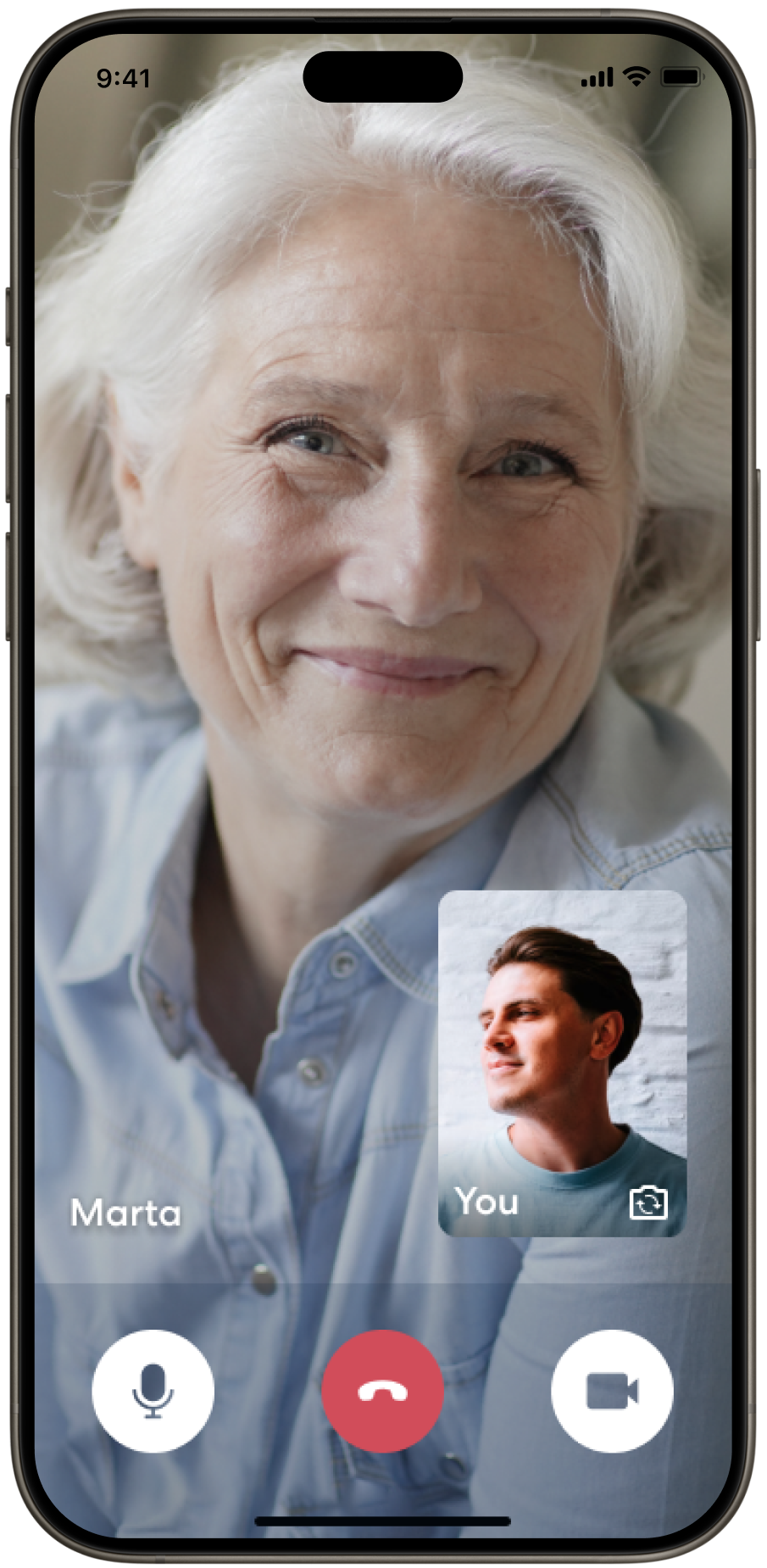
Image source: ElliQ.
ElliQ does not ask every family member to buy a robot.
Relatives use the companion application to send photographs and messages, place video calls, help schedule medication or hydration reminders, and suggest daily activity goals. The older adult continues speaking to the tabletop device and looking at its screen. ElliQ describes this division of work on its caregiver page.
It is a practical allocation of interfaces. Phone tasks stay with the people who are already comfortable using a phone. The older adult gets a fixed, visible, voice-driven point of contact. Family contributions also give ElliQ material drawn from the user’s real relationships rather than forcing the system to invent every conversation topic itself.
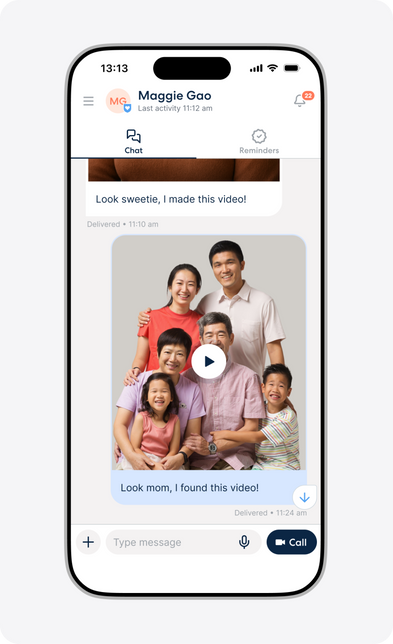
Image source: ElliQ.
Collaboration does not mean unrestricted monitoring. ElliQ says relevant information is shared only when the older adult opts in, and reminders suggested by relatives still require the user’s acceptance. The device is not an emergency response system and should not replace medical or urgent-care services. ElliQ states those privacy, reminder, and safety boundaries in its FAQ.
For an aging product, these constraints are not peripheral. Reassuring relatives and preserving the older adult’s control have to work at the same time.
Making It Talk Is Not the Hard Part
ElliQ still faces the familiar problems of companion AI. A 2025 WIRED review praised the device’s proactive interaction and straightforward setup, while also reporting slow responses, a tone that could feel uncomfortable, and weak integration with existing applications and subscriptions. The tradeoffs appear in WIRED’s hands-on review.
Proactivity is not automatically valuable. The same reminder can be helpful at one moment and irritating at another. A user’s willingness to keep responding determines whether the device becomes part of daily life or another electronic object that gets switched off.
ElliQ’s commercialization lesson is also more specific than “sell AI to government.” The company had to divide the problem into operational questions: how the older adult starts using it, how relatives participate, who pays, who helps when setup fails, and who handles a broken device or a participant’s exit.
Putting a robot in the living room is only the beginning of delivery. Keeping it there requires a service that continues to work around it.