

After a hurricane, hailstorm, or wildfire, an insurer’s call volume can surge within hours. Policyholders need to report damage, but the carrier cannot double its service staff every time severe weather arrives. As queues grow, customers become more anxious and the downstream work of assigning adjusters, inspecting damage, and arranging repairs begins to stall.
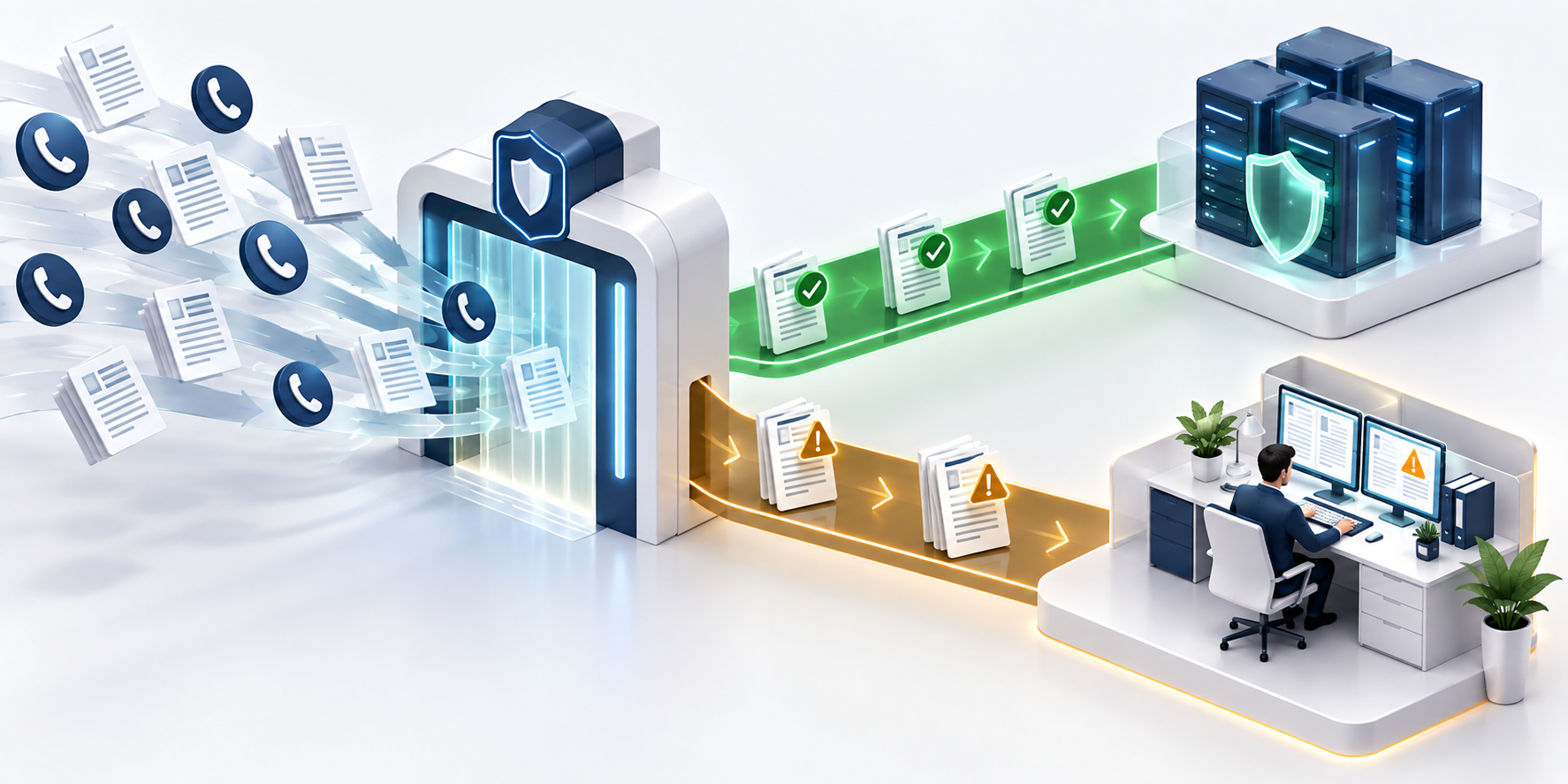
Liberate treats that moment as a product entry point. Its voice and digital agents do more than answer a call. They verify identity, look up the policy, collect loss information, and write a structured claim into the carrier’s core system. When a case falls outside the rules, the agent transfers it to a person with the context already assembled. Liberate’s newsroom describes its first-notice-of-loss integration with Guidewire ClaimCenter.
That is a job an insurer can buy, measure, and govern. It is not a consumer-facing conversation demo.
The Most Difficult Call Is Also A Good Automation Boundary
First notice of loss is not glamorous work. A policyholder describes an accident or damaged property. The system must confirm identity, coverage, location, incident details, and the materials needed next. Missing information creates rework at every later step.
In ordinary weeks, this is a repetitive and rule-heavy process. During a catastrophe, it becomes a capacity problem.
Liberate did not begin by asking AI to decide whether a claim should be paid. It started at the information gateway. The platform page says its agents work across voice, text, email, and digital channels and write results back into insurance core systems. The relevant unit of value is therefore not the number of conversations. It is the number of complete claims that can move into the next stage.
This boundary also avoids the most sensitive promise in insurance AI. Coverage decisions and settlement amounts involve regulation, professional responsibility, and carrier-specific judgment. Identity checks, loss descriptions, document collection, and case creation are still important, but they can be decomposed into explicit fields and escalation conditions.
AI handles the congested entrance. People retain the exceptions and decisions.
One Carrier Treated Catastrophe Readiness As The Acceptance Test
Allied Trust is a property insurer serving several states in the southern United States. Liberate says the carrier launched a digital first-notice-of-loss process in six weeks. Within months, 22 percent of policyholders were choosing the digital route, and the carrier had reached zero wait time before facing a major catastrophe. Those figures come from Liberate’s Allied Trust customer case.
The numbers are vendor-published and should not be treated as an independent audit. They still reveal an important implementation sequence. A carrier cannot wait for a hurricane and then connect a new agent overnight. The workflow must first reach production during normal claim volume, connect to policy and claims systems, and prove that unusual cases can be escalated safely.
The real stress test comes later, when extreme weather turns a steady stream of calls into a spike.
Another case offers a production metric. A white paper hosted by Insurance Journal says Frontline Insurance used Liberate’s voice AI for first notice of loss and reached a 70 percent autonomous completion rate, a 53 percent reduction in call duration, and a zero percent abandonment rate. Insurance Journal identifies the material as produced by Liberate, so the results are supplier evidence rather than independent research.
The figures cannot establish what every insurer will achieve. They do show that the product is being judged inside a measurable operating process, not only in an internal experiment.

The Product Sells Catastrophe Capacity, Not A More Human Voice
Voice AI is often marketed through natural speech. That is not the insurer’s central purchasing logic. A pleasant voice that cannot read the policy system merely moves the queue to a different interface. An agent that can complete first notice of loss and create the case changes both claims throughput and staff capacity.
Liberate raised a $50 million Series B in October 2025. TechCrunch reported that the company served more than 60 customers and that its monthly automated transaction volume had grown from 10,000 to 1.3 million during the previous year. The company also told the publication that customers saw an average 15 percent increase in sales and a 23 percent reduction in costs. TechCrunch reported the customer count, automation growth, financing, and company-supplied outcome claims.
The latter percentages are company claims and should not be confused with independently verified customer return on investment. The customer count and automation-volume change still provide an adoption signal separate from the financing announcement.
The packaging is more instructive than the model itself. Liberate is not selling one inference call. It is selling a deployable slice of an insurance role: answer at any hour, collect the complete report, update the system, and escalate when necessary. The buyer purchases capacity that remains available when a catastrophe overwhelms normal staffing.
Start With Intake, Then Move Down The Workflow
Liberate now presents sales, servicing, and claims as automation areas. First notice of loss remains an effective starting point because the task is explicit, the input is relatively structured, completion can be tracked, and catastrophe peaks make the pain visible to executives.
That starting point can also support expansion. Once the product operates at the claims entrance, it gains workflow context about policies, incidents, and escalation rules. The same voice, messaging, and system-write capabilities can extend into renewal reminders, quote collection, policy servicing, or follow-up requests. This is an interpretation of the product structure, not disclosed revenue data.

This is where vertical AI becomes easier to purchase. A general voice model can understand a description of storm damage. It does not know the carrier’s policy fields, claims system, access controls, or escalation boundaries. Turning those constraints into a reliable product is what allows a customer to hand over its most urgent calls.
Liberate’s case is not that AI replaced claims professionals. It demonstrates a more practical route: own the step that is easiest to overwhelm and easiest to verify, then expand automation from one call into the operating chain behind it.