
Audiohook used Podscan for some time. Then it bought the company.
Why would an audio advertising company acquire a podcast monitoring product? Audiohook’s announcement gave a direct answer: it wanted to improve contextual matching and brand-safety decisions, and Podscan could continuously tell it what people were actually saying inside podcast episodes. Acquisition announcement
This is not a product built to summarize podcasts for listeners. Podscan uses AI to transcribe episodes and identify the brands, people, and topics mentioned in them. Businesses can search and monitor that information or move the data into their own systems.
The same podcast dataset had once left Podscan’s founder worrying about a monthly shortfall of several thousand dollars when sold as a standalone subscription. Inside an advertising company, it became important enough to acquire as a core capability.
Finding one sentence versus obtaining usable data
A brand that sponsors podcasts needs to know where its name appeared and how it was discussed. Searching episode titles and descriptions can easily miss a single mention buried inside an hour-long conversation.
Podscan first converts the audio into searchable content, then delivers the matching passage. Its official monitoring example includes the show, the person mentioned, a timestamp, and the surrounding transcript. A user does not have to listen to the entire episode from the beginning. Official monitoring demonstration
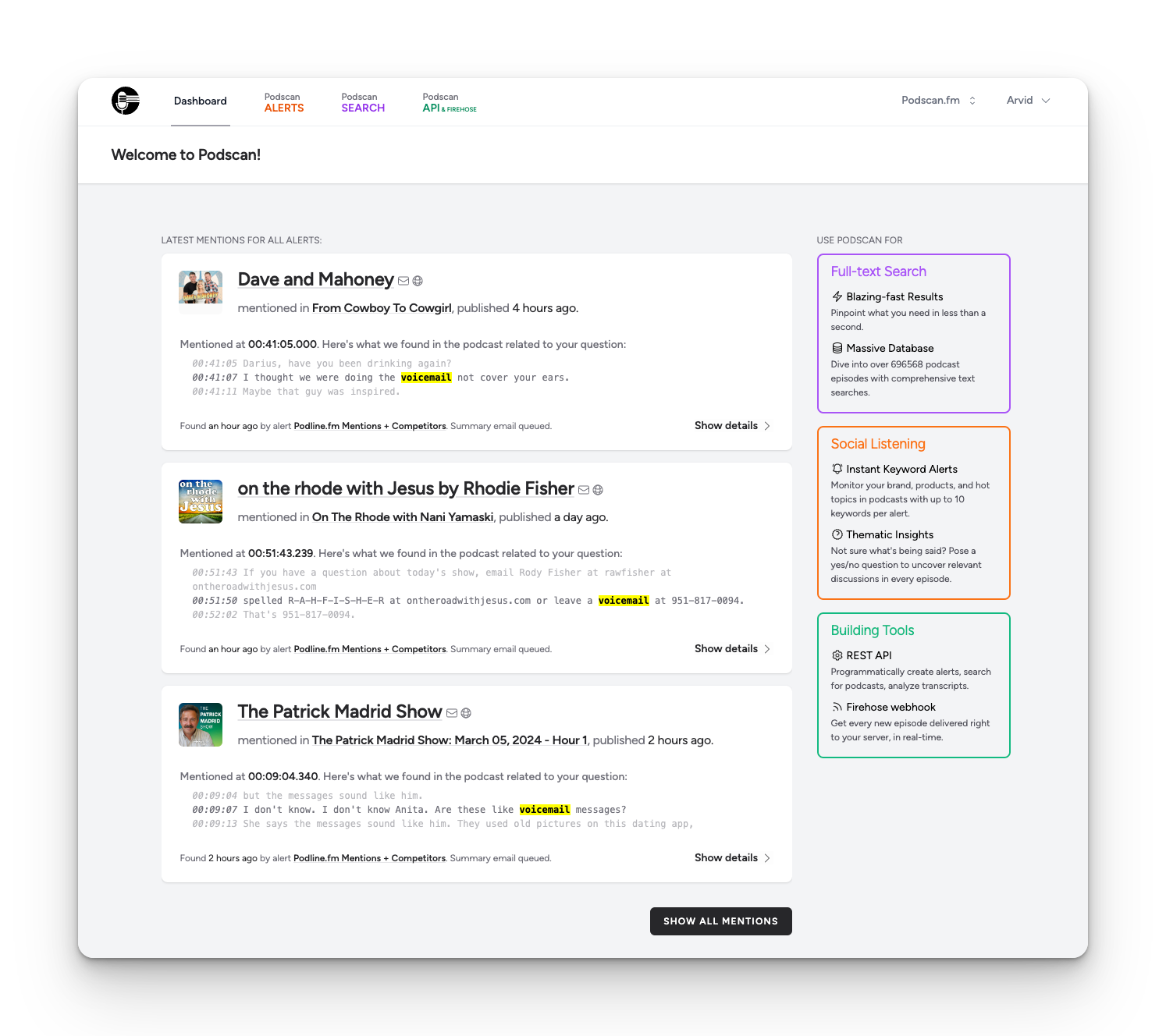
The monitoring result preserves the original words, timestamp, and source. This is an official interface example, not a test performed for this article.
Another official example is more specific. A guest mentions Tim Ferriss, and the result card does more than highlight the name. It also shows episode information, related people, and sponsors. Someone working in public relations or partnership development can decide whether the mention deserves follow-up instead of receiving only a message that a keyword was found. Official result example
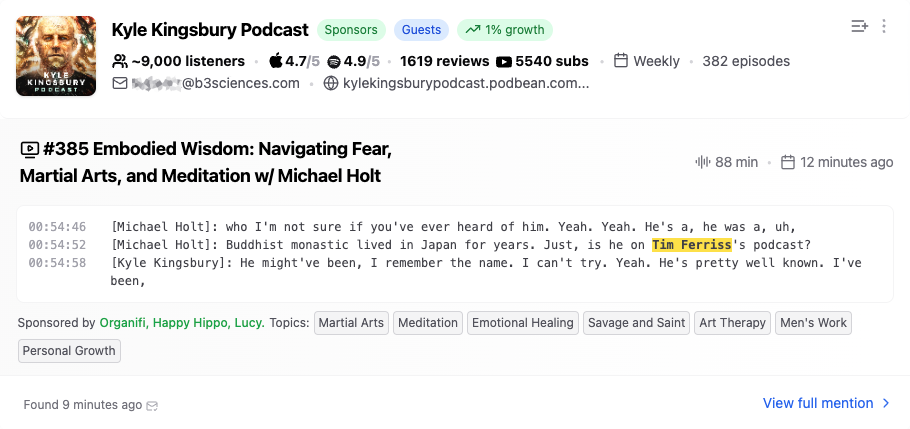
The person mentioned, the original passage, and podcast information appear in the same result card. Source: Podscan’s official monitoring page.
The interface itself, however, was not what changed Podscan’s direction.
In March 2025, founder Arvid Kahl wrote that some customers were making six-figure numbers of API requests each day and repeatedly asking to export transcripts. He decided to reposition Podscan from a product that said, “tell me when someone mentions me,” toward a podcast database that customers could use directly. Founder’s account of the repositioning
Those customers did not merely want to open Podscan each morning and review alerts. They wanted to take the data elsewhere.
The change also affected how the information needed to be organized. A monitoring product could identify a guest in one episode and display the name. A data platform needed to connect that same person across different shows. Without that identity layer, a customer would receive a collection of disconnected names and struggle to track which podcasts a guest had appeared on or whom that person was connected to.
Why more than 100 customers did not guarantee profitability
In April 2025, Kahl announced that Podscan had become profitable. April profitability account
By June, he reported that profitability had lasted only two months. A large customer left, and the business fell below break-even again. At that point, he said Podscan had more than 100 customers, about $6,000 in monthly recurring revenue, and roughly $10,000 in monthly expenses. Those are founder-reported figures for that period, not audited current results. June operating review
The problem was that Podscan could not wait for a customer to search for a show before preparing that show’s data.
Monitoring new content meant that transcription, analysis, and storage had to run after episodes were published. Losing one customer did not remove an equivalent share of those costs. Making processing cheaper mattered, but lower unit costs alone could not solve an insufficient revenue base.
Kahl then brought in help to build a sales process. The company began scheduling demonstrations and helping institutional customers identify data that could support an internal purchasing decision. He also raised the highest monthly tier available at the time from $500 to $2,500. The former $500 tier moved down to become the second level and had already found a buyer; his account did not say that the new $2,500 tier had closed a customer. Sales and pricing changes
Kahl had expected the product and his existing online reach to drive growth. In practice, Podscan still had to actively find organizations with larger budgets and an ongoing need to retrieve podcast data.
The advertising company bought a decision made before placement
Audiohook’s reason for buying Podscan fits that history.
Choosing which podcast should carry an advertisement depends on more than audience size. The subject matter also needs to be appropriate for the brand. Podscan can turn a large volume of spoken content into data that can be filtered for contextual matching and risk review. Audiohook explicitly said it planned to combine this capability with its advertising and measurement technology. Audiohook’s explanation of the acquisition
What Podscan gives an advertising customer is also more than a transcript.
Podscan’s official brand-safety sample analyzes the podcast Office Ladies. The first page defines the scope before presenting a conclusion: 50 of 441 episodes, or about 11.3% coverage. It then provides a risk summary, categories that may fit, and categories that may require caution. Official brand-safety sample
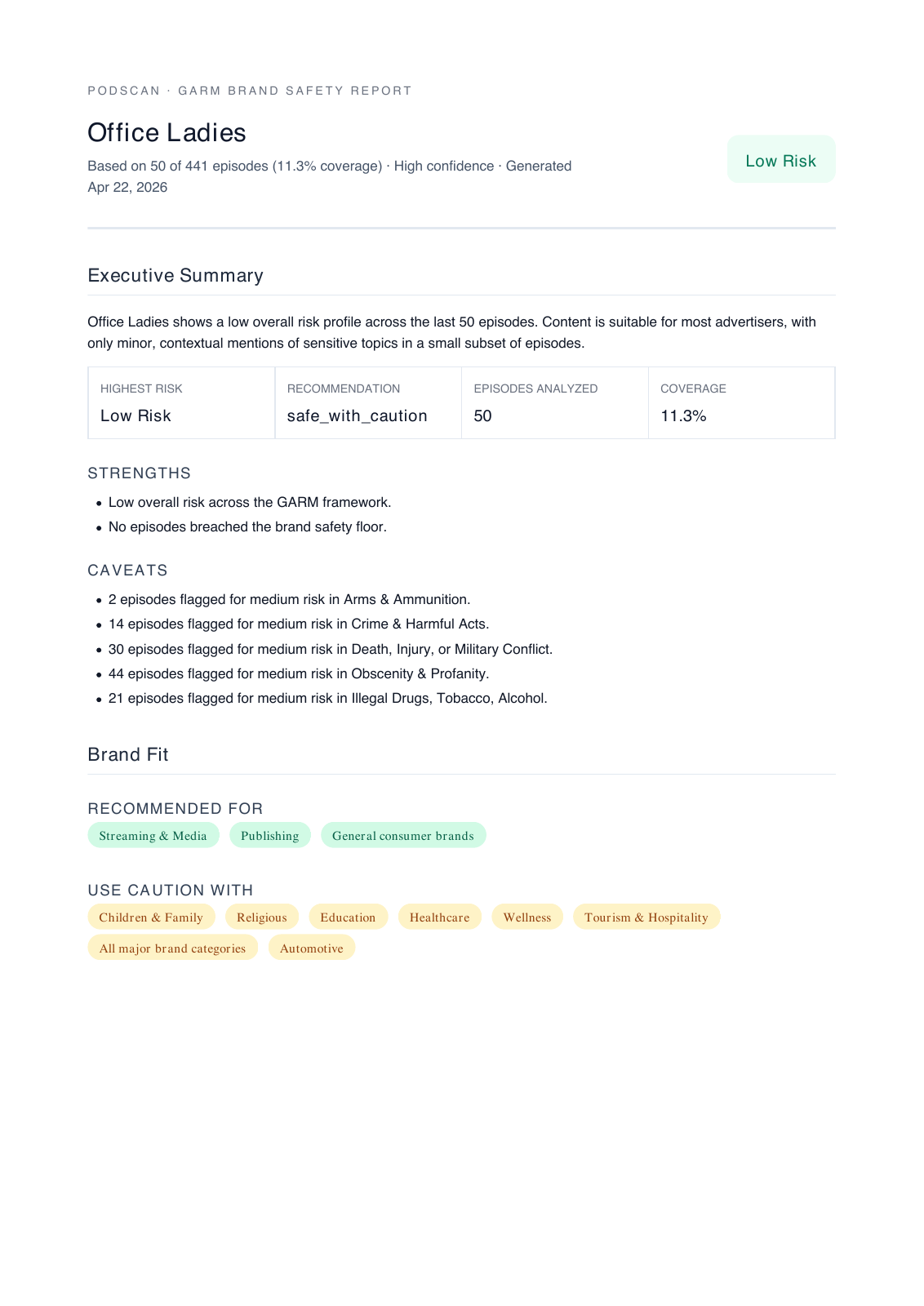
The official sample shows the analysis scope, risk summary, and brand-fit guidance. It does not demonstrate the result of an actual advertising campaign.
The report does not ask an advertiser to trust one isolated score. Later pages organize episodes and supporting passages by category so a person can review the basis for the assessment. It turns the question “Can this show carry this brand’s advertisement?” into material a brand team can discuss, rather than delivering another raw transcript.
The acquisition confirms that Audiohook wanted this capability. It does not establish the purchase price, current Podscan revenue, improved campaign performance, or additional advertising income; none of those results were disclosed.
Why part of the product became free after the acquisition
When Audiohook announced the acquisition, it also said it would make some podcast intelligence available to the industry for free. Publishers could obtain transcripts, categorization, and brand-safety analysis for their own shows, while brands could monitor how podcasts discussed them. The existing Podscan product would continue to operate. Post-acquisition access arrangement
Free access does not cover every use. On November 24, 2026, Podscan’s website still listed paid monthly plans: Premium at $100, Professional at $200, and Advanced at $5,000. Larger enterprise service remained quote-based. Current official pricing
Opening some data to publishers and brands can make the contents of shows easier for both sides to understand and can put the analysis in front of more advertising decisions. Whether that access produces more advertising revenue still requires future operating evidence. What has changed is that the product no longer has to rely entirely on a standalone subscription as its route into the market.
For a founder building a similar data business, an important question arrives before optimizing transcription costs: what transaction does the customer need to complete after receiving the data? If the answer is deciding where to place an advertisement, inexpensive transcription is not enough. The result must be reviewable, able to connect with the customer’s systems, and available before the purchase decision.
Open the original link at the end of the article to view Podscan’s product demonstrations and service.