

Roasting Plant used to build employee rotas in Excel and then prepare payroll data by hand. The coffee chain later adopted Nory, which forecasts sales demand and helps managers decide how many people should work each period. In a customer case study published by Nory in 2025, Roasting Plant reported that labor costs fell 18% during the first two months of using the workforce-management system. The vendor does not provide audited attribution or a breakdown of staffing changes, so the result belongs to this specific customer rather than to every restaurant using the software. Roasting Plant workforce case study
The commercial relationship did not stop with scheduling. When a payroll manager left the business, Roasting Plant chose to move payroll into the system it already used for workforce and inventory operations. That decision shows why a vertical software product can expand inside an account: the same employee, schedule, and time data needed to plan labor is also needed to calculate pay.
A full rota is not necessarily the right rota
Roasting Plant’s original problem was not an inability to fill a spreadsheet. As the chain added locations, managers spent more time entering data but still struggled to see whether staffing matched customer demand. A rota could cover every role and still place too many people in a quiet period or too few at a rush.
Nory put sales forecasts and labor planning in the same workflow. Instead of manually combining separate reports before deciding how to staff the following week, managers could use one operating view. The implementation also included weekly calls, support, and training from Nory’s team. That service component matters because presenting a forecast is different from helping a restaurant change the decisions it makes from the forecast. Roasting Plant workforce case study
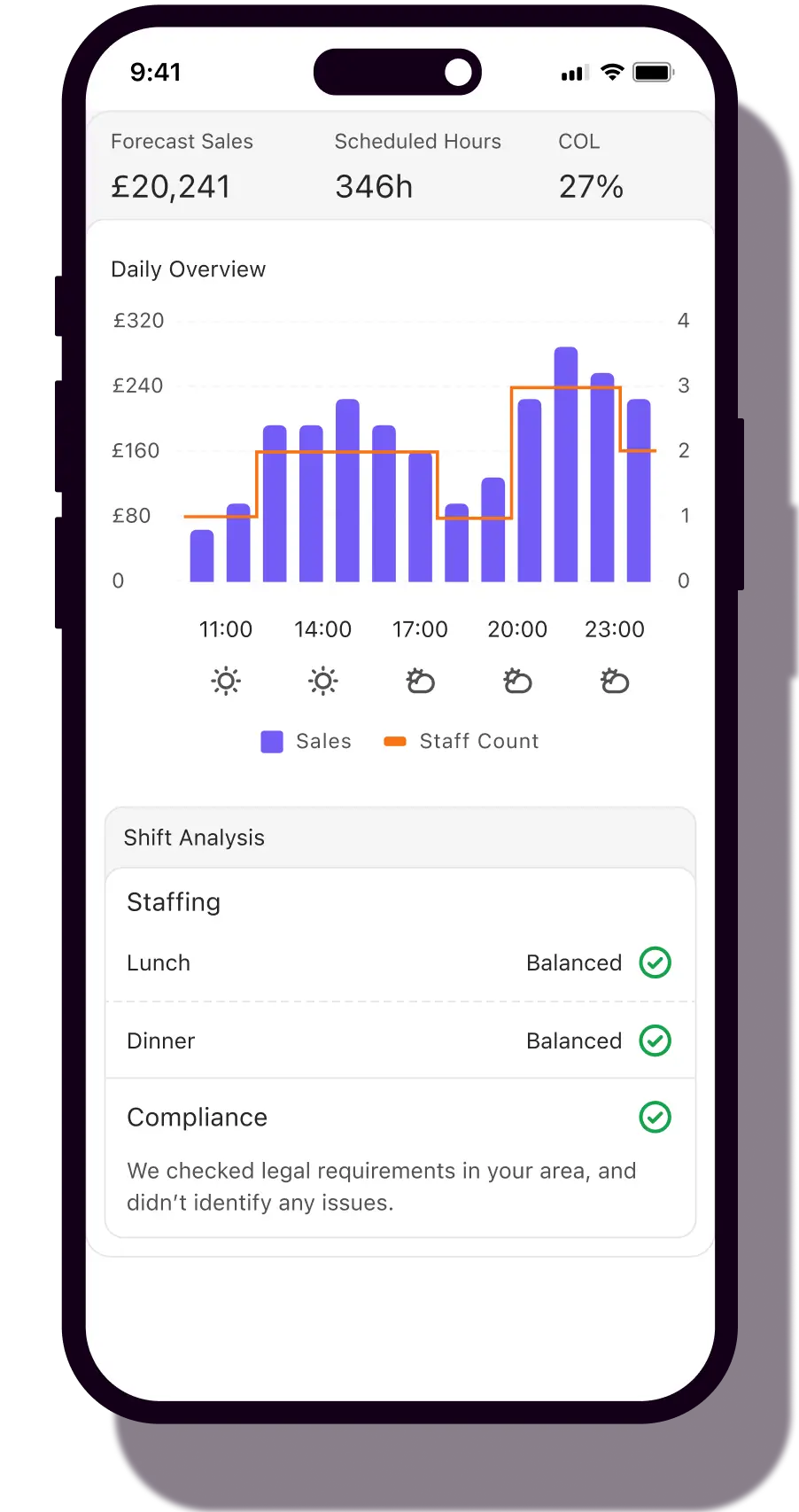
Purple bars show forecast sales, while the orange line shows staff count. Lunch and dinner staffing checks appear below. This is an official Nory product demonstration, not Roasting Plant’s live account.
Nory now presents this process as a scheduling assistant. In the official demonstration, a manager first reviews demand for the next week. The system combines that forecast with operating rules and employee availability to generate shifts. The manager can then inspect scheduled hours, labor cost as a share of sales, and whether coverage matches demand throughout the day. Only after reviewing or changing the result does the manager publish the rota. Scheduling assistant demonstration
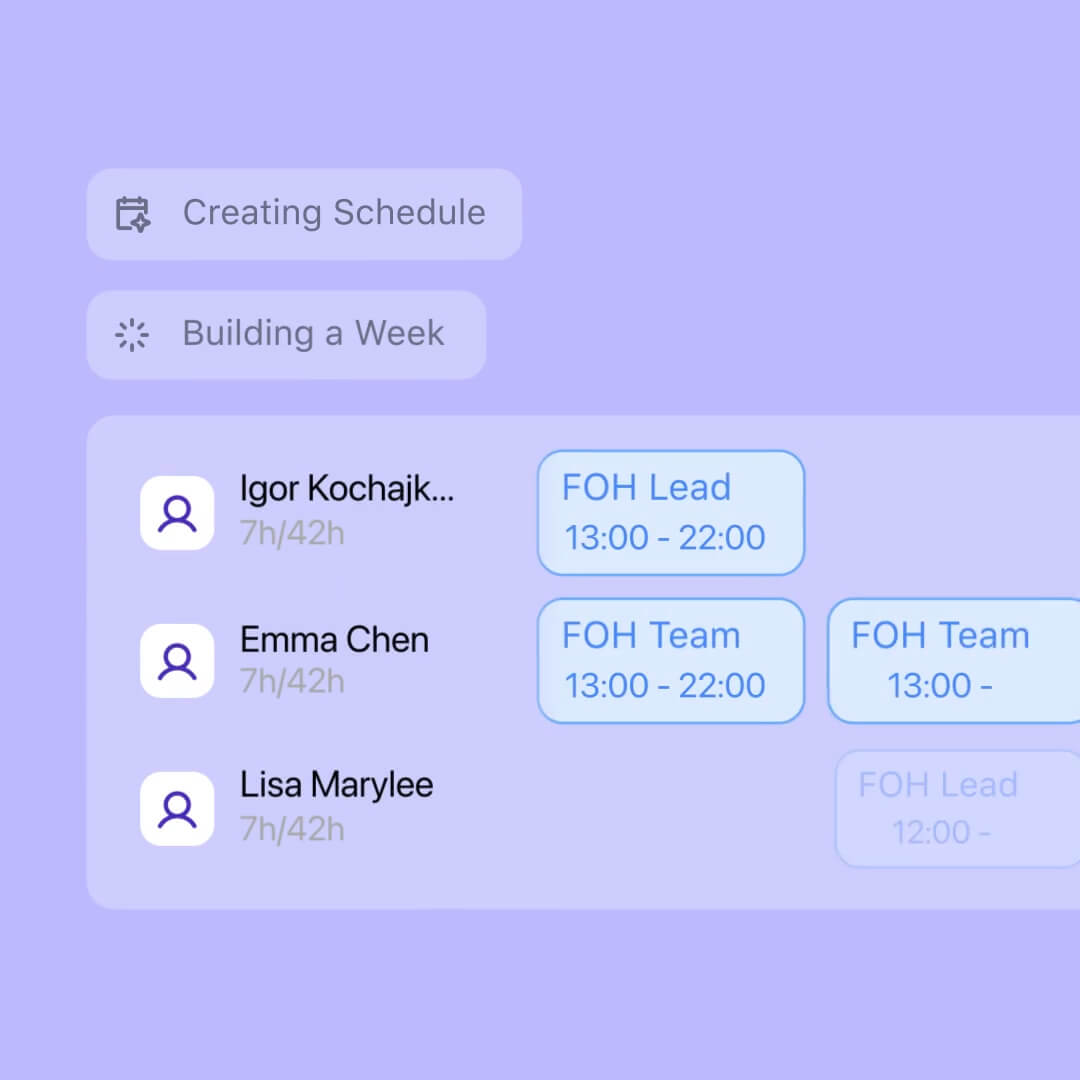
The official illustration assigns a front-of-house lead and team members to specific periods. It shows the schedule-generation process, not a customer’s complete weekly rota.
The division of work is important. The system handles the first pass across forecasts and staffing constraints. The manager still decides whether the resulting rota can work in the restaurant. AI removes the blank-page scheduling task without removing the local operator’s final judgment.
A payroll departure triggered the next purchase
Scheduling was only one of Roasting Plant’s administrative workflows. Managers previously entered hours, leave, pay changes, and departures into SharePoint. A dedicated payroll manager then processed the records line by line and paid employees individually through the bank. Nory’s account says the cycle took two days and had produced mistakes such as overpayments and unrecorded leave.
When that payroll manager left, the chain had a choice. It could recruit for the same process, buy a separate payroll tool, or extend the system that already held its workforce and inventory data. Roasting Plant chose Nory Pay. Roasting Plant payroll case study
The implementation required more than enabling another menu item. Nory’s team adjusted holiday-accrual calculations and configured the bank-payment file. The customer reported that payroll processing fell from two days per cycle to one hour. This is a second vendor-published customer result, not a controlled measurement, and it should not be added to the 18% labor-cost figure as though the two numbers shared one definition. Roasting Plant payroll case study
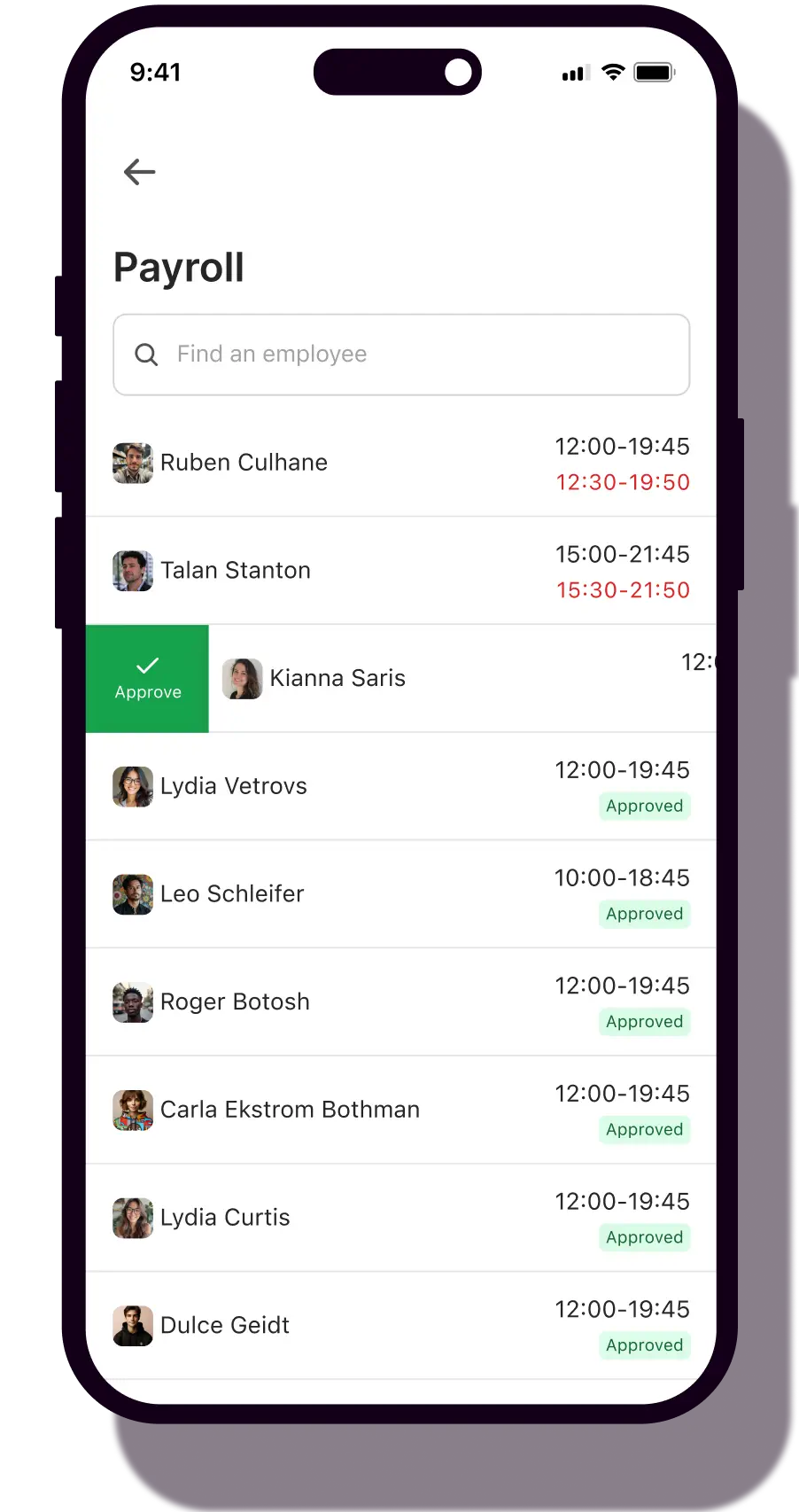
Payroll uses schedule and actual-time data but still requires manager approval. Source: official Nory product demonstration.
The current product keeps that human checkpoint. Existing rotas, clock records, and employee information produce a payroll batch. Exceptions are surfaced for review before payment moves forward. Nory also says its payroll service team handles final submission and some payment work, so this is not an AI independently sending money to employees. Nory payroll product page
For Roasting Plant, the reason to stay in the same system was concrete. Employee records were already there, and actual hours were already there. Adding an isolated tool would have created another transfer and another set of records to reconcile. The expansion therefore depended less on the novelty of a payroll feature than on avoiding duplicate operational data.
One location buys convenience; a chain buys consistency
At a larger restaurant group, the purchasing problem changes again. In another case study published in 2026, Black Sheep Coffee had expanded from 73 sites at the start of 2024 to more than 130. The chain centralized forecasting, scheduling, and inventory in Nory so regional managers could see staffing across stores and new locations could inherit an established operating framework rather than create their own process from scratch. The expansion in store count is not proof that Nory caused the growth, but it shows the operational scale at which standardization becomes valuable. Black Sheep Coffee case study
That adoption pattern matches Nory’s contractual boundary. The company sells software subscriptions and implementation or other professional services through order forms. Its public terms say fees increase when a customer adds a location or integration. Exact prices require a quote, and the terms do not disclose what Roasting Plant or Black Sheep Coffee paid. Nory terms and conditions
For Nory, building another module is only part of the commercial work. The harder task is connecting it deeply enough that the customer can stop maintaining a parallel spreadsheet, transfer, or approval chain. Scheduling created the shared operating data. Payroll gave Roasting Plant a reason to reuse it. More locations then make that shared process increasingly valuable, while also giving the vendor a contractual path to expand the account.
Open the original link at the end of the article to view Nory’s workforce-management product.