

You see an unfamiliar sports car on the street, open Car Catcher, and take a photograph. The iPhone app uses AI to identify the make, model, and year, then turns the result into a card in a virtual garage. Founder Sacha Smith says the app acquired its users through unpaid social-media distribution. He did not respond by buying more reach, however, because the product was generating only about $0.25 in net revenue for each install at the time of his disclosure. App Store product page; founder disclosure
That decision separates two questions that are often collapsed into one. A product can attract attention and even convert some users to paid plans without being ready to purchase installs profitably. Car Catcher’s early product changes show how it first tried to make a single identification useful, then gave users a reason to return before testing whether the resulting economics could support paid acquisition.
First, let a new user catch one car
Car Catcher launched on July 27, 2026. Five days later, version 1.2 made the app free to play, with three vehicle identifications available each day and every identified car retained in the user’s garage. The update also shortened the path to the core action: one tap opened the camera instead of sending the user through a photo-selection screen. After recognition, the result appeared as a card that could be flipped rather than as a bare model name. By mid-September, the developer said the app had completed more than 30,000 vehicle identifications. App Store version history

Car Catcher’s website uses a roadside sports car to show the kind of vehicle a user can photograph and collect.
This is different from a conventional vehicle lookup. Once a lookup identifies the car, the job is finished. A garage changes the endpoint. The user has acquired something and now has a reason to open the camera when another interesting car appears. Later releases turned the garage into a shareable public profile and added a separate tier for extremely rare vehicles. Recognition starts the interaction, but the collection gives the next recognition a purpose. App Store version history
The distinction matters because a camera utility and a collecting game create different retention loops. A utility competes on identification accuracy and speed. A collection also has to answer what counts as progress, which cars remain missing, and why one capture feels more valuable than another. The virtual garage makes those answers visible without claiming that the AI itself creates the entire experience.
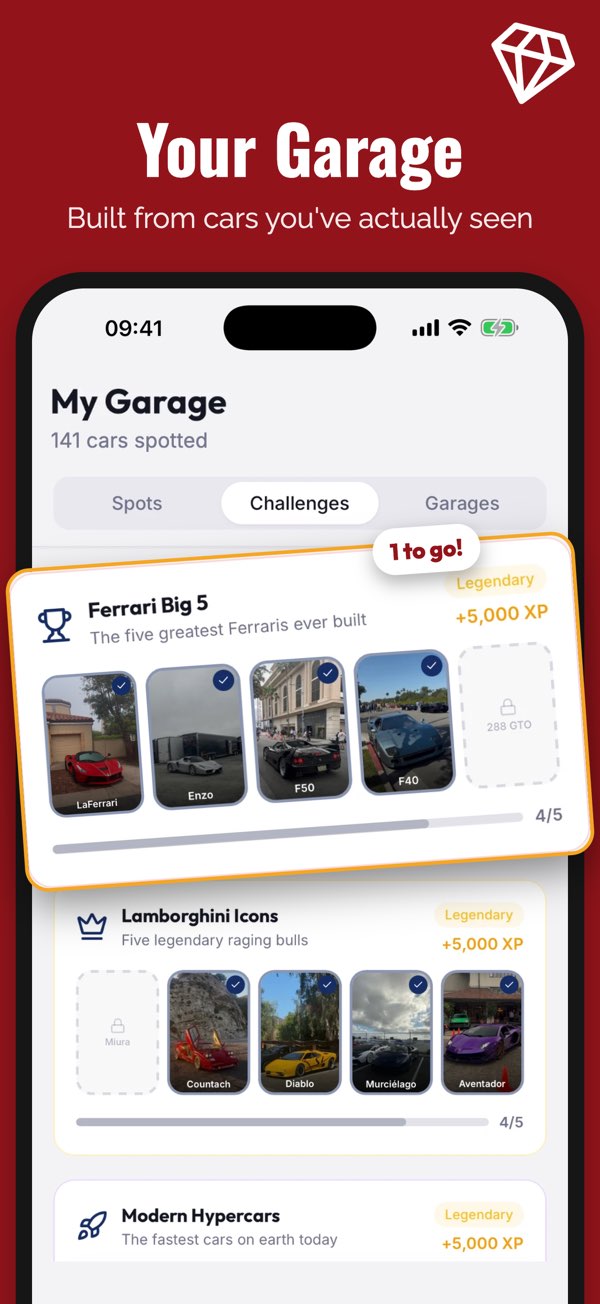
The garage groups cars into themed collection challenges and shows which vehicles are still missing. Source: Car Catcher App Store imagery.
The three daily identifications are therefore more than a generic free trial. They are intended to let a newcomer experience the complete loop: notice a car, photograph it, receive an identification, and add a card to the garage. If the allowance is too small, a new user may never understand the collection. If it is too generous, a frequent spotter may have little reason to pay.
More captures make unlimited free use harder to sustain
One App Store reviewer challenged the design from the opposite direction. If the leaderboard rewards collection size while free users can identify only three cars each day, how can they compete with subscribers? Smith replied that every identification costs the developer money, so the free plan has a limit while the paid plan removes it. The answer makes the payment boundary concrete. Three scans may be enough for someone who occasionally sees an interesting car. A user photographing a dozen vehicles at a car show will encounter the limit immediately. App Store review and developer response
This creates a product tension rather than a simple paywall calculation. The free allowance must be large enough to demonstrate the collection loop, but the ranking system should not make free participants feel that the competition merely measures who purchased unlimited scans. A cap can protect unit economics while still weakening the social game if it is perceived as buying progress.
Smith’s TrustMRR profile lists the subscription at $24.99 per year or $4.99 per month. He also reports that 2.19% of downloaded users had converted to paid by day 35 and that the app earned about $0.25 in net revenue per install. On those figures, he says paid traffic was not yet attractive. The same profile shows approximately $2,534 in RevenueCat-verified cumulative revenue and about $360 in monthly recurring revenue in a record updated on September 28, 2026. Cumulative revenue, MRR, and net revenue per install measure different things; they should not be added together or treated as interchangeable evidence. TrustMRR record
The $0.25 figure explains why the existence of subscriptions does not automatically justify advertising. A paid campaign has to acquire a user for less than the value that user is expected to return after platform fees and other costs, with enough margin to absorb uncertainty. Car Catcher’s disclosed net revenue per install is an early observed outcome, not a universal ceiling on lifetime value, but it gives the founder a concrete reason to keep improving conversion and retention before paying for distribution.
Organic social reach is useful in this phase because it supplies users without requiring the product to clear an acquisition-cost threshold on every install. It also gives the developer more time to observe whether people return to complete garages, whether a car show produces a burst of paid upgrades, and whether unlimited recognition is the benefit that subscribers actually value. None of those questions is answered by increasing top-of-funnel volume alone.
Car Catcher’s three free identifications must pass two tests. They need to be enough for a newcomer to catch a first car and understand the collection. They also need to create a fair reason for a frequent user to pay without turning the leaderboard into a spending contest. The first test determines whether people stay; the second helps determine why the people who stay subscribe. Advertising can bring more people to the camera button, but it cannot solve either product question on their behalf.
Open the original link at the end of the article to view Car Catcher in the App Store.