
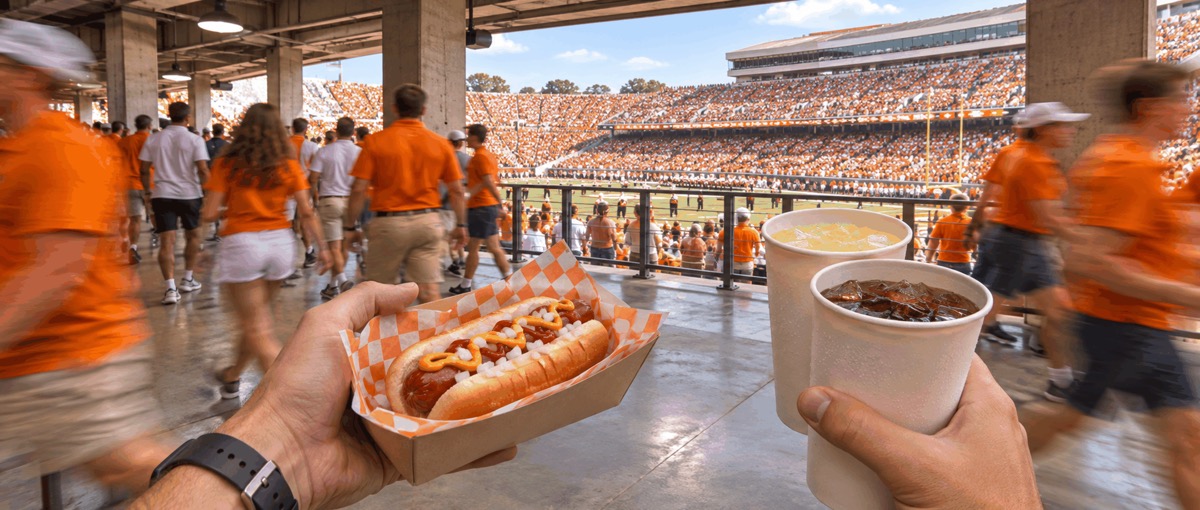
A customer puts a hot dog and a drink in the checkout area together. There is no need to turn each package around, find its barcode, and line it up with a scanner. Cameras recognize the items, the customer confirms the total on the screen, and payment completes the order. That is the small interaction Mashgin is trying to repeat at stadium scale. Mashgin product page
The football stadium at the University of Texas at Austin first tested 14 Mashgin self-checkout units. In August 2026, the university said it would add 16 more for the season, bringing the stadium’s configuration to 105 units. The announcement is evidence of a customer expanding its deployment after a trial. It says what the venue planned for the season; it is not an independent inspection confirming that all 105 units were already installed on the announcement date. University of Texas athletics announcement
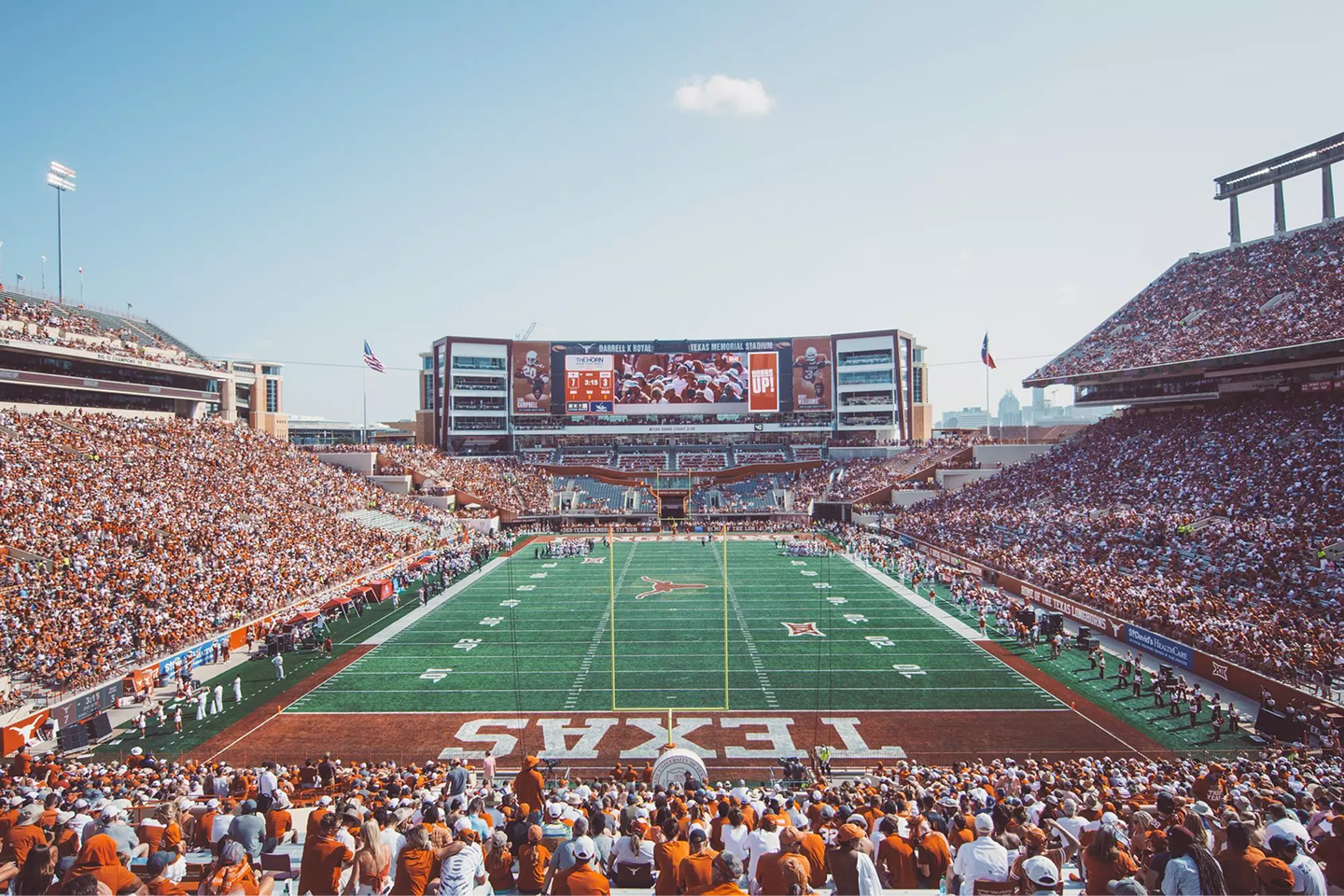
Mashgin published this image with its University of Texas stadium case study.
What a stadium wants to save is the time one order occupies the counter
Stadium demand does not arrive evenly. Large groups of fans leave their seats at the same moments, and a concession stand can have food ready while still losing sales to the checkout line. Each order occupies a counter until every item is entered and payment is complete. When demand is concentrated into short breaks, shaving time from that step can matter more than adding another item to the menu.
Mashgin changes the input method. Instead of scanning products one by one, the customer places several items in the recognition area at once. The system identifies them visually and presents the order on the screen for confirmation. The relevant operating question is not simply how many snack packages the model can name. It is whether a stand can complete more transactions before the crowd returns to its seats. Mashgin product page
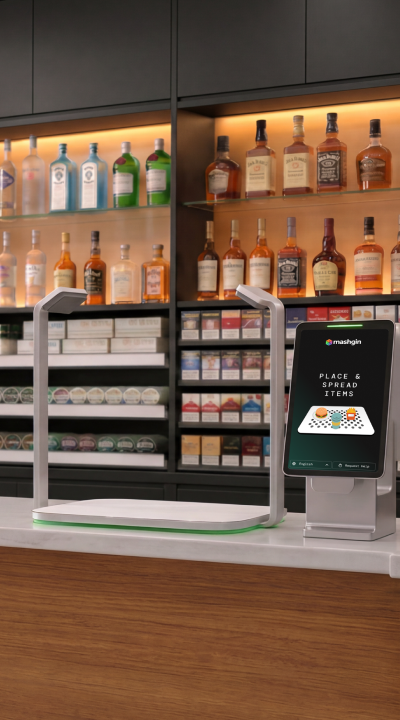
This Mashgin product image shows the recognition area on the left and the customer screen on the right. It is not a photograph of the University of Texas installation.
For the initial deployment, the university and its food-service operator renovated four existing stands and built two new ones. Mashgin’s review of seven home games says the pilot checkouts recorded a median transaction time of 12.5 seconds and that revenue at the renovated stands was 125% higher than the year before. Those figures need a narrow reading. The revenue result applies to the affected stands, not the stadium’s entire food-and-beverage operation. It also does not separate the effect of the checkout system from changes in stand layout, location, capacity, menu, attendance, or customer flow. Mashgin stadium case study
The more durable commercial signal is the customer’s next action. A 14-unit pilot can show whether an individual machine is fast enough and whether customers understand the interaction. Expanding the venue to 105 units means the buyer is moving beyond a limited experiment and choosing the same checkout method for more points of sale. That does not prove that every venue will see the same revenue result, but it does show that the operator found enough value to widen the deployment.
The stadium case also illustrates why workflow fit matters. A system designed for peak demand must be simple for first-time users, quick to reset between orders, and available during the busiest minutes. Recognition accuracy is necessary, but the buyer experiences the product as a complete checkout station. A fast model inside a machine that is confusing, offline, or difficult to support would not solve the queue problem.
The product is a checkout unit that remains usable each month
Mashgin publishes pricing that starts at $1,000 per unit per month. The subscription includes the hardware, computer-vision software, product setup, and support, and volume discounts may apply. This is public offer information, not the University of Texas contract price. The university and its operator may have negotiated different commercial terms. Mashgin pricing and ROI FAQ
The pricing model aligns the vendor with an operating requirement. A concession operator needs the units most when orders are dense and failure is most expensive. Bundling hardware and support into the same recurring payment means the customer is not only buying recognition software. It is paying for a checkout station that should remain configured, supported, and usable through repeated events.
Per-unit monthly pricing also gives the buyer a clear path from trial to expansion. A venue can start with a limited number of stands, observe transaction behavior, and then add units where queues and sales opportunities justify the expense. The supplier’s revenue grows as the operator expands the number of checkout points. The operator, meanwhile, does not need to make a separate software decision every time it adds another station.
This does not make the economics automatic. At the public starting price, the operator still needs enough incremental throughput or labor flexibility to cover the recurring fee. Performance can vary by stand location, event schedule, product mix, and customer behavior. The 12.5-second median and 125% stand-level revenue increase are useful evidence from one deployment, but they are not a universal payback calculation.
The progression from 14 units to a 105-unit venue configuration is therefore the most useful part of the case. The pilot tested whether the interaction worked in a few locations. The expansion applied that checkout method across more of the stadium. For builders of physical AI products, that sequence is a practical commercialization pattern: prove the workflow at a small number of operating points, measure what happens under real demand, and make the next purchase an extension of the same supported system rather than a new technology project.