
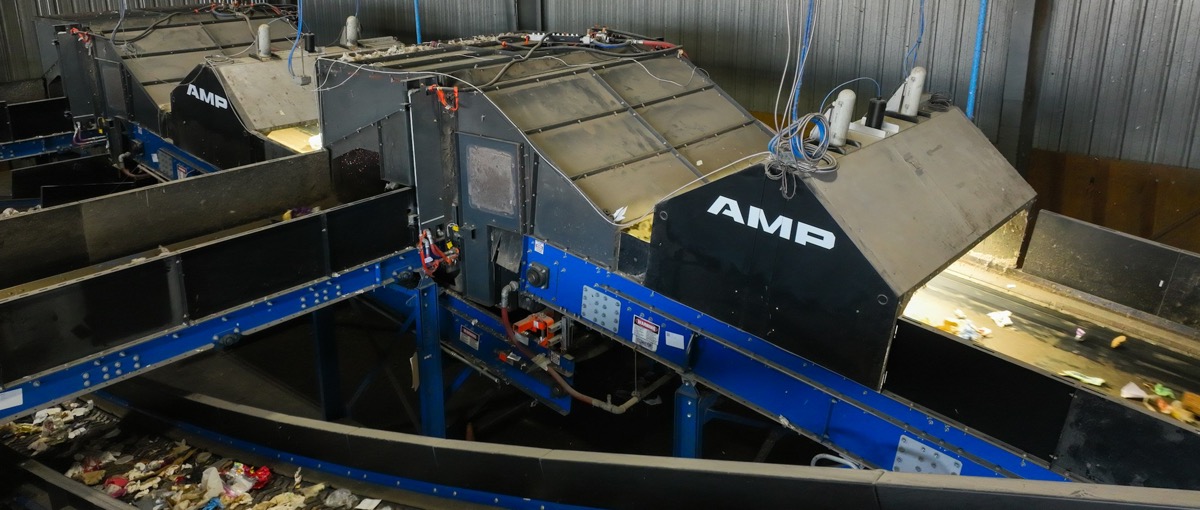
Beginning in July 2026, residents of Suffolk, Virginia, could still roll their blue carts to the curb on the same collection day. What changed was what could go inside. Both blue and green carts could hold ordinary household trash and recyclable material. Collection stayed at the curb, but separation moved downstream to a processing facility. AMP uses cameras and AI to identify materials on a conveyor, then directs recoverable items out of the mixed waste stream. Suffolk collection notice
The City of Suffolk did not sign the processing contract. The buyer was the Southeastern Public Service Authority, or SPSA, the waste-management authority shared by eight cities and counties in the region. SPSA contracted with AMP affiliate Commonwealth Sortation for 20 years of waste-processing services. Public broadcaster WHRO reported that the agreement guarantees at least $22.5 million in annual payments, with the amount able to rise as processing volume increases. The buyer is not paying for a camera to label bottles on a screen. It is paying for less material to end up in the landfill. SPSA contract announcement WHRO procurement report
The buyer is not purchasing recognition accuracy
Portsmouth’s former waste-to-energy plant closed in 2024. WHRO reported that the regional landfill subsequently began receiving about 1,000 additional tons of waste each day. SPSA estimated that even with an expansion then underway, the landfill would last only until about 2060. The authority needed another destination for material that already existed. It was not simply shopping for a smarter camera to add to a conventional recycling line. WHRO facility report
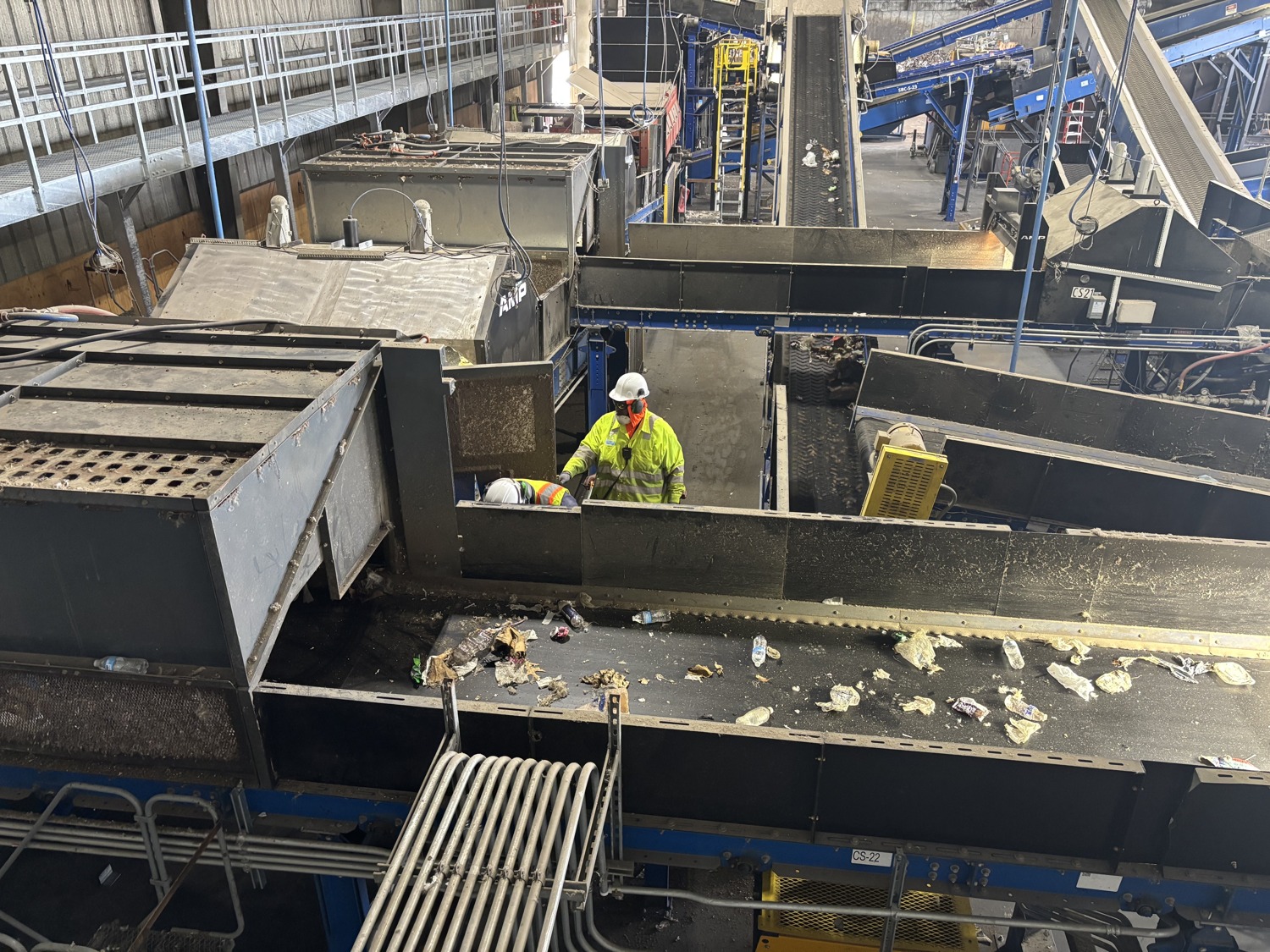
Mixed waste moves along a conveyor in the Portsmouth facility. Photo by Katherine Hafner for WHRO.
Once mixed municipal waste enters the Portsmouth plant, it moves onto high-speed conveyors. Cameras photograph the passing material, and AI classifies what it sees. At the end of a belt, short bursts of air push selected items away from the falling waste and onto another path. Recognition is only the first step. If a bottle is labeled correctly on a screen but does not reach the right output stream, the system has not prevented that bottle from being buried. AMP vision-system description WHRO facility report
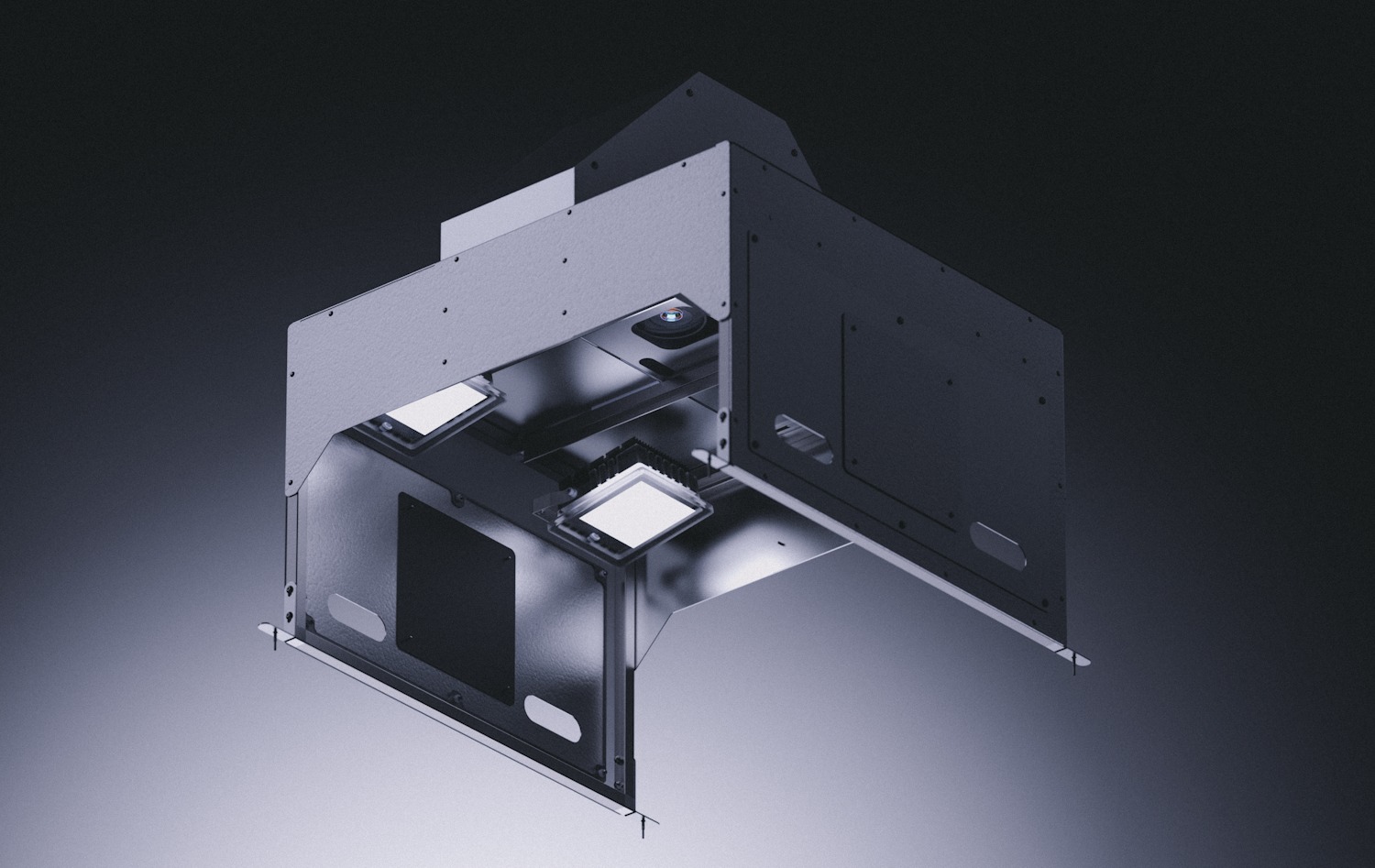
AMP’s official product image illustrates the vision stage. It is not a photograph of the Portsmouth acceptance test.
This distinction changes what a useful procurement metric looks like. A computer-vision vendor can report model accuracy, detections, or objects classified per minute. A public waste authority still has to measure physical outputs by weight, inspect contamination, and know which destination received each stream. The software matters because it helps control the machinery, but the service is accepted through the movement of real material.
The contract is accepted by where the waste goes
The agreement requires at least half of the waste SPSA delivers to AMP to avoid landfill. By inbound weight, 20% is assigned to materials recovery and 30% to organics processing. The organics category includes food scraps and yard waste. The requirement does not mean that half of every load becomes marketable plastic, paper, or metal. SPSA contract announcement
AMP did not encounter the region’s waste for the first time after the long-term contract was signed. According to SPSA, the Portsmouth pilot had operated since 2024 and processed about 30,000 to 40,000 tons per year. In January 2026, the expanded line went through a three-day performance test observed by two third-party organizations. SPSA formally accepted the results. WHRO reported that from roughly 513 tons of incoming waste, the test separated about 130 tons of recyclables and another 234 tons of material suitable for use as feedstock for biochar. The second number describes feedstock separated during the test, not finished biochar already produced and sold. SPSA acceptance announcement WHRO facility report
Those three days matter because they connect the AI system to an observable purchasing condition. The cameras and classifiers are not being accepted as a demonstration in isolation. They sit inside a line whose outputs were weighed and checked by parties outside the vendor. That makes the test more meaningful than a product demo, but it also limits what can be claimed. A short acceptance run does not establish the plant’s diversion rate over months, the resale value of recovered materials, operating margins, or the reliability of every future line.
The contract also separates several financial facts that can easily be collapsed into one headline. WHRO’s $22.5 million figure is the reported minimum annual payment under the service agreement, not confirmed annual revenue already collected by AMP. SPSA describes a project investment of about $200 million, with AMP responsible for arranging half of the required funding. Contract payments, capital investment, and recovered-material revenue are different economic streams. The public evidence supports the scale of the commitment, but not a profit calculation.
Passing acceptance creates the right to scale
By April 2026, AMP said the Portsmouth facility’s annual processing capacity had expanded to 108,000 tons. The full project is designed to reach as much as 540,000 tons per year. The first figure describes capacity already added at that stage; the second still depends on more processing lines and organics infrastructure. SPSA says AMP is responsible not only for operating and maintaining the facility but also for helping finance the buildout. The 20-year contract gives the company a reason to invest in a plant, while leaving it accountable for expansion and day-to-day performance. AMP expansion announcement SPSA contract announcement
For Suffolk residents, the visible change is modest: ordinary trash can now go into the blue cart too. For SPSA, the more important number after the three-day test is the weight that actually reaches the landfill each month. That is the commercial shift behind this case. AMP is no longer selling only an identification component to another facility operator. Through its affiliate, it is taking responsibility for financing, operating, and expanding a system whose output can be measured against a public-service contract.
The model also transfers risk. A long contract can support capital spending, but it does not make mixed waste uniform or recovered materials automatically valuable. Input composition changes by city and season. Equipment has to remain available, downstream processors must accept output streams, and planned organics capacity still has to be built. The buyer’s result is physical diversion, so failures elsewhere in the plant cannot be excused by saying that the AI classifier worked as designed.
That is why the next useful evidence will not be another recognition benchmark. It will be monthly or annual data showing how much SPSA material entered the facility, how much left for materials recovery or organics processing, and how much still went to landfill. The acceptance test showed that the expanded line could meet a defined performance gate for three days. The 20-year business will be determined by whether the same operating system can keep doing it as more cities send their mixed waste through the plant.