
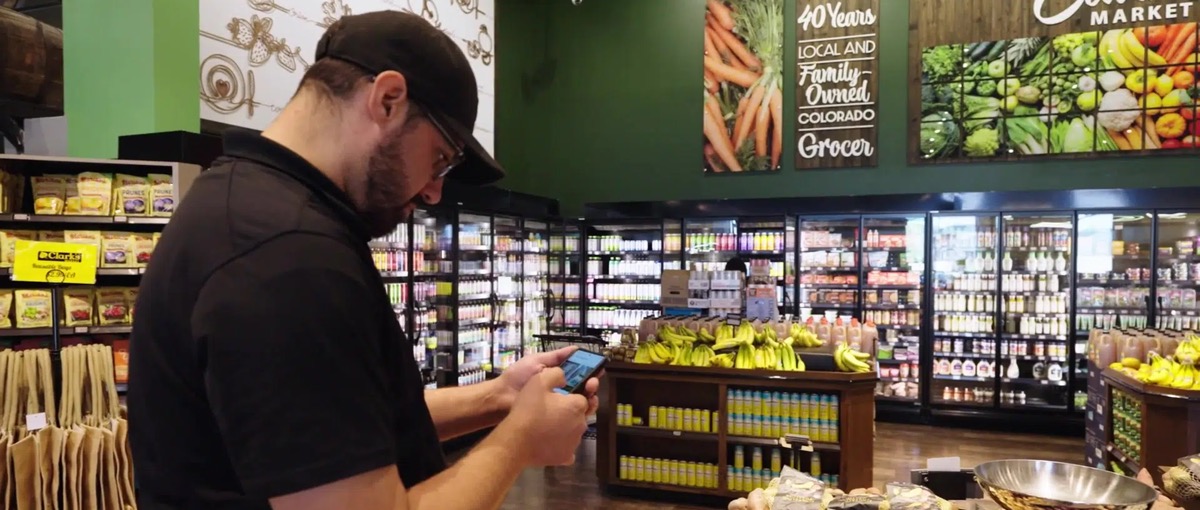
At Winters Market in California, an employee who receives a video clip selected by AI does not immediately walk over and confront a shopper. Owner Suhdeep Kaur told CBS that the team watches a clip several times, confirms what appears to be happening, and only then decides whether to speak with the person before they leave. The store uses Veesion, subscription software that connects to existing surveillance cameras and sends staff short videos of gestures that may indicate theft. CBS on-site report
CBS reported that theft costs the store about $40,000 a year. That number describes the store’s estimated annual loss, not a measured saving produced by Veesion. Kaur did not replace the cameras. Instead, the store added a layer that helps employees see a relevant moment while there is still time to review it, rather than discovering missing inventory and searching through recordings afterward. CBS on-site report
The cameras keep recording while staff stop watching every screen
Veesion connects a small server to a compatible video surveillance system. The software analyzes live footage for actions such as placing merchandise inside clothing or a backpack and then sends a short clip to store employees. The cameras capture the scene, the AI selects moments for review, and a person decides what the footage means. The system is therefore an alerting and triage layer, not an autonomous accusation or enforcement tool. Veesion product description
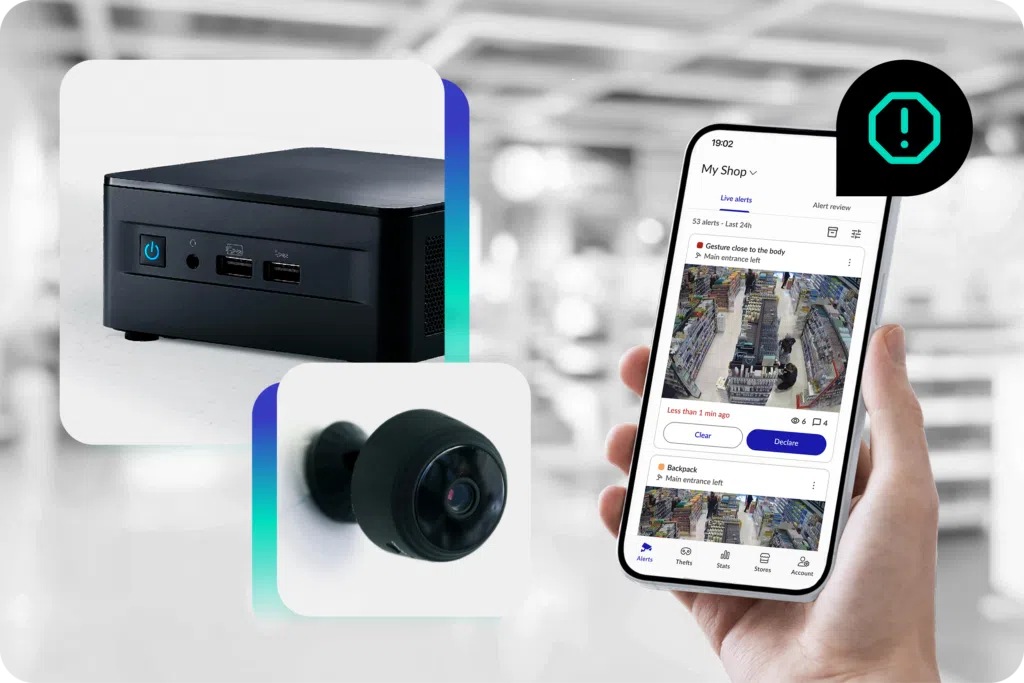
Veesion’s product illustration shows the small server that connects to the store’s existing camera system in the upper-left corner.
Stores can disable specific kinds of alerts. A retailer whose customers routinely bring reusable shopping bags, for example, can turn off gesture detection for those bags while keeping alerts involving backpacks. Configuration can be adjusted by store and by camera rather than applying one undifferentiated rule to every aisle. This matters because every alert creates work: an employee has to interrupt another task, watch the clip, and decide whether the behavior is suspicious or simply normal shopping in that location. Veesion product description
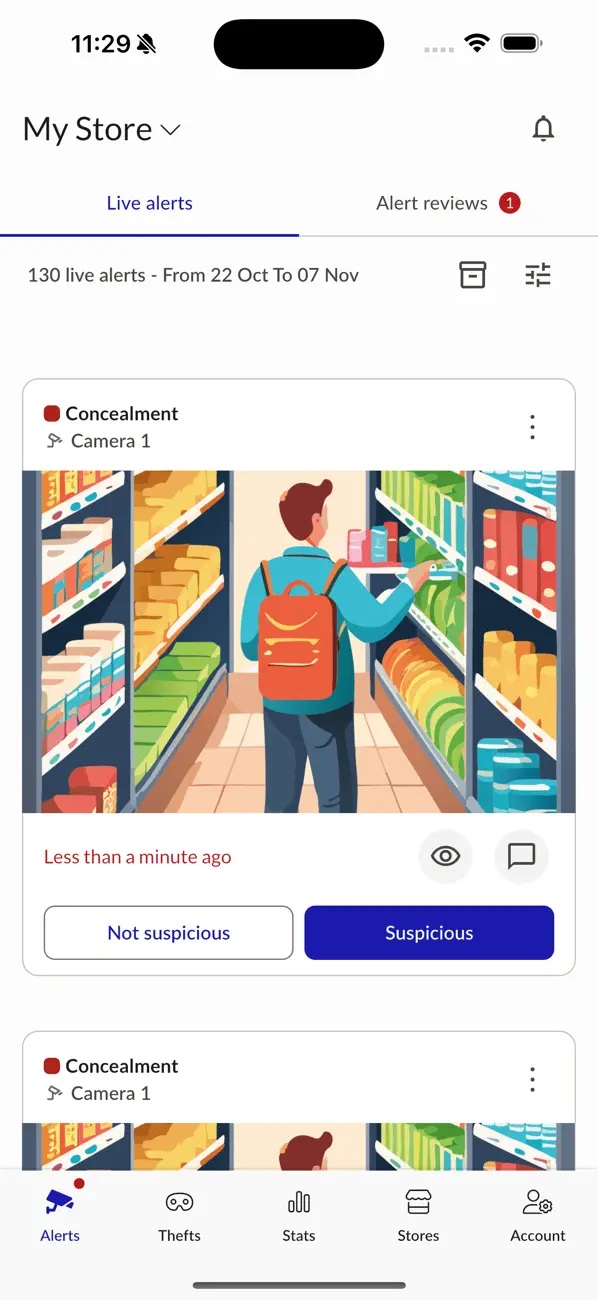
Employees can review alerts and mark clips as suspicious or not suspicious. The image is a demonstration from Veesion’s official App Store screenshots.
A SPAR convenience store in Evesham, England, describes the same change in workflow. In an interview published by Veesion, the store said that employees previously had to sit in front of surveillance screens to look for clues. With clips delivered for review, they can spend more time operating the store and check video when an alert arrives. For a small retailer, that is a concrete operational tradeoff: it may no longer need to devote an entire shift to continuously watching monitors, but somebody still has to review each useful alert and make the decision. SPAR Evesham interview
That human review is not a minor detail. A gesture model can narrow hours of video into a short queue, but it cannot remove local context. A shopper placing an item in a bag can be ordinary behavior in one store and worth checking in another. The product becomes useful when its configuration and the staff response process reduce the amount of video employees must inspect without treating every machine-selected clip as proof.
The subscription sells analysis, not another camera system
Dutch technology reseller Axians publicly lists a starting price of EUR275 per store per month for as many as nine cameras. This is a channel offer in the Netherlands, not the invoice paid by Winters Market in California and not a universal global price. A retailer has already paid for cameras and recording equipment; the recurring fee covers continued analysis of that footage and delivery of selected clips to employees. Axians Netherlands offer
The pricing unit is revealing. The offer is organized around one store and a camera allowance, which fits the product’s deployment model: connect to an existing system, choose the relevant cameras, and configure alerts for that location. The merchant is not buying a one-time hardware replacement. It is paying each month for the software to keep reviewing live streams and for the workflow that brings selected moments to staff.
In February 2026, SPAR International announced a partnership with Veesion that allows authorized retail operators to adopt the technology. Because the software can use existing surveillance equipment, an operator does not have to wait for an entire chain to replace its camera estate before testing it. The announcement establishes an approved route for adoption; it does not disclose how many SPAR stores have deployed the product. SPAR International announcement
US supermarket chain Clark’s Market followed a pilot-first path. In a customer interview published by Veesion, the retailer describes starting with a small trial and then expanding the software to more stores. It is a named vendor case showing that the system moved beyond one test location, but it should not be combined with the SPAR partnership to imply a chain-wide or global installation count. Clark’s Market customer interview
A pilot should measure attention, not just alert volume
For a retailer evaluating the system, the most useful pilot question is not how many alerts the model can generate. It is what happens during a real employee shift. Which clips surfaced events that staff would otherwise have missed? Which clips interrupted checkout, stocking, or customer service without changing an outcome? How often did employees agree with the alert after watching it more than once? Those observations reveal whether the system is reducing search time or merely moving surveillance work from a monitor to a phone.
Camera count helps determine how a store buys the service, but alerts worth stopping to review determine whether the monthly fee is justified. Winters Market’s reported $40,000 annual theft loss shows the size of the problem the store is trying to manage; it does not prove how much the software recovered. The Axians price shows one public route to buying the product; it does not establish the California store’s cost. Keeping those distinctions intact makes the business case more useful: the product is a recurring decision-support layer for existing cameras, and its value depends on how accurately it directs scarce employee attention.