
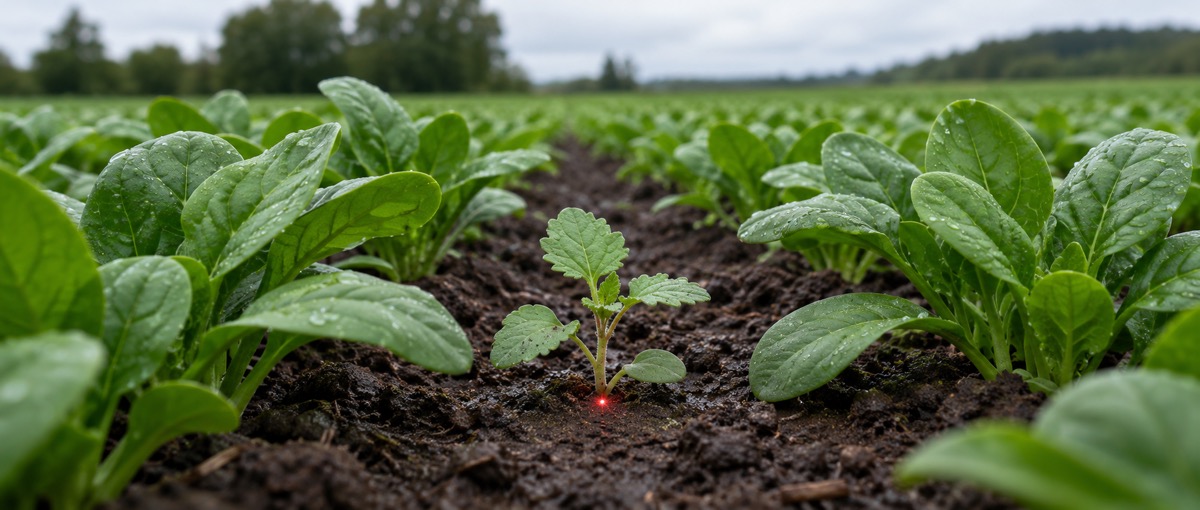
Irish farmer Philip Draper bought a laser weeder, then changed his planting schedule before anything else. He staggered crops such as organic carrots so that weeds would not emerge everywhere at once and overwhelm the machine’s available working time. In the operating pattern he described to Ireland’s Agriculture and Food Development Authority, each acre receives three passes over roughly six hours. A job that once required a full hand-weeding crew now leaves only a small number of workers to pull the weeds the machine misses. Teagasc farm visit
Draper bought the second-generation Carbon Robotics LaserWeeder. It is not an autonomous robot that drives itself into the field. It is a tractor-mounted implement: cameras record the crop rows below, AI distinguishes crops from weeds, and lasers target the weeds. When weeds grow larger, the tractor has to move more slowly. Second-generation LaserWeeder Irish operating record
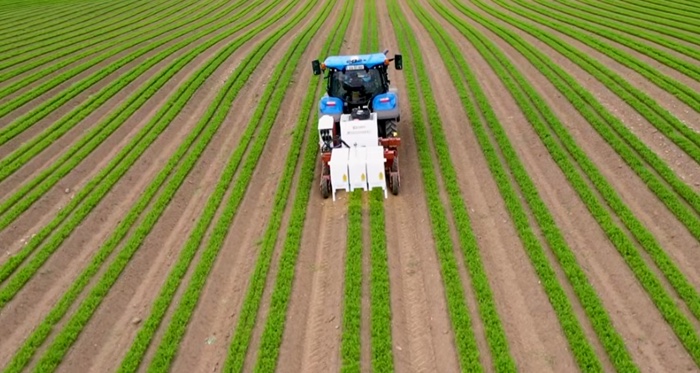
The laser weeder working on Draper’s farm. Source: Ireland’s Agriculture and Food Development Authority.
The machine enters the field, but labor costs do not disappear
How should a farm evaluate the purchase? Western Growers published a detailed case in 2024: US vegetable producer Braga Fresh paid $1.2 million for an early LaserWeeder. After accounting for both machine and labor costs, the association calculated savings of $350 per acre. The purchase price and savings in this calculation belong to Braga Fresh. They are not Draper’s purchase price or the operating result of his Irish farm. Western Growers cost case
Braga Fresh grows densely planted organic vegetables including spinach and arugula. The case put its previous all-manual weeding cost at $900 per acre. Western Growers did not simply compare that number with the machine’s $267.72 operating cost, because workers still had to enter the field and pull remaining weeds after the LaserWeeder passed. Cost case, pages 4-6
| Weeding cost per acre | Braga Fresh case |
|---|---|
| Previous all-manual process | $900.00 |
| Machine operation, including depreciation | $267.72 |
| Hand weeding after the machine pass | $282.28 |
| Machine and remaining labor combined | $550.00 |
| Savings versus the previous process | $350.00 |
The machine operating cost also included the tractor, fuel, operator, transport, hardware, and remote update service. The association depreciated the $1.2 million purchase over five years and assumed that each machine would cover 2,350 acres per year. Under those assumptions, depreciation alone was about $102 per acre. A farm with less land, lower utilization, or more expensive operation and transport would produce a different per-acre result. Cost case, Tables 1 and 4
The case therefore offers a more demanding purchasing test than a demonstration video. A buyer cannot treat the laser as a complete replacement for hand weeding, nor can it assume that the machine will spread its fixed cost over the same acreage as a large vegetable producer. The relevant comparison is the cost of the entire old process against the cost of the machine plus whatever labor, transport, and field management remain.
Recognition is not the end of the job
During Braga Fresh’s early trial, the machine mistakenly identified arugula as a weed. Varieties and growth stages do not all look alike. According to the process described by the farm manager, Carbon Robotics spent about a day and a half identifying the variety grown on the farm and updating the model. That is work the supplier still has to perform after the purchase. A wrong label on a screen can be edited; a laser aimed at the wrong plant can damage the crop. Cost case, pages 4-5
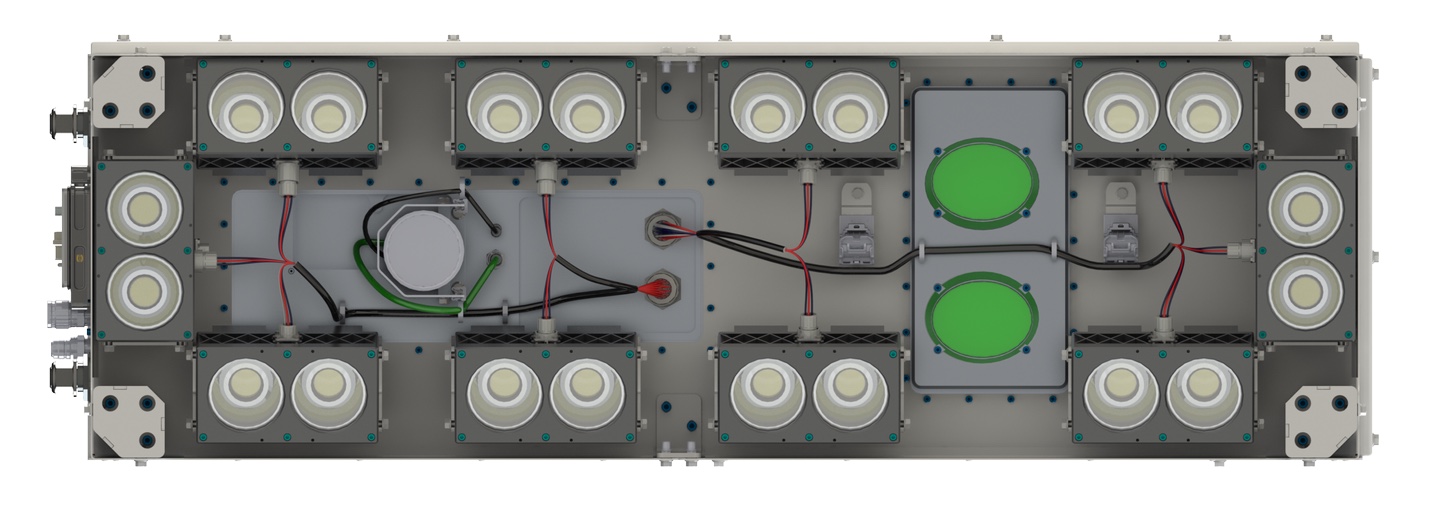
The underside of a laser-weeding module. Source: Carbon Robotics product page.
Carbon Robotics introduced a modular second generation in 2025, offering different configurations for crop beds and tractors. A wider machine can cover more rows, but maximum width is not the answer for every field. Draper’s response is more revealing: because the ideal weed-treatment window is short, he staggers planting so the machine can reach successive batches at the right time.
That operating change connects the technology to the cost calculation. A machine may be able to recognize and strike a weed, yet still fail to earn its place if planting schedules, weed size, travel time, and available acreage prevent it from processing enough ground. Utilization is not merely a finance assumption added after purchase; it depends on how the farm organizes the season.
The two cases should not be merged into one result. Braga Fresh used an earlier machine in the United States and supplied the purchase and cost figures behind the Western Growers analysis. Draper operates a G2 in Ireland, where the public account describes field timing and labor changes but does not disclose his purchase price or savings. Together, they show the two sides a buyer has to examine: a complete per-acre cost model and the operational changes required to make that model plausible.
Carbon Robotics’ second generation gives farms more hardware configurations, but the acceptance test remains local. Buyers need to ask not whether the laser can hit one weed in a demonstration, but whether the machine and the people still needed afterward can handle a full season more economically than the previous process. Second-generation announcement Draper farm visit