

Swaledale Butchers supplies meat to restaurants from Yorkshire in the United Kingdom. When chefs send orders, employees must do more than identify what they want. They need to remember how each customer wants a cut prepared, how it should be trimmed, and how much each portion should weigh before entering everything into the company’s internal system.
According to a customer case study published by Choco, roughly 70% of Swaledale’s orders previously arrived through WhatsApp, while the rest came through procurement platforms. Manually processing each order took about two minutes. After the company adopted Choco’s OrderAgent, the case study reports that processing time fell to eight seconds and staff shifted to checking the information entered by AI. That eight-second figure describes order-entry processing for this customer, not the complete journey from placing an order to receiving a delivery. Customer case study
The important part of this change is that automation did not require every chef to adopt a new ordering app. Customers kept sending messages; the operational change happened on the distributor’s side.
The hard part is not reading the words. It is identifying the right product
The product name in a message may not be the name used in an inventory system.
Choco’s engineering team offered an example in a 2025 article. A customer might ask for two kilograms of tomatoes, while the distributor’s catalog contains 40 tomato products in different package sizes. An employee who knows the customer may understand that she usually buys a particular 500-gram can, so the correct order is four units rather than an arbitrary item containing the word “tomato.” Engineering explanation
Speech-to-text alone cannot complete that task. The system must connect the customer’s language to the distributor’s products, units, and purchasing history.
OrderAgent accepts orders from voicemail, email, text, photos, and other channels. It organizes them into reviewable data and passes the result to the company’s existing ERP, the system used to manage orders, inventory, and related operations. Product description
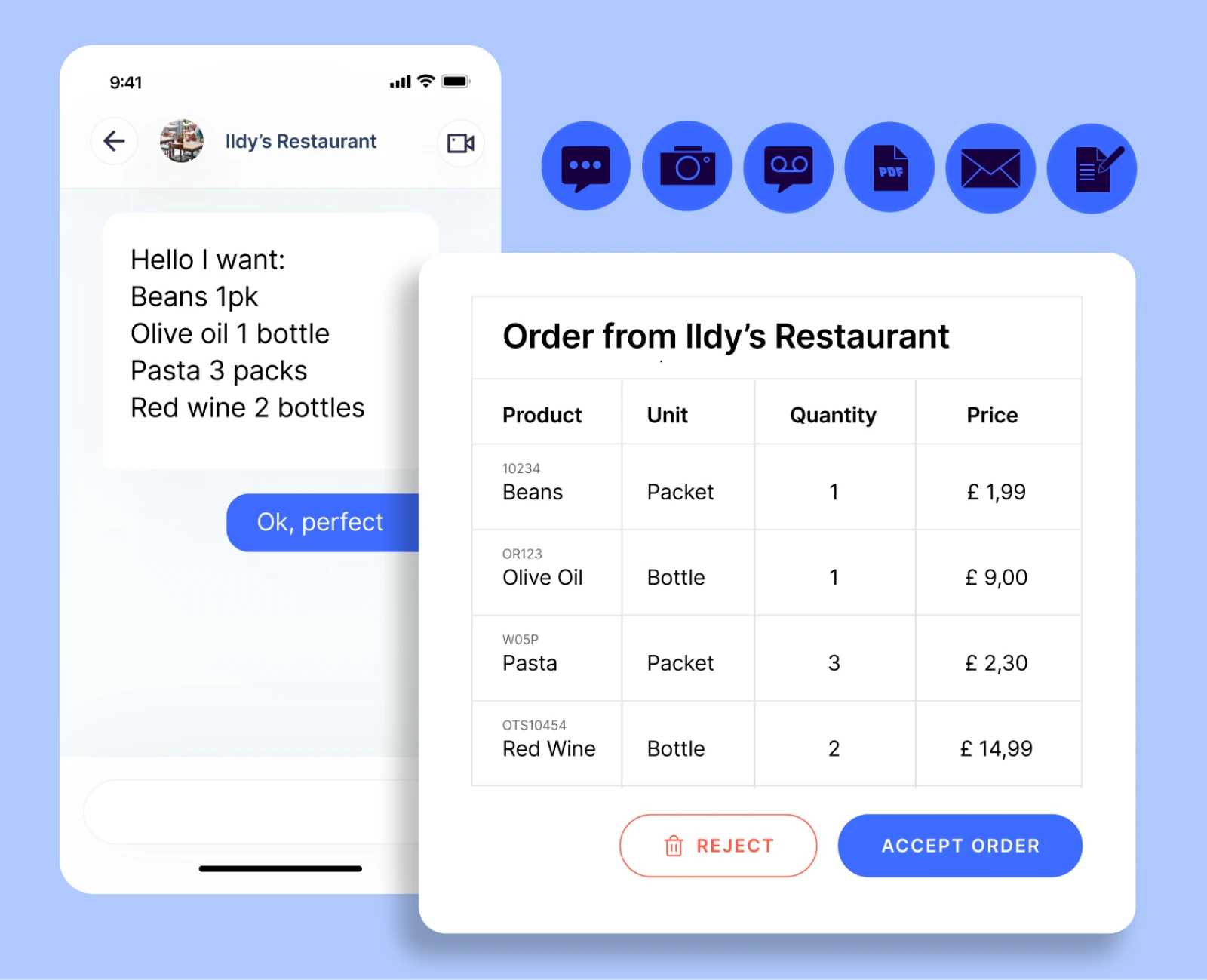
From a message to product line items. Source: Choco’s official product demonstration.
The distributor paying for the product does not need an elegant chat summary. It needs an order that can enter its system and continue through operations.
Do not wait for every restaurant to switch apps
Requiring restaurants to submit orders in a standard form would make data entry easier. It would also transfer some of the work to chefs, who would have to remember the platform, find each product, select the right unit, and follow a prescribed process.
Choco currently supports both paths. Restaurants that want an app can manage suppliers through its free ordering product. Customers who do not want to change their habits can continue sending email, voicemail, text messages, and photos for OrderAgent to process. Restaurant product, OrderAgent
That distinction matters to a distributor. The software can create value before every restaurant completes a migration.
In a product-evolution article published in November 2025, Choco described its own shift from a mobile app that helped restaurants place orders to an AI platform that processes orders for food distributors. Restaurants still use the product, but the newer AI capabilities primarily address supplier operations. Product evolution
This is not simply the original app with a chatbot attached. The paying customer’s operational problem became the center of the product: orders arriving through different channels must ultimately enter the same business system.
The human did not disappear behind the eight-second result
The Swaledale case study also reports 97% accuracy. That number comes from a vendor-published customer account rather than a general benchmark, and the account does not describe employees leaving the process entirely. Staff now supervise and verify what the system enters. Customer case study
In Choco’s published review interface, the original order appears on the left and predicted product details appear on the right. An employee can compare them, make corrections, accept the order, and then synchronize it with the ERP. Review workflow
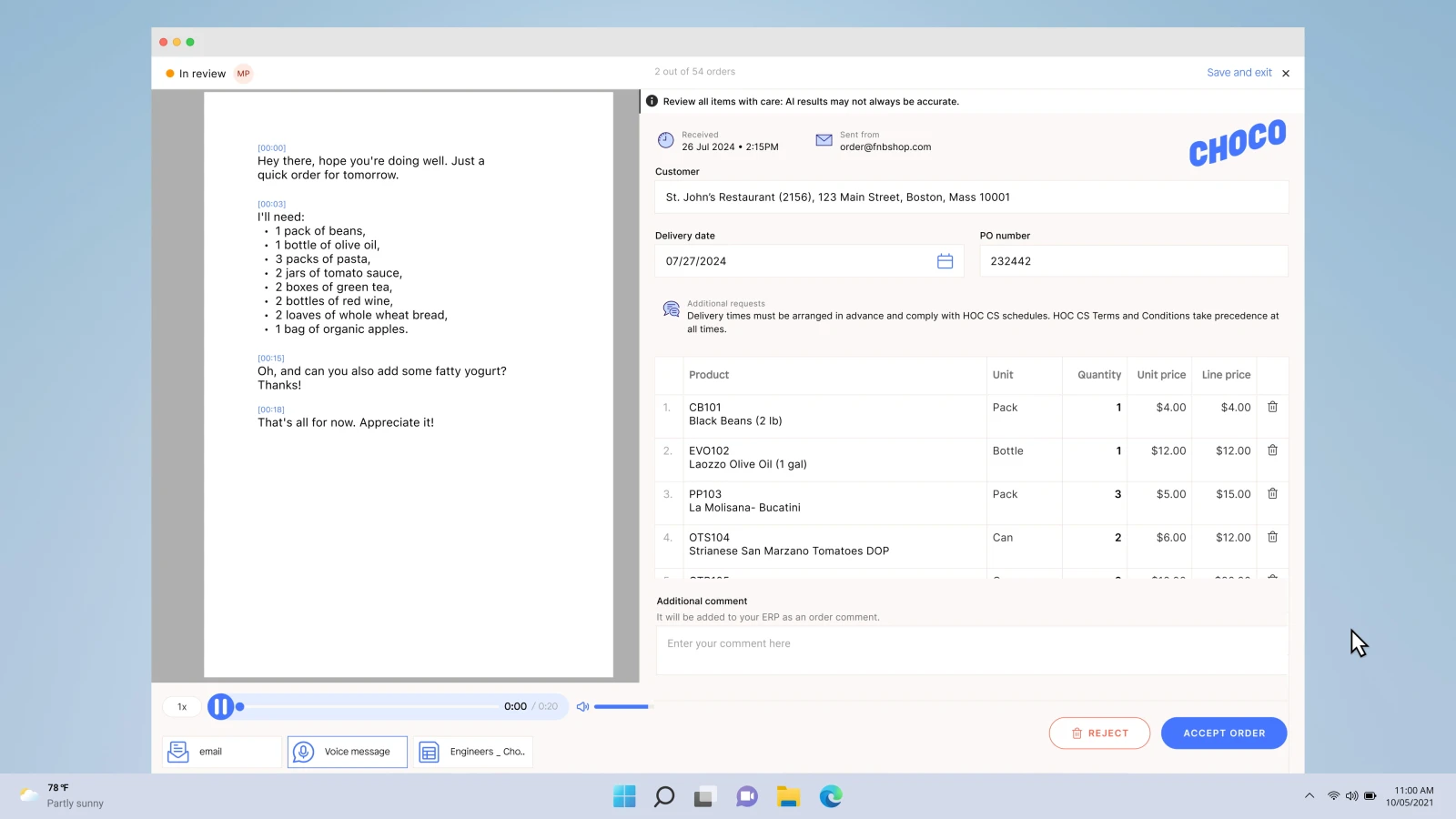
The original input remains on the left, while products, units, and quantities can be checked on the right. Source: the product interface published by Choco’s engineering team.
Keeping the source content visible is not a minor design choice. Selecting the wrong product has different consequences from writing an imperfect summary. A product error can affect purchasing, cutting, and delivery, and resolving it may require returning to the customer’s original message.
Choco’s Autopilot mode separates orders further. Suitable orders can flow directly into the ERP, while others remain under manual review. The distributor controls which customers and which orders can be processed automatically. Autopilot mode
Choco charges for software, not for the restaurant’s groceries
Choco’s UK pricing page explains the transaction model: suppliers pay a monthly fee based on usage, with pricing agreed through sales rather than listed as a standard public amount. The restaurant ordering app is free. Supplier pricing, restaurant product
That gives the commercial value a concrete anchor. Distributors already spend labor receiving, checking, and entering orders; Choco asks them to pay for automating part of that work.
Whether the software is worth the price cannot be judged only by recognition speed. A real deployment also depends on how many orders require rework, whether exceptions are discovered quickly, and whether the system connects reliably to existing operations. Producing structured rows is only half of the delivery.
Joe Lodge, Swaledale’s operations and sales manager, says in the case study that the team now has time to speak with chefs. In a business that prepares products to customer specifications, an employee’s value is not limited to typing quickly. It also includes discussing products and handling unusual requests. Customer feedback
That is the opportunity worth looking for in this category of AI product: customers have already expressed what they need, but the company still employs people to enter the same information again. Connect that repetitive step first, and then decide how far automation should go.