

In a product demonstration by Letterly founder Anton Lebedev, a recording ends and its text appears inside a note. He selects a rewrite option and turns the same spoken passage into another version. Favorite transformations sit at the bottom of the screen, next to a one-tap copy control.
The app is easy to explain: it turns speech into an email, message, or organized note that is ready to send. In an interview with Starter Story, Anton said Letterly had about 20,000 paying subscribers and $250,000 in monthly revenue at the time. These are historical figures reported by the founder, not current revenue and not profit. Founder interview
The interesting question is not whether its speech recognition is slightly better. Transcription and rewriting are no longer scarce capabilities. Why would someone still pay for a dedicated app?
The job is not recording speech; it is avoiding another round of organization
Letterly stores the speaker’s original words separately from the edited result.
According to the official workflow, a user opens a note after recording, taps Rewrite, and chooses a light cleanup, structural reorganization, or a format such as an email or list. The original transcript remains unchanged. Each transformation creates a new version, and the user can move between versions. Letterly rewrite workflow
That is more specific than a generic “polish with AI” button:
| The text in front of the user | How Letterly can process it |
|---|---|
| The idea is complete, but the speech is loose | Apply a light cleanup while preserving wording and tone |
| The main points exist, but their order is confusing | Reorganize the structure |
| The thought is clear and needs to be sent | Convert it into an email, list, or another useful format |
The user decides how much the wording should change instead of sending every passage through the same full rewrite. Rewrite option guide
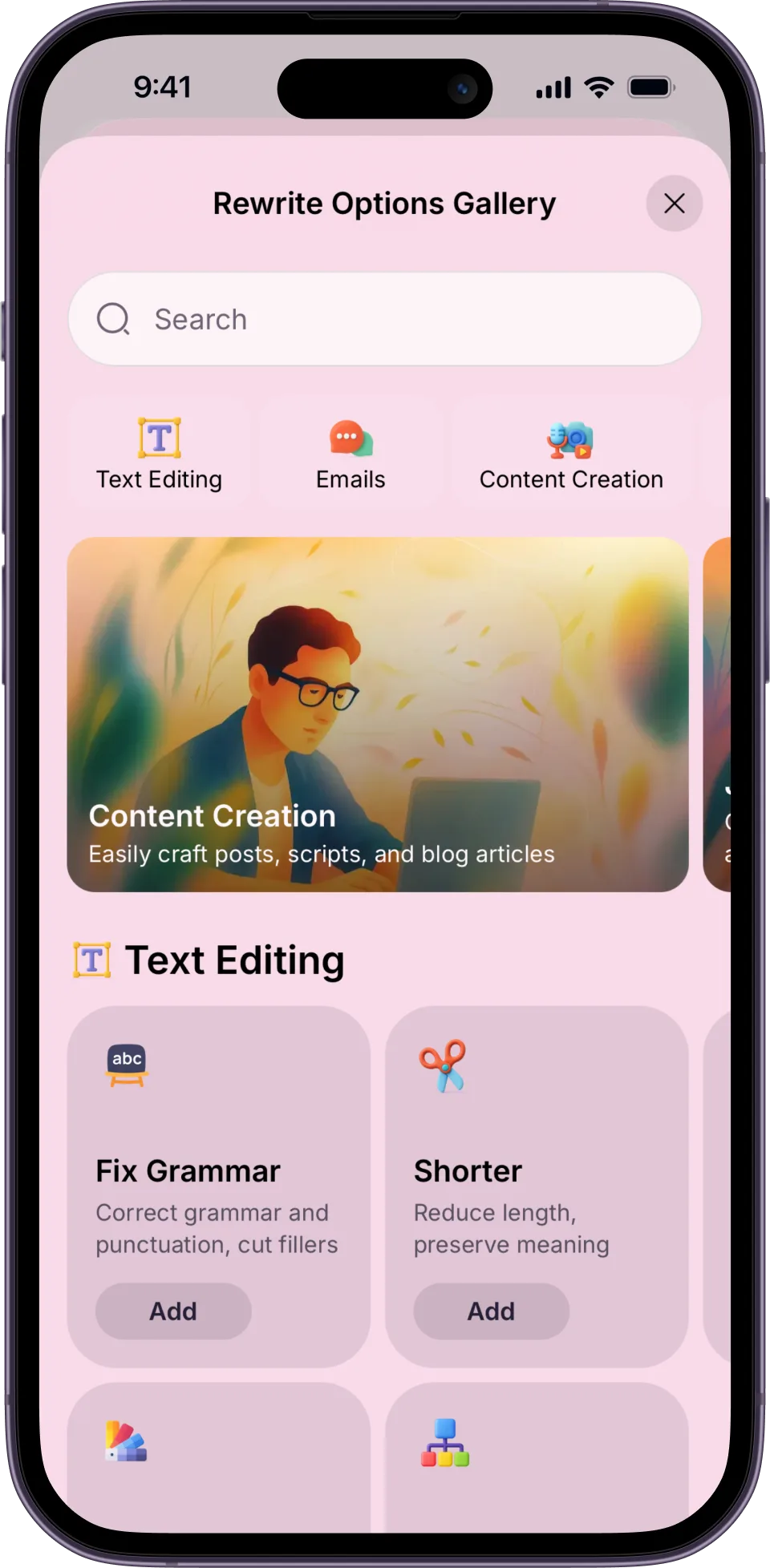
The rewrite library includes text cleanup, email, and content-creation options. Image source: Letterly’s website.
Keeping the source transcript also gives the user something to check. A thought can be spoken before the person decides whether it should become a formal email or a private note.
The app does not reduce the time it takes to speak. It removes part of the cleanup that follows.
Move from opening an app to the place where the user is already writing
That value depends on reducing friction. Writing two sentences should not require a long sequence of opening an app, recording, rewriting, copying, and switching back to the original destination.
In June 2026, Letterly brought rewriting into the iPhone keyboard. A user can dictate and immediately shorten the result, clarify its structure, or turn it into an email or message. An October update added Shortcuts entry points. On supported iOS versions, a recording can begin from the Action button, Control Center, or Lock Screen without opening Letterly first. Letterly product updates
The direction is clear. The initial product captured speech inside its own notebook. Later versions let users complete voice input where they already intended to write.
Letterly does not place every capability behind a paywall. Under its current official plans, free users can save ten notes, record for up to three minutes per note, and use a limited number of basic rewrites. Pro provides longer recordings and the complete rewrite library through monthly, annual, or lifetime purchases. Letterly free and Pro plans
The boundary between free and paid access follows frequency and processing needs. A person can complete one small task first, while regular users pay for more capacity and more ways to shape the result.
Revenue growth came from more than product experience
The easiest way to misread Letterly’s story is to conclude that a simple product grows automatically.
A customer case study from subscription platform Adapty says Letterly’s monthly recurring revenue grew 345% between April and August 2025. It reports $600,000 in total revenue from June through August, ten times the $60,000 generated from March through May. The case study also states that advertising played an important role. These are vendor-published customer figures rather than audited financial statements. Adapty growth case study
The team did not treat the subscription screen as a page that could be designed once and left alone after acquisition began.
According to the same case study, the team designed its own paywalls, assembled each one with a tool, and could launch a version in about 20 minutes. Two better-performing paywalls generated approximately $127,000 and $95,000 respectively. The visual examples appear below, but the traffic was not equal, so the figures do not prove that one color or layout caused a specific amount of additional revenue. Paywall examples and analysis
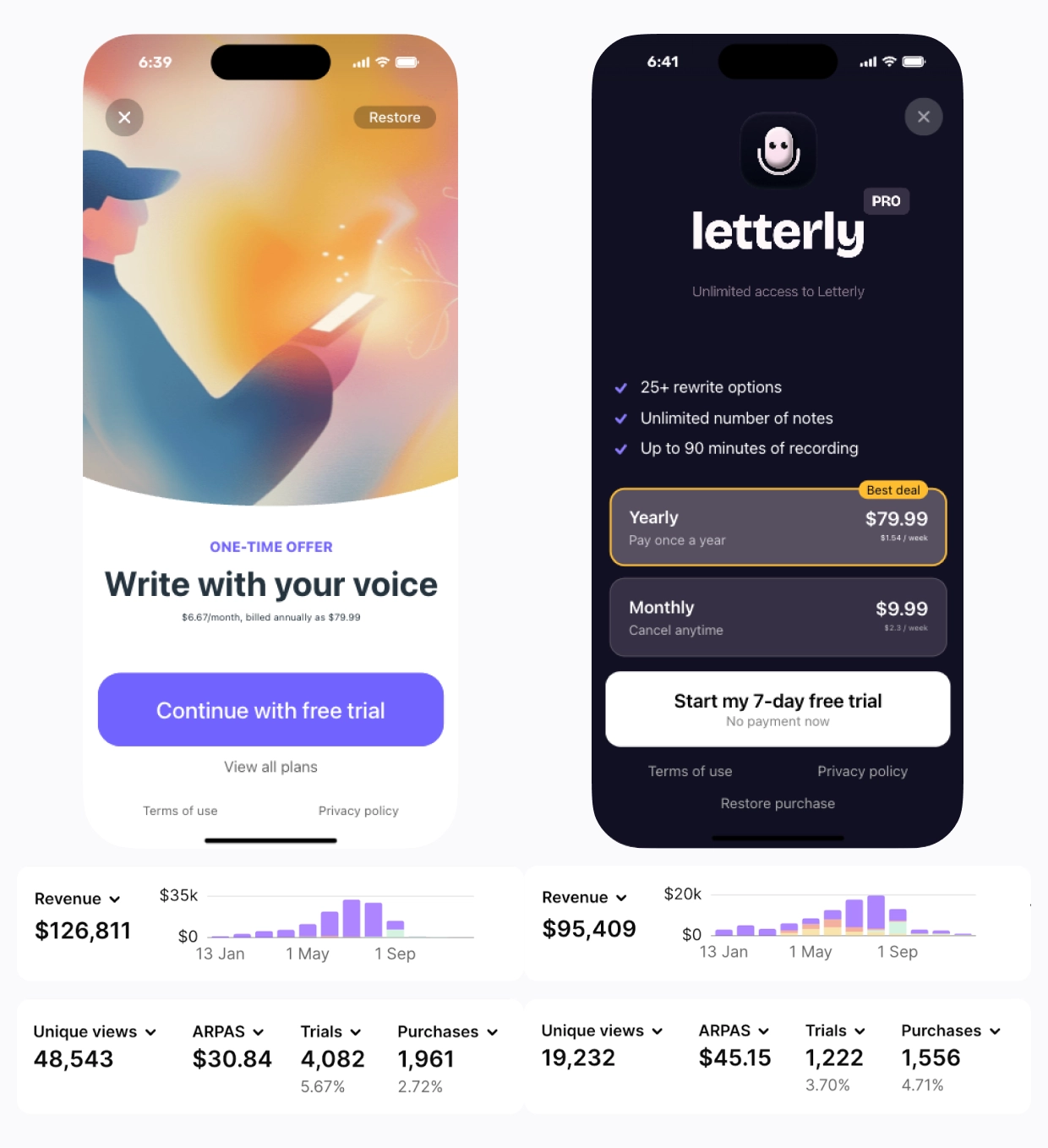
Image source: Adapty’s customer case study. The prices are historical paywall examples rather than current China-market prices, and the traffic volumes differ, so their conversion rates should not be compared directly.
The more useful lesson is the operating method behind the screens. The team examined revenue and renewals by country, product, and user cohort, exposed an offer to real users, and then decided whether to keep or change it.
That gives “simple” a commercial second half. A smooth recording experience determines whether people want to use the app. Subscription design affects whether they buy. Advertising determines how many new users see it. None of the three automatically compensates for a missing one.
$250,000 a month did not mean effortless profit
In the same interview, Anton said the team had about ten people, spent roughly $30,000 per month on salaries and $5,000 on AI, and invested approximately $200,000 per month in advertising. Founder cost disclosure
Those figures are enough to challenge the idea that connecting an app to a model produces a low-cost subscription business. They still do not constitute a full income statement. Annual plans, renewals, platform fees, and the timing of cash collection would all need separate treatment, so subtracting the disclosed costs from revenue would not establish net profit.
What builders can borrow from Letterly is its focus on both ends of the business. One end helps a user reach usable text sooner. The other repeatedly tests whether acquisition and pricing work. Product quality did not replace growth operations, and growth tooling did not replace the product.
For a new entrant, the better question is not whether another speech model can be integrated. It is: after users receive a transcript, how much more work remains before they can send it?
Visit Letterly through the original article link.