
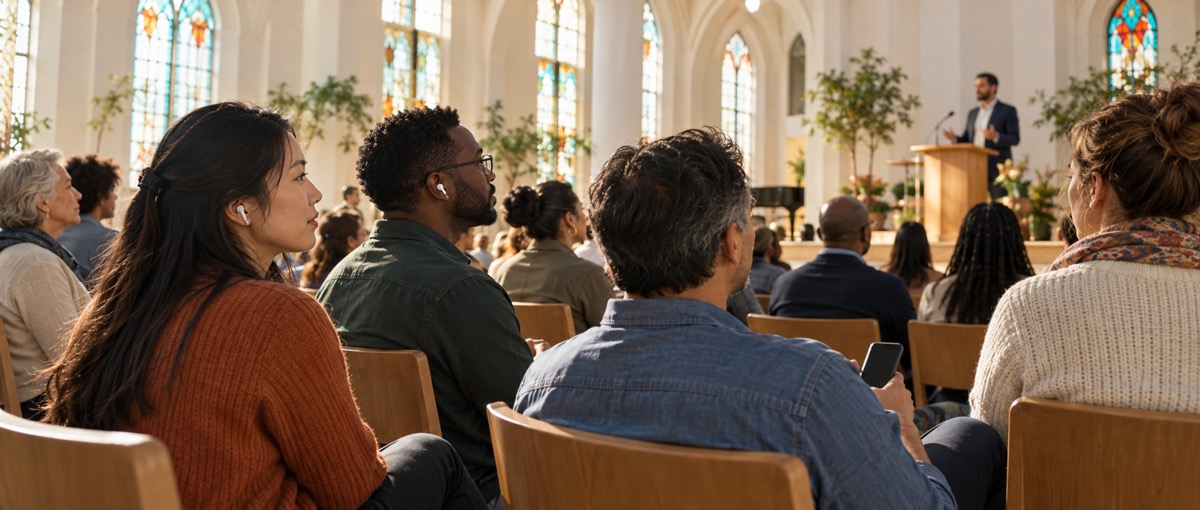
How can one sermon make sense to people from more than a dozen language backgrounds?
ICF Limassol, a church in Cyprus, uses Glossa. The sound from the stage enters a computer, and listeners receive translations on their own phones. The church’s website links directly to its event page on Glossa, providing a public example of the product in use. ICF Limassol website
The business is collecting real payments. According to revenue data that TrustMRR says it verified through Stripe records, Glossa generated $31,765 in September 2026. The buyer is not each person sitting in the audience. It is the church organizing the gathering. Glossa revenue record
Fifty people need to listen, but interpreters are scarce
In a customer account featured on Glossa’s website, Damon describes a church conference in Alabama. About 50 attendees spoke only Spanish during the six-hour meeting, while the organizers had a serious shortage of interpreters. They turned to Glossa.
Derek from ICF Limassol says the weekly congregation includes people from more than ten national and language backgrounds. The church could not afford an on-site interpreter and equipment for every language, so it now distributes translations through a single audio stream. The church’s own website independently confirms the connection. Glossa customer accounts
One event was an urgent shortage; the other repeats every week. Both reveal the same thing: the organizer has to solve the problem instead of asking dozens of listeners to improvise separate solutions.
Having a translation app on a phone is not the same as listening continuously to an entire sermon. Who captures clean audio? Where does translation begin? How do dozens of people listen at once? Glossa connects those pieces.
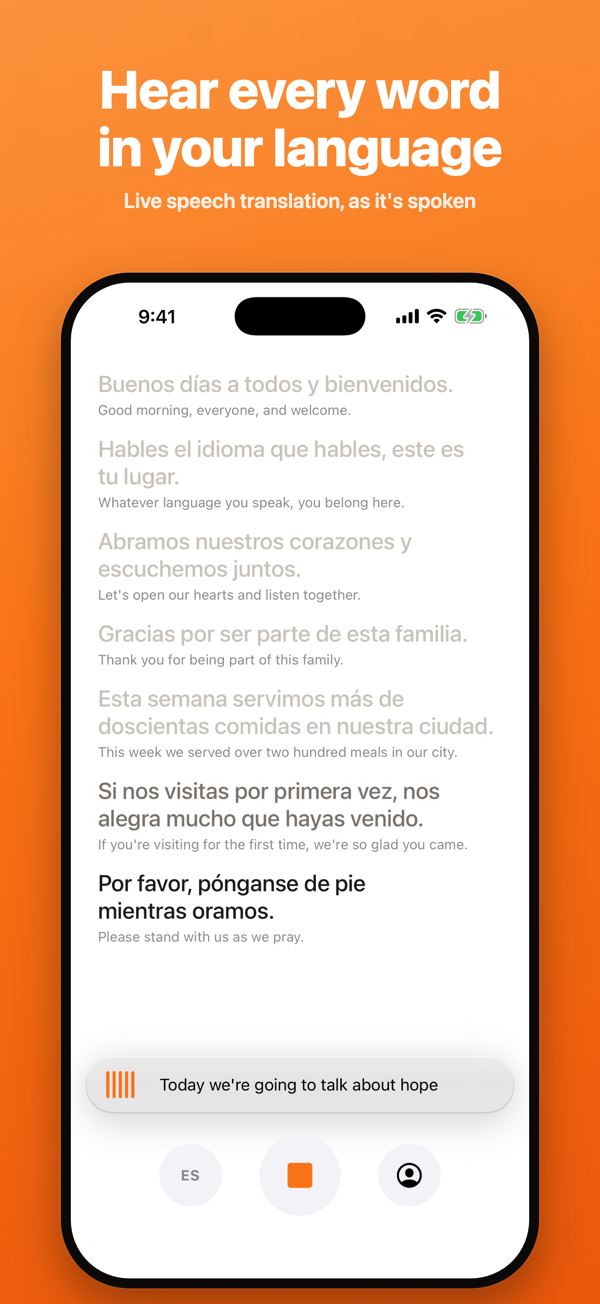
The listener receives live translated text and speech. Image source: Glossa’s official App Store listing.
One microphone connects to every listener’s phone
An organizer opens Glossa on a computer, selects the audio input, source language, and translation languages, then starts the service. Listeners scan a QR code, choose a language, and either read captions or hear translated speech. A browser is enough; downloading the app is optional. Starting a translation Sharing the QR code
One operational detail is easy to lose behind the phrase “real-time AI translation”: the organizer must supply good sound.
Glossa’s help documentation recommends taking audio directly from the mixing console rather than placing a phone across the room. Background noise, echo, and distance all reduce recognition quality. The company says normal translation delay is about two to five seconds because the system waits for a sentence to finish. This is not zero-latency simultaneous interpretation. Audio input setup Translation startup guide
In other words, the product centralizes the venue’s audio and redistributes it to listeners. It does not ask every phone in the seats to hear the stage independently.
Even the QR code is designed for weekly use. It points to a congregation entry rather than one temporary stream. As long as the organizer does not delete that entry, the same code can be printed by a seat or displayed permanently instead of being replaced every Sunday. Reusable QR code documentation
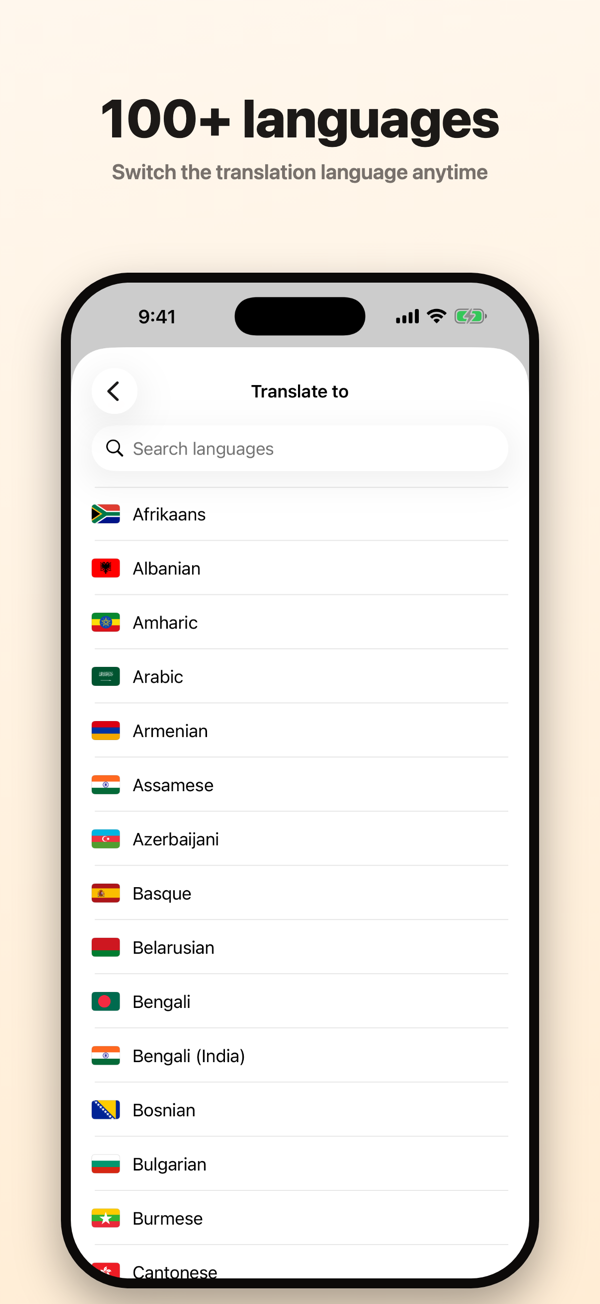
Listeners choose from the languages enabled by the organizer. Image source: Glossa’s official App Store listing.
Translation costs the same for five listeners or 500
Glossa’s usage price is $5 per language per hour. Translating one hour of content into three languages costs $15, not $15 for each listener. Glossa pricing explanation
Dozens of additional listeners do not change the bill unless the organizer adds translation languages or time. The church does not need to count how many people require translation at the door and decide who receives access.
The product also limits another billing risk. Organizers enable the required languages in advance, and listeners can choose only from that set. One attendee cannot create an unexpected charge by selecting a language that the organizer never approved. Language configuration
Subscriptions begin at $99 per month and include 25 language-hours. The $299 and $499 plans include 100 and 250 language-hours respectively. A language-hour means one hour of content translated into one language. Glossa plans
Weekly use does not automatically make a subscription cheaper.
At current prices, imagine four one-hour services per month with three translated languages. That totals 12 language-hours, or $60 under usage pricing, below the $99 entry subscription. Monthly plans suit customers with higher volume; they are not mandatory for every church.
Glossa also says silence and songs do not count toward usage, and the service does not transcribe sung lyrics. If organizers leave the event running while people continue speaking after the audience has gone, billing can continue. Usage rules
$31,765 in revenue is not $31,765 in subscriptions
Payment records show growth, but not a straight line:
| Month | Revenue recorded by TrustMRR |
|---|---|
| November 2025 | $7,040 |
| April 2026 | $20,676 |
| June 2026 | $16,479 |
| September 2026 | $31,765 |
September revenue was about 4.5 times the November result, with a decline between some months. TrustMRR last synchronized the snapshot on October 19, 2026. It also reported $14,404 in monthly recurring revenue and 100 active subscriptions. These are payment-platform records rather than audited financial statements, and 100 subscriptions should not be rewritten as 100 churches. Revenue and subscription record
Why was monthly cash revenue higher than MRR? The product sells both metered use and subscriptions, so not every payment is revenue expected to repeat each month. Public data does not provide the complete split, and it cannot establish profit or retention.
It does answer a more basic question: people are not only saying that this niche product is useful. Someone is paying for it.
The lesson is not simply to build another translator
Glossa chose customers with a defined moment of use: the next weekly service or the next conference. An organizer can prepare the microphone, network, and listening entry in advance, then pay for the event centrally.
For teams building AI products, that is more actionable than saying that everyone has cross-language needs. The broad claim describes a large market. The recurring event identifies a customer who can be found, served, and charged.
The sharper test for a niche market is: when the same event happens next week, who is responsible for keeping the system running, and who approves the bill?
Visit Glossa through the original article link.