
At construction company UrbanCore, the estimating team has brought part of the bidding process into customer meetings. It uses Togal.AI to extract quantities from drawings, passes those quantities to Zebel for estimating, and adjusts the estimate as the discussion continues. The team does not always need to end the meeting, return to the office to recount the plans, and wait for another round of communication. This workflow comes from a customer case published by Togal. Togal UrbanCore case study
Togal is not selling architectural renderings. It performs another task for estimators: reading construction plans, recognizing spaces, measuring areas and lengths, and organizing the quantities that must be understood before a price can be prepared.
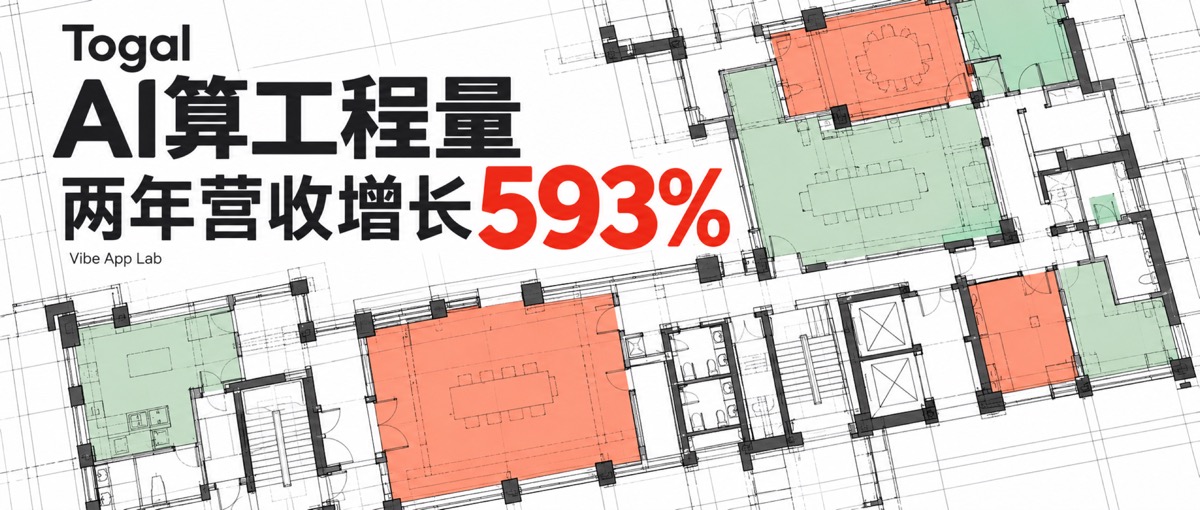
The business has a reported growth signal. In 2026, Togal cited a South Florida Business Journal ranking and said its revenue had grown 593% over the preceding two years. This is a company-reported growth rate, not an absolute revenue figure and not profit. Togal revenue-growth announcement
The useful question is not merely whether AI can read another drawing. It is how the quantities it identifies enter work that customers will keep paying to perform.
A $3,588 Annual Seat Buys More Than Recognition Runs
Togal’s Growth plan is listed at $299 per user per month, billed annually. One seat therefore costs $3,588 per year. The plan includes unlimited automated takeoffs, image or symbol search, collaboration inside the account, and unlimited collaboration with people outside the account. A Business plan for teams of four or more is sold by quote and adds services such as training and classification-library templates. Togal pricing
This is not priced for a homeowner who wants to measure a room once. It is aimed at professional teams that repeatedly review project drawings and submit estimates.
Counting is only the first step. Quantities must be handed to specialists, combined with material and labor rules, compared when designs change, and checked with subcontractors before a bid is submitted. If AI exports its result into a new spreadsheet and stops there, the next people in the process may still spend time reconciling versions and merging data.
That is why UrbanCore’s division of labor matters. Togal extracts quantities from the plans; Zebel then turns them into a price estimate. The customer receives a faster estimating discussion rather than merely a reduction in mouse clicks. The case study does not disclose incremental contract value, but it does document the team’s ability to produce estimates during customer meetings. Togal UrbanCore case study
This also explains why Togal does not need to own the entire software stack. Giving an existing estimating system quantities earlier can still make the takeoff product part of everyday work.
When a Drawing Changes, the Rest of the Process Cannot Start Over
A case involving Coastal Construction shows a different source of friction. When several estimators work together, separate files, manual exports, and spreadsheet consolidation create coordination work. Coastal used Togal to keep team takeoffs, drawing-revision comparisons, and quantity checks with subcontractors in one cloud environment. The value is not only speed on the first measurement. It also includes seeing how quantities change when the next design arrives.
According to the vendor’s case study, Coastal estimated that it saved $3.2 million in 2025. The number cannot be attributed entirely to AI. The same account mentions larger projects, internal process improvements, and project-selection strategy. Coastal also has a relationship to the Togal founder’s family construction business, so it is not an unrelated external sample. Togal Coastal case study Background on Patrick Murphy and Coastal
The more transferable point is the collaboration change. Time saved during initial recognition can disappear during handoff unless the people who check scope, prepare bids, or coordinate subcontractors can continue using the result. Togal’s Growth plan allows unlimited external collaboration, at least avoiding a pricing rule that requires every outside participant to buy an identical seat before joining the process.
Next, the Product Starts Calculating Materials Inside the Wall
Togal’s Assemblies feature moves the product deeper into a specific trade, beginning with light-gauge metal framing and drywall partitions.
Traditionally, an estimator measures wall dimensions and then moves the numbers into a spreadsheet. The team applies rules for wall type to calculate studs, drywall sheets, screws, labor hours, and equipment. Togal now lets users configure materials, labor, equipment, and formulas, then apply that rule set to measured quantities. The workflow combines AI plan recognition with professional formulas; it does not ask a model to invent a budget from nothing. Togal Assemblies
| Stage of the work | Decision that remains with the professional |
|---|---|
| Recognize and measure quantities from drawings | Verify project scope and measurements |
| Apply wall rules to calculate material, labor, and equipment quantities | Build, select, and apply the calculation rules |
| Turn quantities into a project bid | Set prices, markups, overhead, and taxes in the existing estimating process |
The official description draws a useful boundary. Assemblies currently calculates quantities, not the final total price of a project. Its present trade coverage is also drywall partitions rather than every construction discipline. Togal Assemblies
That limitation makes the commercial direction more concrete. A general promise that “AI will prepare your estimate” is hard to verify. Mastering the calculation rules for one wall system gives customers something reusable across the next drawing and the next project.
The customer’s old formula library may be another important switching cost. Togal offers industry templates and says it will help migrate existing calculation libraries from PlanSwift or On-Screen Takeoff. Users do not need to rebuild years of accumulated rules from a blank page before the new tool can take over established work. Togal Assemblies
For a vertical AI product, that creates a practical product question: after customers hand over their drawings, can they preserve the methods they have developed over years? Togal has turned that question into a migration service rather than leaving it as a vague promise of easy onboarding.
The 593% revenue-growth figure makes the business noticeable, but the workflow explains why a customer might continue paying. Recognition starts the process. Integration, revision handling, professional formulas, and migration make the result usable by the rest of the estimating organization.