
When the quarterly board report reaches his desk, Holiday Extras CEO Matthew Pack no longer relies only on the keyboard to revise it paragraph by paragraph. He dictates his comments with Superwhisper, then combines the original document and those comments into the next draft.
The product itself is easy to recognize: hold a shortcut, speak, and place text into the application already in use. In Pack’s case, however, the input is not merely a sentence or two. It includes his judgment about an existing report. According to a customer story published by Superwhisper, adoption began with Pack, expanded to roughly 30 executives, and then moved toward more employees at the 905-person travel company. Superwhisper customer story
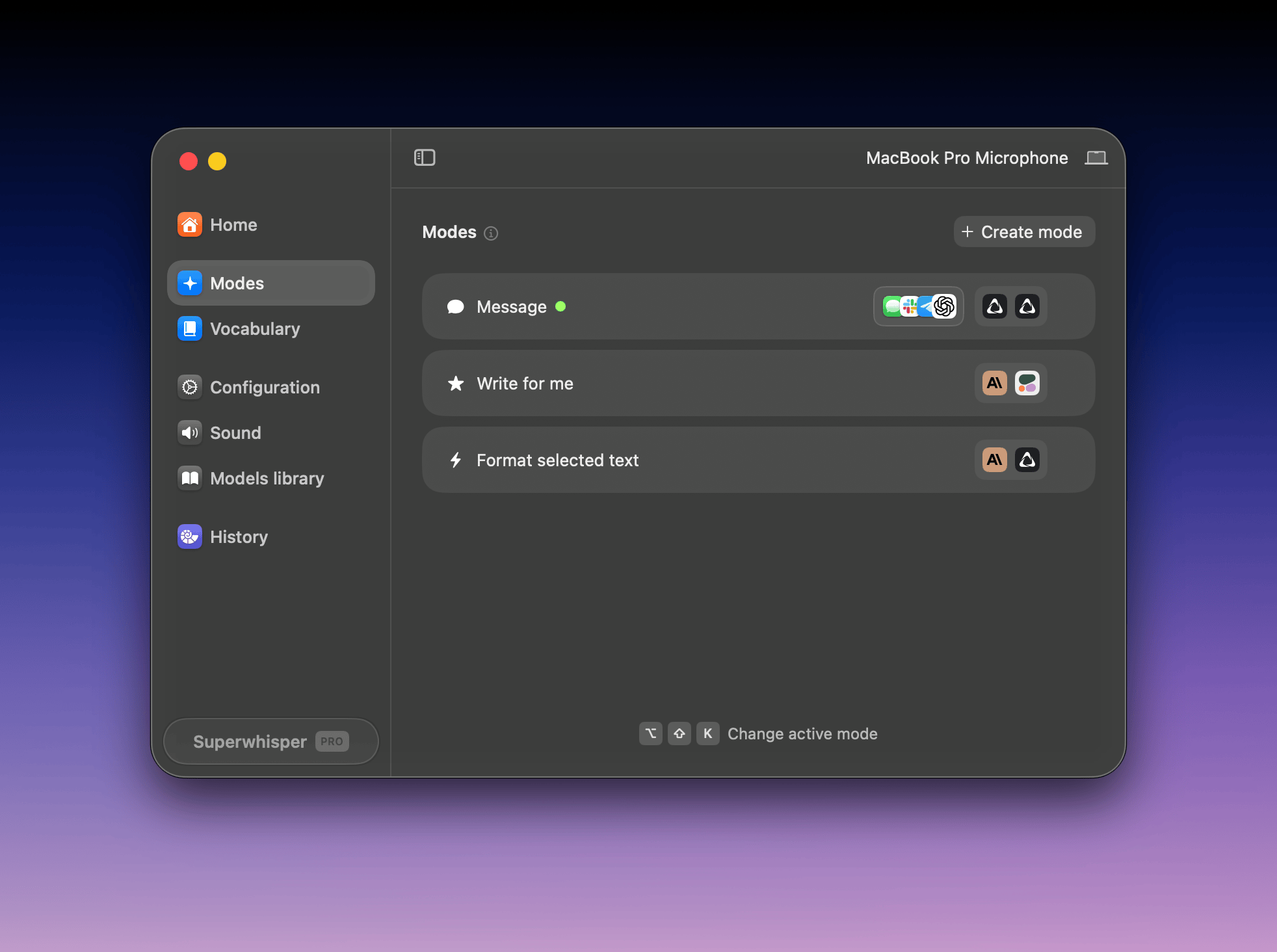
Superwhisper mode settings. Image source: official documentation.
The commercial twist is that Superwhisper later made part of its previously paid capability free. On August 26, 2026, every local Whisper model on Mac became available to free users. The company did not eliminate Pro. Instead, it drew a clearer boundary between transcription and the AI processing that comes afterward. Superwhisper changelog
If basic dictation is free, what remains worth buying? The answer begins with the second task that follows accurate recognition.
Hearing the Words Is Not the Same as Finishing the Writing
In a sales example on the company’s website, a representative dictates notes from a completed call. The salesperson contacted Sarah at ACME, learned that she was interested in a 50-seat plan, heard that an IT leader should join the discussion, and mentioned the end of the quarter. The spoken input runs together and includes normal verbal hesitation.
The processed output separates the account’s interest, the next action, and the target timing. The table below paraphrases what the official demonstration shows. It is a vendor example, not a test performed for this article. Superwhisper enterprise demonstration
| Information mixed together in the dictation | Structured call note |
|---|---|
| Contact and interest | Sarah at ACME; interested in a 50-seat plan |
| Requested participant | Next step: introduce the IT leader |
| Timing | Target close: end of quarter |
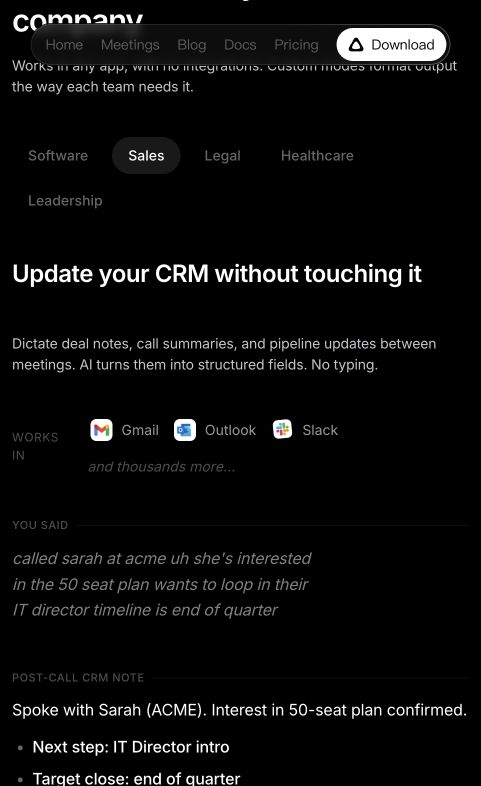
An official sales-workflow demonstration. Image source: Superwhisper.
The result is easier for another colleague to scan, but it still needs judgment. Classifying “end of quarter” as a target close date should be checked, and creating a note does not automatically complete the introduction to IT.
Plain transcription handles recognition. The second step reorganizes language around a task. Superwhisper’s documentation makes the same distinction: a pure transcription mode performs no AI processing, while message mode removes spoken filler, email mode supplies an email structure, and notes mode organizes key points and action items. Superwhisper built-in modes
Another chat tool could also rewrite a transcript. Superwhisper is selling the convenience of saving those instructions as modes and automatically enabling them inside selected applications. The user does not need to copy a transcript into another window and explain the desired format every time. Superwhisper modes documentation
That is also the paid product’s test. If every result needs extensive correction, the phrase “AI processing” is not enough to justify a subscription.
Win Over the CEO, Then Make Adoption Possible for Colleagues
The Holiday Extras story explains organizational adoption more clearly than a feature list. AI engineering lead Jason Jack introduced the tool to Pack. It did not begin with a company-wide purchasing announcement. Pack used it in his own work first, then brought it to the management team.
Revising a board report is a particularly legible use case. The source document already exists, and the executive has a clear view of what should change. The friction lies in expressing those judgments completely. Dictation lets Pack state the feedback first; the existing report gives the processing step its context. The software does not need to make the executive decision.
Expansion then becomes an installation and behavior problem. The customer story says Holiday Extras distributed the software through its internal software service and trained employees to become comfortable speaking in an open office. Adoption by roughly 30 executives is the reported milestone. The company’s total headcount of 905 is not the number of paid seats. Superwhisper customer story
The training detail matters. Voice input removes typing, but it asks people to speak. What can be said in an open office, whether speech disturbs colleagues, and which material is appropriate to dictate are not questions that higher recognition accuracy can answer.
For a tool builder, the lesson is not that finding one CEO guarantees an enterprise sale. It is that an influential user can first complete a real task, after which the company still needs an installation path and a way to teach others how to use the product.
Enterprises Also Ask Where the Content Goes
Personal convenience is not enough for company deployment. Board reports contain business information, and customer conversations may contain sensitive data.
According to the customer story, Holiday Extras used local processing together with existing OpenAI and Anthropic enterprise accounts. API keys connected Superwhisper to model accounts already managed by the company. The vendor identifies this arrangement as one reason the security review moved quickly. This does not mean all processing is offline; it means the organization can choose and govern the processing path. Superwhisper customer story
The enterprise product also includes consolidated billing, single sign-on, employee account configuration, and model-access controls. Access can follow the company’s directory when people join or leave, and model availability does not have to be decided independently by every employee. Superwhisper enterprise product
These controls do not necessarily improve the accuracy of one dictation. They determine whether an individual tool can enter a managed company environment. Supporting model services the enterprise already pays for also reduces the need to approve an entirely separate data-processing path just to test a voice-input product.
What Stays Free, and What Does Pro Charge For?
The free tier is not a five-minute demonstration. It includes unlimited local Whisper dictation, custom vocabulary, text replacement, and as many as two modes without AI processing. Pro adds AI processing, context awareness, cloud models, and file transcription.
The listed prices are $8.49 per month, $84.99 per year, or $249.99 for a lifetime purchase. New users receive a 3,000-word Pro trial and return to the free tier after using it; their existing content is not deleted. Superwhisper plans and billing
This design lets users compare the tiers with their own work. Someone dictating a few short messages each day may find local transcription sufficient. Someone regularly turning long spoken passages into emails, reports, or structured work notes can evaluate a more concrete outcome: how much editing remains after processing.
Holiday Extras shows the second layer of the purchase decision. Getting one person to speak depends on making a specific task easier. Letting many employees do the same requires installation, training, and data governance. The enterprise plan is designed to address that latter work.
Superwhisper’s paid boundary is therefore not simply “more speech-to-text.” Dictation can be free while structured, contextual, and governable output remains commercially valuable.