

On August 27, 2026, Rize added project profitability, resource scheduling, and invoicing in the same team-product update. A tool that originally helped individuals understand their computer time was beginning to answer a question that matters more to a small agency owner: Is this client still worth serving? Rize for agencies and teams
That question is closer to running a business than counting today’s focused hours. A software studio, design agency, or consultancy can see the amount written in a contract. Repeated calls, unplanned revisions, and maintenance after delivery are more likely to disappear across the workdays of several people.
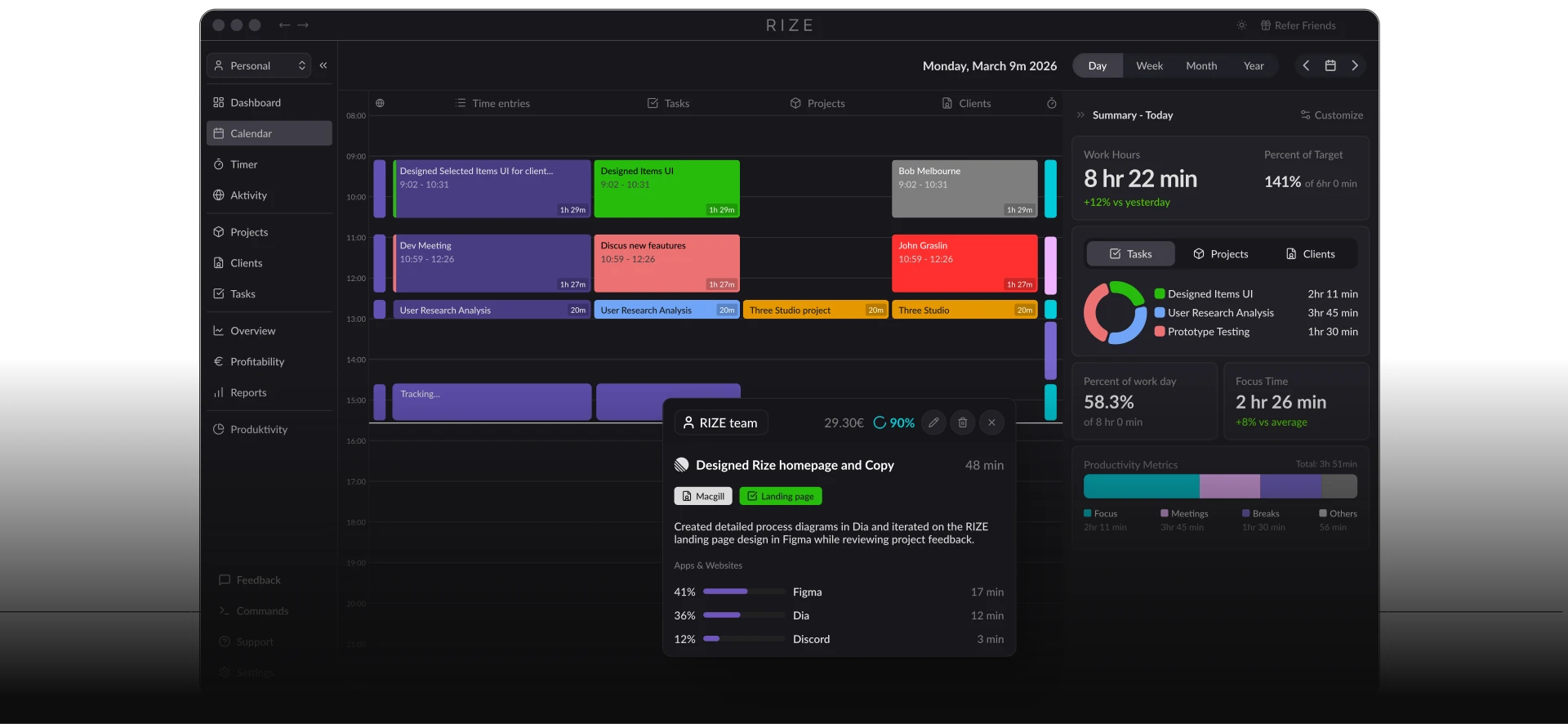
Rize product interface. Image source: Rize.
The time record is already a product that customers have continued to buy. Rize says it has served more than 20,000 paying customers since 2020 and has remained profitable since 2022. That is a cumulative paying-customer figure, not the current subscriber count and not the number of team-plan customers. Rize company overview
One Person Installs It, Then the Team Needs the Record
Impulse Lab provides a concrete adoption path.
In a customer interview published by Rize in August 2025, founder Leonard Roussard said he had used Rize to track his work as a freelancer. After he started a development company, the requirement changed. He needed to know not only how long he worked, but how much time the team spent on each client. Impulse Lab customer interview
The problem with a manual timer is not that people cannot operate it. They forget. Messages, meetings, and several projects interrupt the day, making it difficult to press a timer every time the context changes. Missing time is later reconstructed from memory.
Roussard said he names projects after GitHub repositories so Rize can use working context to recognize them. He also uses the records to judge the effort spent on feature work and maintenance, and to identify an expanding scope of delivery. Impulse Lab customer interview
The path is commercially important: solve one person’s administrative problem first, then support that person after they become responsible for a team. The interview confirms actual use and a change in purpose. It does not establish a paid conversion rate or prove that Rize increased the company’s profit.
AI Must Classify the Time Before the Business Can Count It
Rize begins with metadata about foreground computer activity, including application names, window titles, and URLs. It organizes activity into time blocks, then uses rules and context from calendars and task tools to suggest which client, project, or task should receive the entry. Rize time-entry suggestion documentation
The important output is not an elegant summary of the work. It is putting the half hour on the correct client record. The same browser can be used for customer research or for the agency’s internal work. A classification error flows into every calculation that follows.
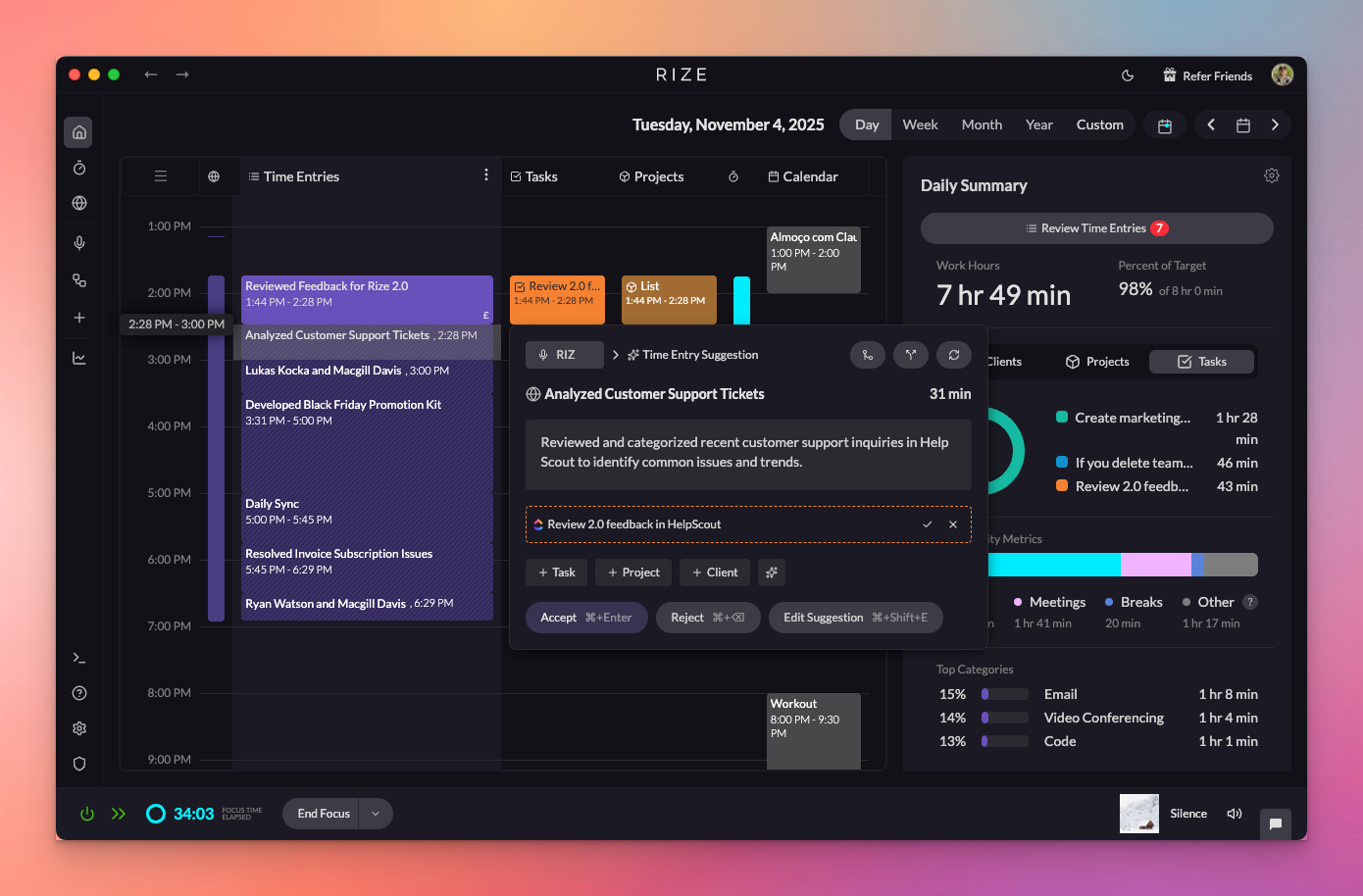
AI suggests a classification that the user can accept, reject, or edit. Image source: Rize.
Rize therefore provides confidence thresholds and can automatically approve suggestions. Its documentation recommends establishing the client and project structure first, reviewing early entries, and increasing automation gradually. Rize time-entry suggestion documentation
This introduces a fact that is less attractive in marketing but essential in deployment: installing the software does not immediately produce trustworthy operating data. Inconsistent client names and missing task context do not repair themselves merely because AI has been added.
The Same Contract Can Produce Different Profit Depending on the Hours
Rize’s profitability feature connects four inputs: recorded time, client contracts, team-member costs, and project expenses. A contract may bill hourly, use a fixed recurring retainer, or combine both methods. Rize profitability feature
Each pricing model creates a different question for the time record:
| Billing model | What the time record should reveal |
|---|---|
| Hourly billing | Which completed work has not entered a billable record? |
| Fixed retainer | How much margin did additional work consume while revenue stayed fixed? |
| Hybrid billing | Which work belongs inside the base service and which work should be billed separately? |
Suppose a fixed-fee service was planned for 20 hours but consumed 40. This is a hypothetical example that explains the mechanism, not a reported Rize customer result. Even when the client pays on schedule, the additional 20 hours do not automatically create more revenue.
Without client-level time, an owner may reach the end of the month knowing that everyone was busy but not knowing which engagement absorbed the extra work. Assigning the effort creates evidence for the next price discussion, a limit on revision rounds, or a revised statement of work. That is the difference between recording time and managing the economics of delivery.
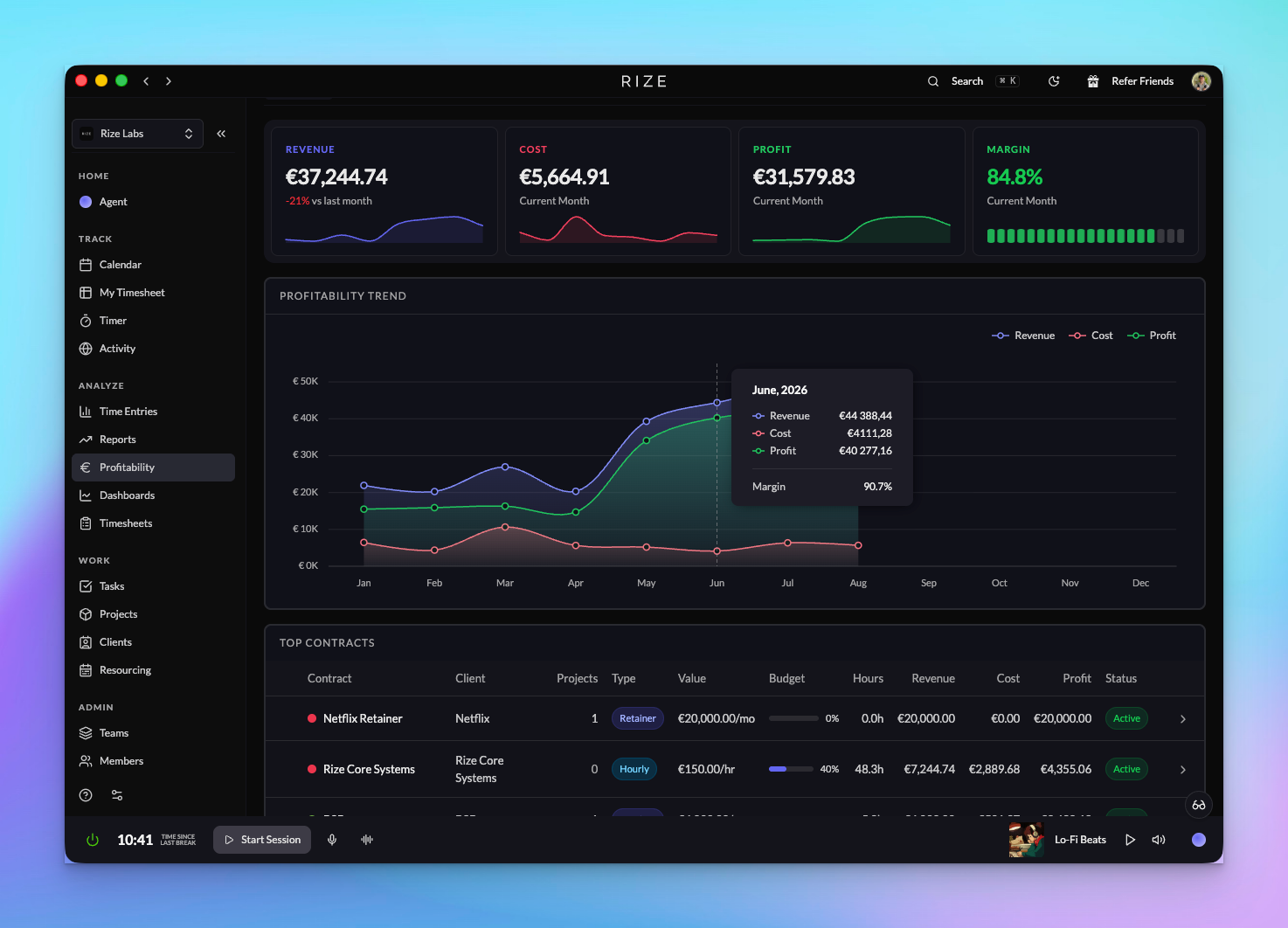
Official product example; the displayed amounts do not represent Rize revenue or a verified customer outcome.
The profitability shown by the software still depends on complete contracts, cost rates, and expenses. It is not an audited profit-and-loss statement and does not mean that cash has arrived in a bank account. Rize profitability feature
From $9.99 per Month to $29.99 per Seat
As of October 14, 2026, Rize’s pricing page says it was last updated on October 12. The personal Basic plan works out to $9.99 per month on annual billing. The team plan costs $29.99 per seat per month when billed annually, with a minimum of two seats, or $39.99 per seat on monthly billing. A seven-day trial does not require a credit card. Rize pricing, AI usage, and privacy terms
The price difference reflects a different purchase. An individual pays to avoid manual timekeeping and understand personal focus. A team owner evaluates whether a more complete view of project effort and economics is worth the higher per-seat cost.
That does not prove that Rize has converted all personal users into team customers. The Impulse Lab account and the team-product expansion do show the budget the company is pursuing as users move into responsibility for other people: the product is no longer only for the person performing work; it is also for the person accountable for delivery.
AI usage creates another pricing boundary. Current plans include different numbers of AI credits for chat, reports, and automations. When the credits run out, AI features pause while basic time tracking continues. Rize pricing, AI usage, and privacy terms
The design separates continuous activity capture from incremental model consumption. The user’s record does not stop because an AI allowance has been exhausted, and the vendor does not have to promise unlimited model usage.
Creating an Invoice Is Not the Same as Collecting Payment
Rize can use time entries for a selected client and date range to generate invoice details. After review, the user can export a PDF, send it, and record full or partial payment. The product does not currently process card payments directly; its own release notes direct that need to other tools. Rize invoicing feature
That boundary clarifies the product strategy. Rize first makes the work record useful for pricing reviews and invoicing instead of attempting to become a complete financial system immediately.
A team deployment still depends on trust. Default activity metadata should not be confused with the optional Screen Text feature, which requires authorization from the individual user. The pricing page also describes access restrictions around this capability. Rize pricing, AI usage, and privacy terms
If employees believe the product is simply a new way for a manager to watch their screens, even a complete profitability dashboard may not produce reliable participation.
Rize’s team page emphasizes reviewed time before sharing, while the detailed settings also allow automatic approval. Rize team product Rize time-entry suggestion documentation A manager should explain which permissions are active and which records are shared before deployment rather than after an employee discovers them.
Rize’s expansion is worth examining not because it added another AI button, but because it moves data that began as a personal productivity record into discussions about contracts and cost.
Public evidence still does not show how much new revenue or renewal improvement the team plan has created. The stronger commercial insight is more specific: service teams rarely lack a feeling for how busy they are; they lack records credible enough to support decisions about price, scope, and cost. Automatic capture is only the beginning. Whether the record becomes a trustworthy decision input determines whether a team will keep paying.