
Having someone in your contacts does not mean you will remember whom to call the next time you need help. If the contact details already exist, why pay to manage relationships? That is the business Mesh is building. It gathers people from email, calendars, and social platforms, preserves the context of the last interaction, and reminds the user when it may be time to reconnect. Mesh product website
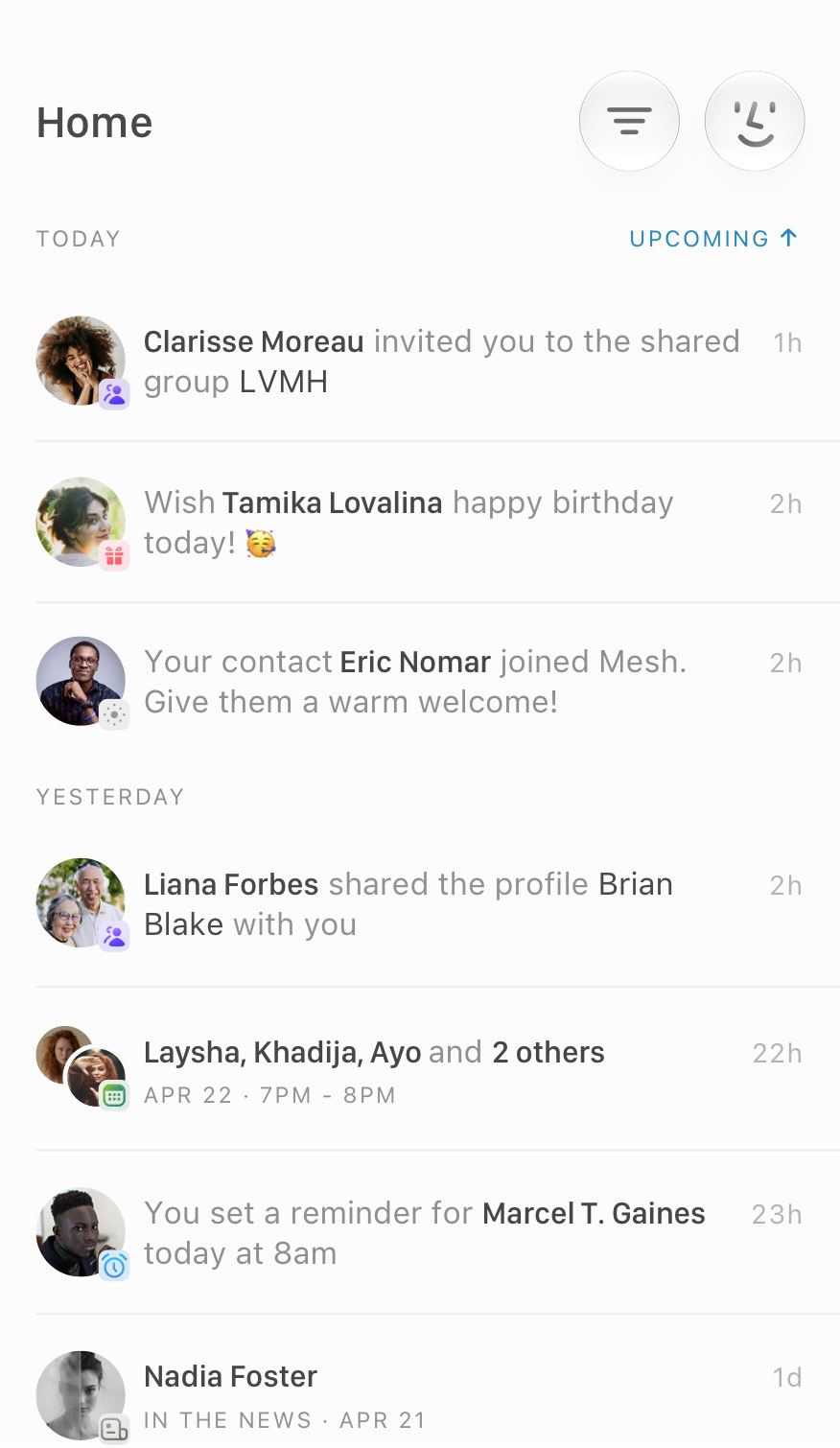
Mesh mobile interface. Image source: Mesh.
For Chinese readers, WeChat is a useful comparison because so many relationships live inside it. That does not mean Mesh synchronizes WeChat. The product focuses on relationships distributed across email, calendars, LinkedIn, and similar tools.
In June 2025, Automattic, the company behind WordPress.com, acquired the product. It was then called Clay and has since been renamed Mesh. Its value is not the number of phone numbers it can store. The opportunity lies in people whose details are already stored but whose relationship context has faded. Automattic acquisition announcement
A Contact in Your Phone Is Not the Same as Remembering the Person
You may remember meeting a healthcare investor at dinner but not remember the name. You may know that a former colleague changed jobs but postpone sending a note for months. You may need an introduction to a customer without knowing which friend already knows that person.
A conventional address book cannot answer those questions. The missing information is not the phone number. It is the history around the relationship.
Mesh puts that history on a contact record: how the two people met, where the contact works, when they last interacted, and which notes the user saved. Its home screen then surfaces birthdays, job changes, news mentions, and reminders. The user does not always have to remember a person before searching for them; the app can put a relationship back in view. Mesh product website
This is a personal CRM, or personal relationship management system. Unlike a sales CRM, it does not require an expected deal value for every person, and it does not assume that every relationship must become a transaction.
The business is not purely about friendship, however. A founder told TechCrunch that about 70 percent of customers use Mesh for some form of business activity. That is a founder-reported usage mix, not a percentage of paid accounts. TechCrunch founder interview
For a casual user, forgetting to send a message may be a missed social moment. For consultants, investors, recruiters, and founders who depend on referrals and accumulated trust, a neglected relationship may also mean a lost opportunity. That group has a clearer reason to pay for continuing maintenance.
The Real Competitor Is the Work Users Will Not Keep Doing
Building a contact spreadsheet is easy. Opening it after every meeting and email to update the record is not.
If a personal CRM merely makes the spreadsheet prettier, the user still performs the same maintenance.
In September 2025, Mesh introduced a Gmail sidebar. While reading a message, a user can see the profiles, employment history, interactions, and notes associated with people on the thread. A new contact can be added, annotated, and grouped without switching back to another app. Mesh Gmail sidebar update
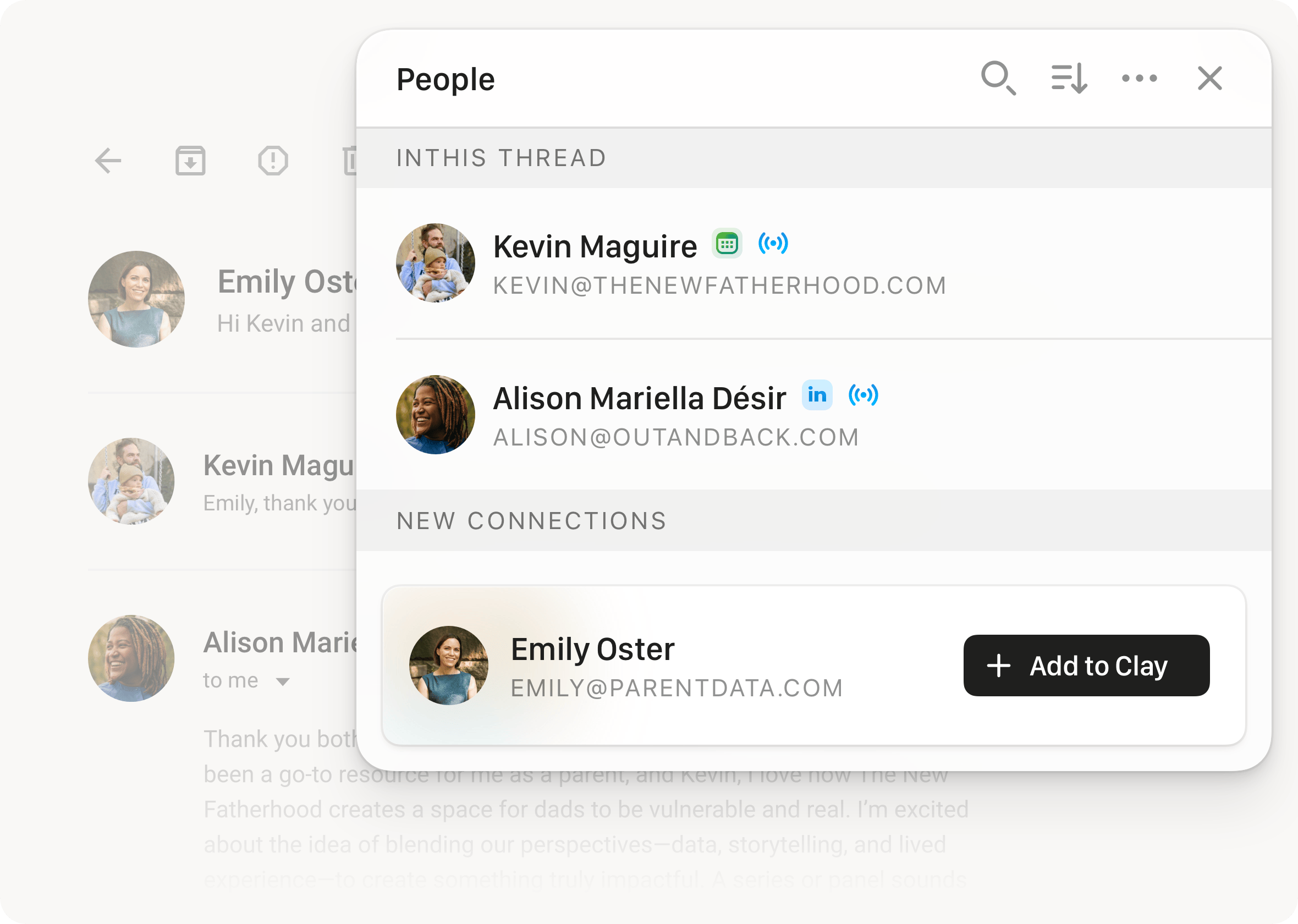
The Gmail sidebar still carries the former Clay name. Image source: Mesh.
In January 2026, the Nexus AI assistant moved further into action. In Mesh’s example, a user can say that a meeting with Bob went well and ask for a follow-up reminder in three weeks. Nexus finds the contact, adds the note, and creates the reminder. The update also supports contact changes, group management, duplicate detection, and web research with sources. Nexus 4.0 update
That is more consequential than drafting a polite message: it turns one conversation directly into the next action.
A photo-library feature released in March follows the same logic. It matches faces in the user’s photo library to people in the relationship network, helping reconstruct where encounters happened. Mesh says the scan runs on the device, and users can restrict the photo range, pause it, or stop it. Photo-library feature
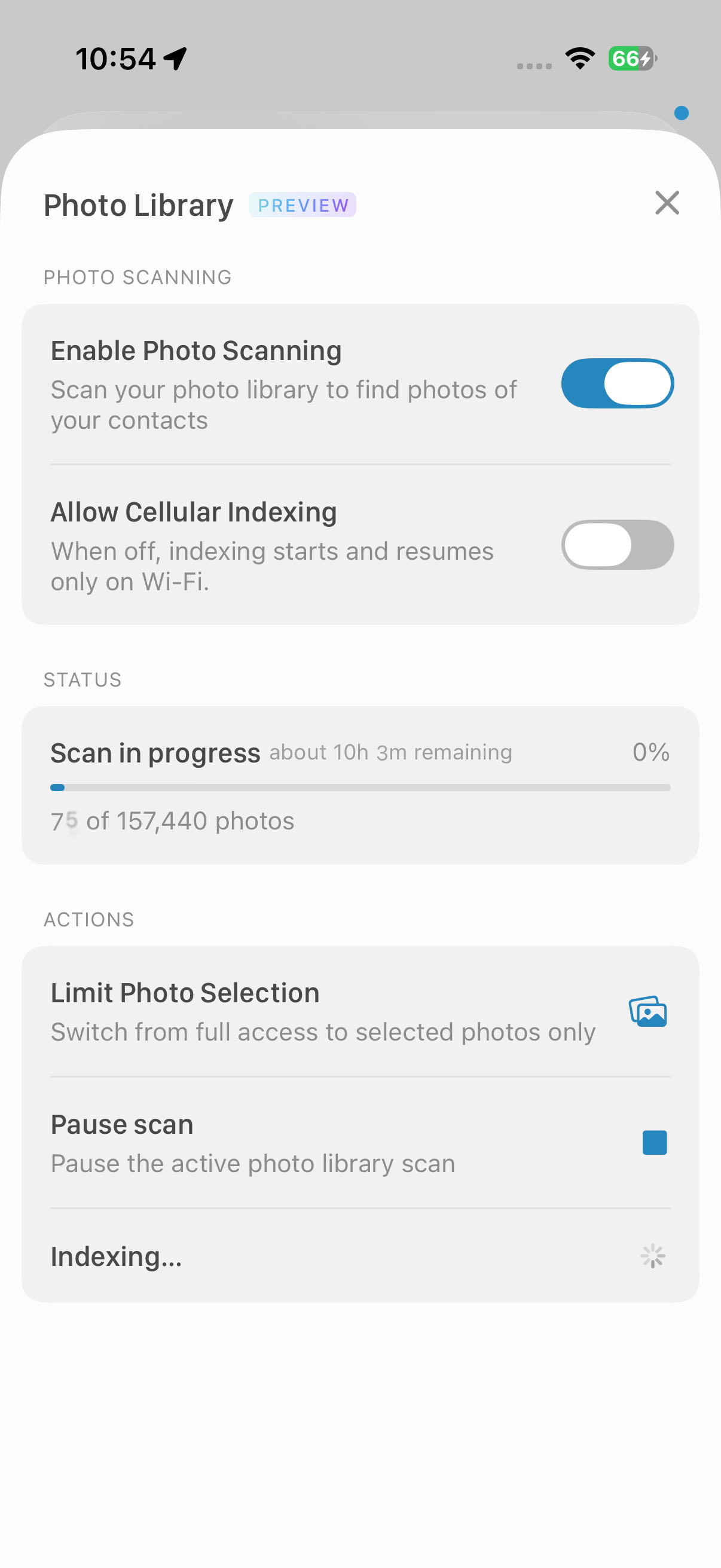
Preview controls can limit or pause indexing. Image source: Mesh.
Email already contains a record of communication, and a photo library already contains traces of meetings. Mesh is trying to remove duplicate entry rather than create another habit that depends on users filling in fields every day.
Payment Begins With Network Size and Collaboration
Mesh’s free plan supports as many as 1,000 contacts, along with search, groups, contact reminders, birthday notifications, and people updates. On the annual billing view, Pro works out to $10 per month and adds unlimited contacts, spreadsheet imports, and priority data refreshes. Team works out to $40 per seat per month and adds team members, enhanced enrichment, and administrative controls. Mesh pricing and trial terms
The paywall does not ask people to pay merely to remember a birthday. It lets them establish the habit first, then charges when the network exceeds the free limit or colleagues need to manage relationships together.
| Tier | Core need | Reason to pay |
|---|---|---|
| Free personal plan | Maintain a bounded personal network | Search, record context, and receive reminders |
| Pro | Manage more contacts whose data changes | Capacity, importing, and faster refreshes |
| Team | Help colleagues understand who knows whom | Shared relationships and permission controls |
Moving from one person’s address book to a team that can find a path to an introduction also changes the budget. The first plan competes for a personal subscription. The second can compete for company software spending.
Shared access does not mean that every detail becomes public. Mesh offers visibility controls such as hiding email subjects or calendar-event titles. For this type of product, the decision about what colleagues can see is not a secondary setting. It determines whether a team is willing to connect its accounts at all. Mesh for Teams
The free entry point still has friction. Mesh says new users begin with a 14-day Pro trial that requires a credit card, and they can downgrade to the personal plan in settings. Free availability therefore does not eliminate the subscription decision. Mesh pricing and trial terms
Personal CRMs Do Not All Sell the Same Workflow
Products with contacts and reminders can still ask users to do very different work.
| Product | Product emphasis | What it asks from the user |
|---|---|---|
| Mesh | Multi-source relationship data, people updates, AI actions, and team sharing | Connect accounts and let the system maintain context |
| Dex | LinkedIn and tool syncing, contact cadence, voice input, and meeting-note integration | Place it inside a professional relationship workflow |
| Covve | Mobile relationship notes, reconnection reminders, and conversation prompts | Keep recording and following important relationships |
| Mogul | People and interaction records, with reminders and custom fields in paid plans | Deliberately choose and maintain records |
This comparison uses current official feature descriptions, not a hands-on ranking of all four apps. Dex 2026 changelog Covve personal CRM Mogul pricing
In September 2026, Dex added voice operation and Granola meeting-note synchronization. Notes attach to attendees and update interaction dates and contact reminders. Dex is also trying to reduce the work that follows a meeting instead of merely adding a chat window. Dex 2026 changelog
Mesh is therefore not the only personal CRM using AI. Its distinctive commercial position is that it is simultaneously building a personal memory, a shared relationship layer for teams, and entry points across other tools.
Automattic Bought More Than Another App
When Clay became Mesh in March 2026, the company said it was hosting more than 170 million relationships. That is a count of relationship records, not 170 million users and not a subscriber count. The renaming announcement also distinguishes Mesh from Clay.com, the unrelated sales-data product. Mesh renaming announcement
Automattic’s acquisition announcement makes the strategic direction explicit. The Clay team joined the Other Bets division alongside Beeper and Gravatar to explore connections between relationship management and messaging. Automattic acquisition announcement
Beeper organizes messaging, Gravatar represents identity, and Mesh organizes relationships. The portfolio logic is broader than another subscription app: products that previously recognized only an account may gain context about what a person means to the user. That is an interpretation of the portfolio, not evidence that the products have already been fully integrated.
Mesh is also opening access to assistants that users already operate elsewhere. The Nexus update introduced an MCP connection for assistants including Claude and ChatGPT. An October 7 API migration notice then described read-only and read-write permissions plus rules for duplicate contacts. Nexus 4.0 update API and integration migration notice
The AI interaction may happen in another tool while the relationship data remains in Mesh. For a subscription product, that is a notable choice: the company does not require every task to return to its own interface, as long as the maintained relationship layer becomes useful in more workflows.
The Product Still Has to Remember Accurately
Two App Store excerpts show both sides of the proposition. In a September 23, 2024 renewal review, CoreyPud wrote:
“you are excited to pay it because of the value that it brings to you.”
Another reviewer, Feed My Cat, complained about contact notes and the Nexus interface, concluding:
“$120 down the drain.”
These excerpts express one willingness to renew and one disappointment with an annual payment. Individual reviews do not represent overall product performance or prove that the reported problems remain in the current version. Mesh App Store reviews
No matter how capable the AI becomes, missing notes, duplicate contacts, or inaccurate reminders can send a user back to the system address book.
Mesh’s privacy documentation also sets boundaries. Its email integration reads message headers rather than message bodies, and its messaging integrations calculate interaction statistics rather than importing chat text. AI features are optional; the company says data may be processed through its servers and third-party partners but is not used for model training. Mesh privacy and AI data policy
Mesh is not a magic box that secretly reads every conversation and automatically understands every relationship. It has to work reliably with the information users choose to provide. The more important the relationship, the less that reliability can be replaced by a promise that AI will remember.