
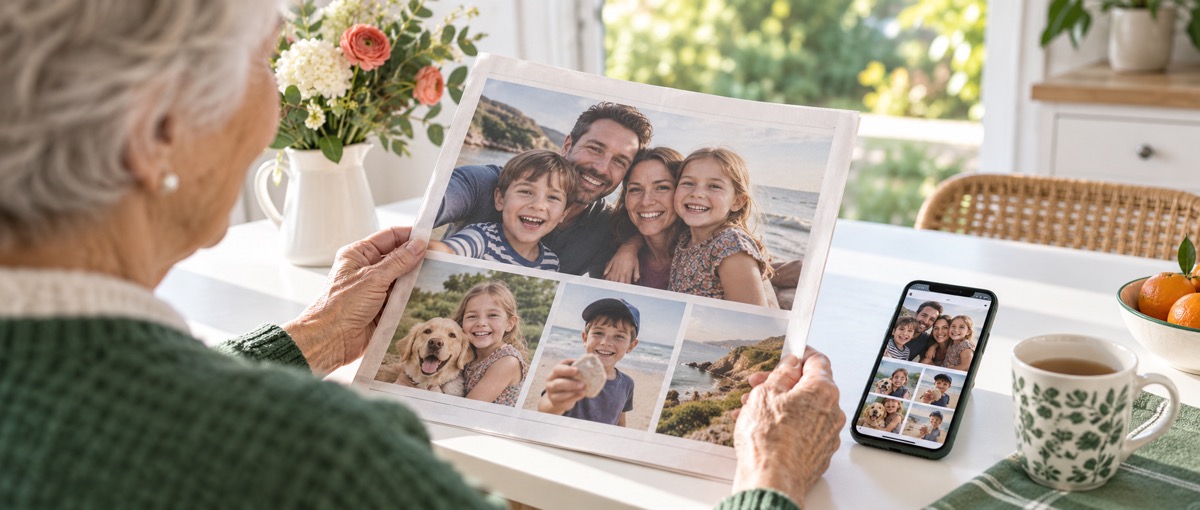
The tablet bought for a grandmother ended up inside a cabinet.
Tanguy de Gelis’s family thought they had solved the problem. Cousins shared photographs in a WhatsApp group, but their grandmother was absent, so a tablet should have brought her back into the conversation. During a later visit, he discovered that she had not used it. She had been reluctant to tell the family that what she missed were the letters and postcards she used to receive. De Gelis retold the experience in a 2026 interview with French radio station Hit West. The interview is available in Hit West’s profile of Famileo.
Famileo emerged from that mismatch. Children and grandchildren continue uploading photos and writing short updates on their phones, while the older relative receives a printed family newspaper. There is no app to download and no password to remember. The recipient only has to open an envelope. Famileo shows the format in its newspaper examples.
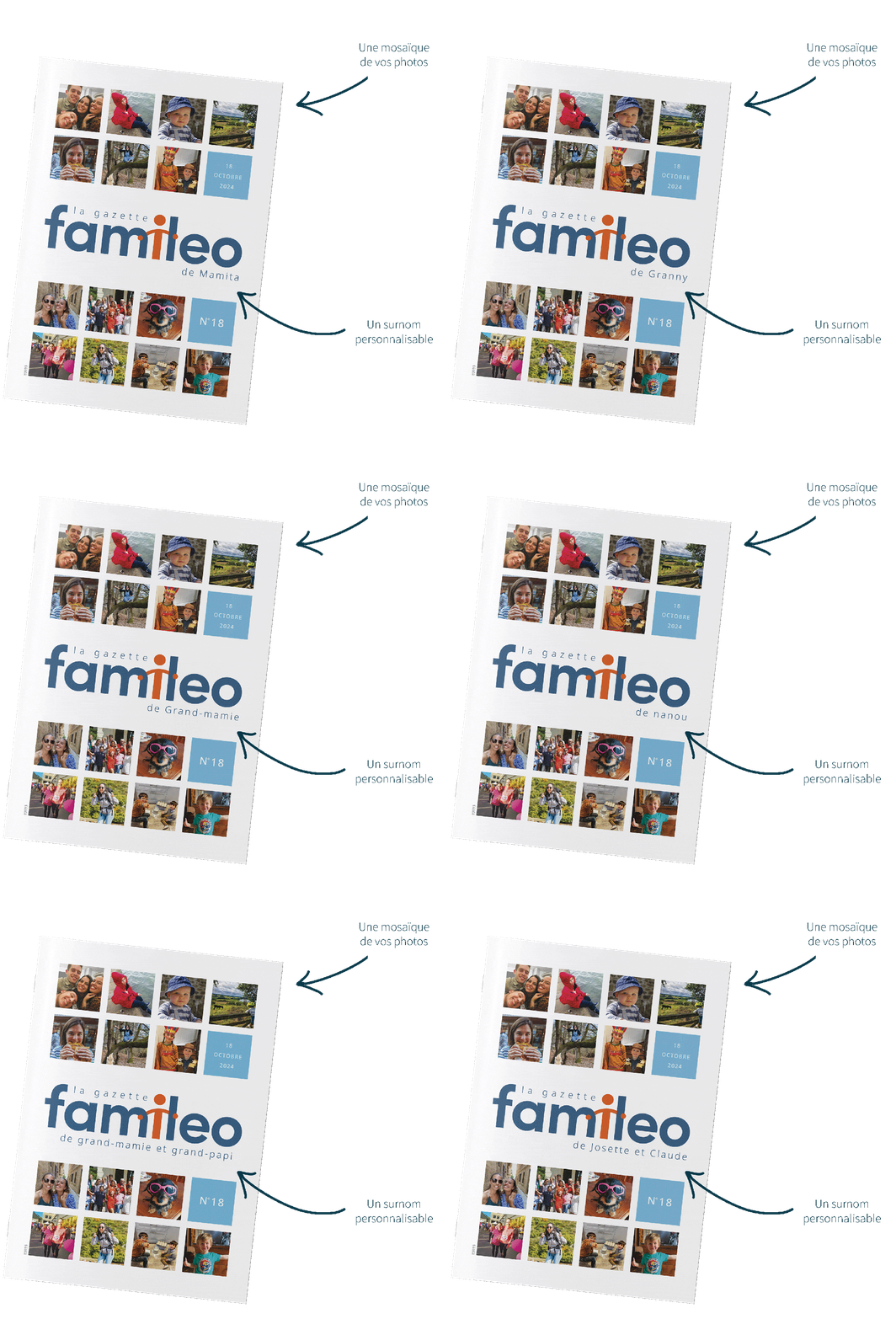
Image source: Famileo. Families can use a personal photograph and the recipient’s name on the cover.
This is no longer a souvenir service for a small group. Hit West reported in February 2026 that 260,000 families subscribed. Yet Famileo did not invent a new category of family content. It collects the same small moments people already share for free in group chats. The subscriber figure comes from the same Hit West report.
If the family group chat is free, why will people pay for the newspaper?
The Payer Uses a Phone; the Recipient Does Not Have To
Famileo does not require every family member to learn the same communication tool. One person starts the subscription. Other relatives join free with a family invitation code, then upload photographs and write short updates from their own devices. As many as 60 people can join one family account, and contributors can add money to a shared family wallet to divide the cost. Those rules appear in Famileo’s help center.
The product serves three different roles: the person who opens and manages the subscription, the relatives who supply the content, and the older person who receives the paper. Treating all three as conventional app users would make the service harder to use.
Younger relatives do not have to take turns laying out pages. The recipient does not have to cross the smartphone barrier. Famileo handles the work that neither side wants to own.
The newspaper also does not simply reproduce a social feed. It uses A4 paper, large photographs, readable type, full-page images or half-page combinations of text and photography. The back page can list upcoming family birthdays. The design is made to be held and turned, not scrolled with a thumb. Famileo presents those choices in its format guide.
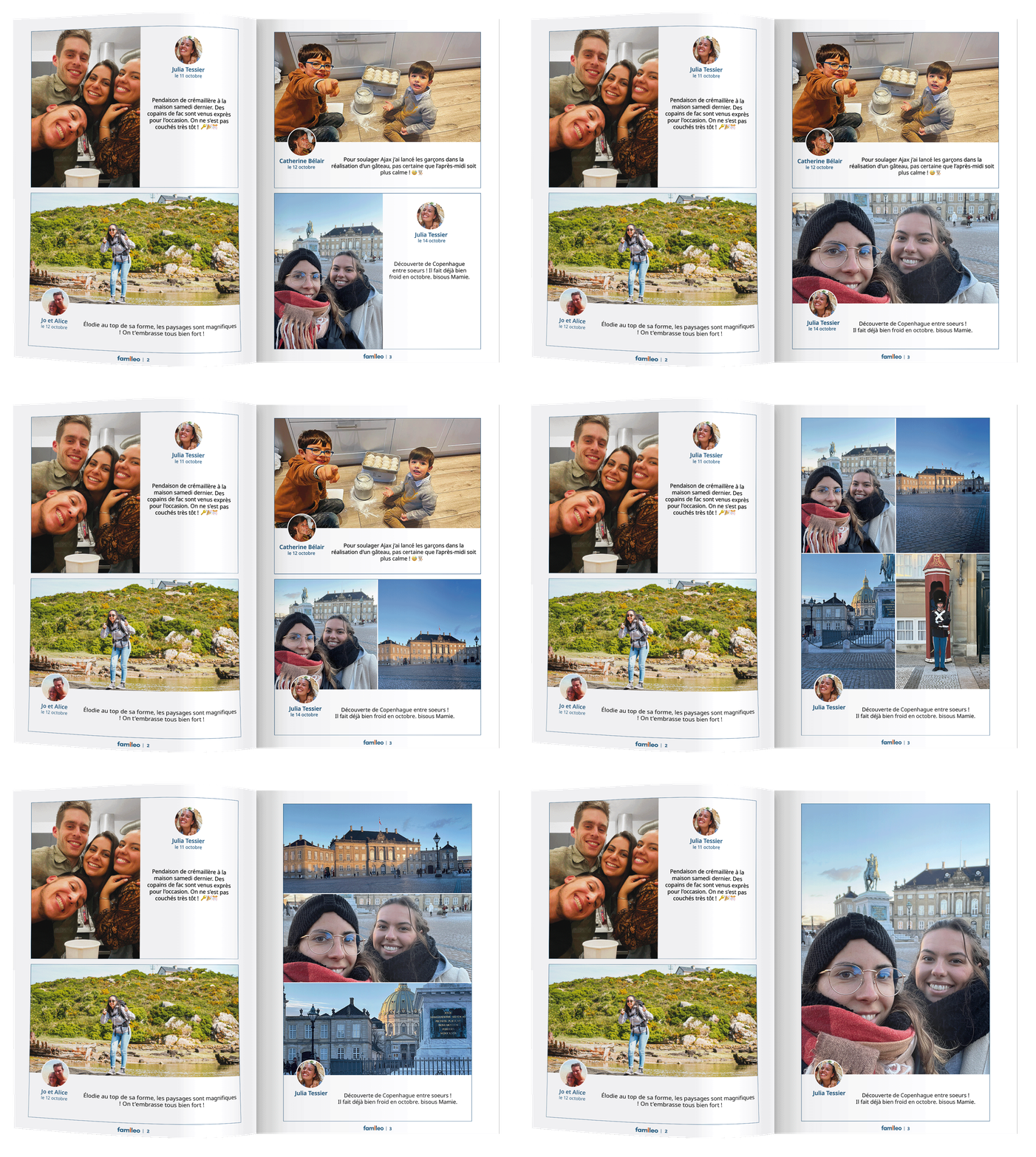
Image source: Famileo. Each update retains the photograph, text, author, and date.
The convenience does not come from replacing paper with a screen. It comes from allowing the same family life to exist in two forms.
It Sells the Next Issue, Not One Photograph
As of October 7, 2026, Famileo’s main French subscription prices were as follows. These are euro prices for France and should not be mixed with the company’s UK or US offers. The current plans appear on Famileo’s French website.
| Plan | Updates allowed per issue | Monthly price |
|---|---|---|
| One issue per month | 20 | EUR 5.99 |
| One issue per month | 28 | EUR 6.99 |
| One issue per month | 36 | EUR 7.99 |
| Two issues per month | 28 per issue | EUR 10.99 |
The differences answer two direct questions: how much news the family wants to include, and how often the recipient should receive it. The plans do not charge each contributor for a membership or unlock a series of editing controls.
Someone travels, a child has a birthday, or a relative photographs an ordinary meal. Printing those pictures separately requires one person to remember, choose, arrange, and send them. A subscription tells the whole family that another issue is approaching.
In a January 2025 Reddit post, one user said the family had subscribed for a grandmother for several years. After the grandmother died, they planned to cancel, but they did not want to lose the habit of sharing updates across the family. An ordinary chat group felt different: without an issue to fill, many small parts of daily life would never be posted. This is one user’s account, but it explains a specific reason the subscription can persist. The discussion appears in the user’s Famileo replacement question.
Paper gives each message a destination, while the publication schedule gives sharing a deadline.
The same story also exposes a natural limit. This is not a subscription that can continue forever by assumption. When the recipient’s life changes, the family’s reason for using it may disappear. A real family relationship should not be converted directly into a permanent retention forecast.
The First Customers Were Not Families Scattered Across the Internet
When Famileo launched in 2015, it sold first to care homes rather than billing individual households.
In a 2025 interview with Le Journal du Dimanche, a co-founder said the team spent six months meeting care-home directors and eventually entered hundreds of facilities. Families then began asking when a second grandmother who still lived at home could receive the same service. The consumer version grew from a visible request rather than an imagined second market. The history is described in Le Journal du Dimanche’s Famileo profile.
Both offers produce newspapers, but payment and delivery work differently.
| Setting | Who pays | How delivery works |
|---|---|---|
| Older relative living at home | A family subscription, which relatives can fund together | Famileo prints the newspaper and mails it to the home |
| Older relative living in a partner care home | The institution purchases the service; relatives participate free | The institution receives the newspaper file, then prints and distributes it locally |
The institutional product is not merely a bulk consumer subscription. Famileo’s UK website lists pricing from GBP 55 per month for a facility with up to 50 residents, with a six-month commitment. The service also includes onboarding and materials for communicating with families. The offer is described on the Famileo Pro pricing page.
One care provider has documented the workflow publicly. In November 2025, LV Care Group said it was offering Famileo to residents. Relatives share updates through a phone, tablet, or computer; the resident receives a personal newspaper every two weeks; and relatives can also receive news and photographs from the home. This confirms a concrete use of the service, but it does not disclose contract value or renewal. LV Care Group explains the rollout in its Famileo introduction.
The institution is buying more than a printable file. Residents hear from their families, while relatives can see parts of life inside the facility. For Famileo, one care home can introduce the product to many households without persuading each family from the beginning.
The facility still needs someone to print and distribute the papers, and it must encourage relatives to keep uploading. Signing a care home does not guarantee that every resident starts using the service.
A Year of Content Can Be Sold Again
Beyond the monthly newspaper, Famileo sells an annual album. It binds previously published family newspapers into a book, with choices for size, cover material, and date range. The website currently displays a 2025 annual edition. Famileo presents the product on its annual album page.
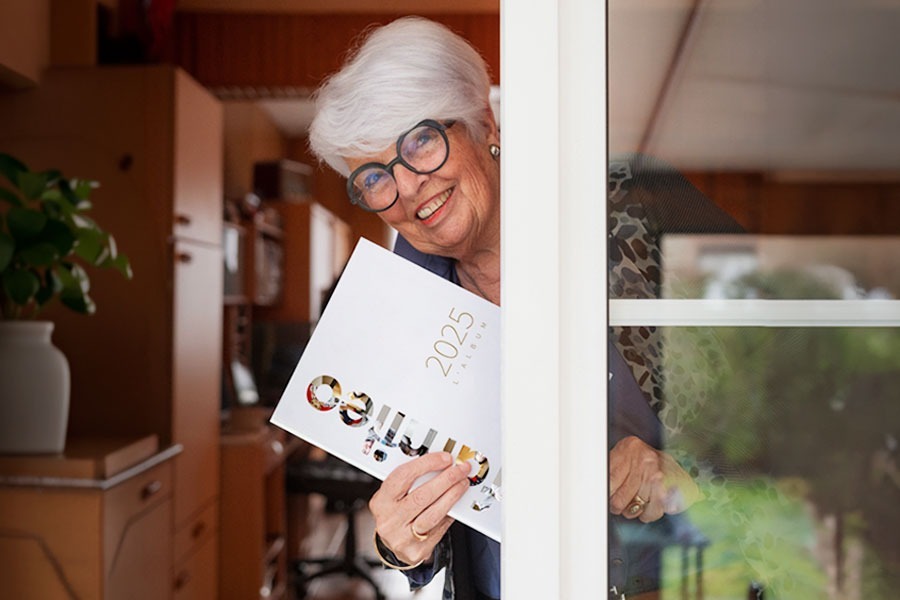
Image source: Famileo.
Conventional photo-book products first have to solve the problem of who will organize the pictures. Famileo users have already completed that work over the year. The photographs were selected, captions were written, and the chronology was preserved. The album does not ask a family to begin another large project. It binds the result of continued use.
That creates a specific add-on path: each issue accumulates material, and the year’s material becomes a keepsake the family can purchase. Public sources do not disclose how many households buy the album or how much revenue it contributes.
Paper Generates Revenue and Real Costs
Scale cannot be measured only by the number of people inside the app.
In February 2025, a co-founder told Le Journal du Dimanche that approximately 260,000 older people received the newspaper, about 1.8 million people participated through the app or website, and the company generated roughly EUR 15 million in revenue. These are interview figures reported by the publication, not audited financial statements reviewed for this article. The 1.8 million participants should not be described as paying users. The figures appear in the same Le Journal du Dimanche profile.
In a 2026 republication, the French graphic-communications association CCFI cited Famileo’s reported 2024 revenue of EUR 14 million and more than 200,000 customer families. The sources refer to different periods and different populations, so they should not be combined into a precise growth curve. The figures are discussed in CCFI’s article on paper-based consumer startups.
The same report highlights the cost side. Famileo reportedly compressed its margin to absorb increases in paper prices and preserve a low consumer price. Every additional newspaper carries printing and delivery costs. This is not a software subscription where another account costs almost nothing to serve. CCFI discusses the effect of paper prices in the same report.
That makes seemingly modest product rules commercially important: limits on the number of updates, fixed publication schedules, and local printing inside care homes. They shape the customer experience, but they also determine whether the service can be delivered economically.
Famileo is worth studying not because paper is always better than a screen, but because it does not require the newspaper’s recipient to become a skilled app user. Relatives share from their phones, an older family member opens an envelope, and the company performs the work between them.
The tablet placed in the cabinet failed to bring one grandmother into the family group. The newspaper that arrived later did not require her to join any group at all.