

In March 2025, Freed raised a $30 million Series A. The more useful signal was in Sequoia’s description of the business: Freed was already serving more than 17,000 clinicians across nearly 100 specialties, with an emphasis on doctors in small and midsize practices. Sequoia described the clinicians and specialties using Freed.
Healthcare software usually enters through a hospital procurement process. Freed took a different route. It first gave one clinician a product that could be tried and purchased without waiting for a large institution to approve a project.
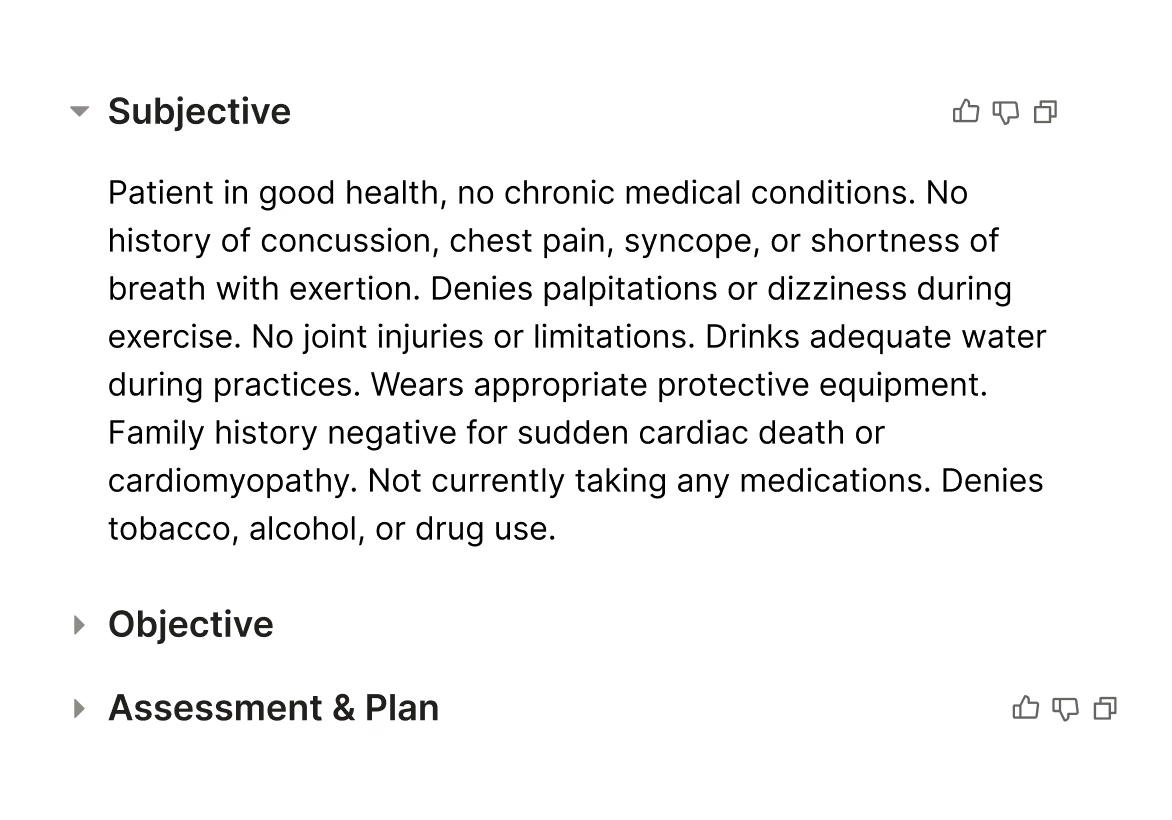
The product listens during a visit and drafts the clinical note. It applies specialty templates, recognizes medical terminology, and uses the clinician’s edits to shape later output. VentureBeat described Freed’s note-generation and personalization workflow.
That changes the buying decision. Freed is not asking a hospital to add transcription to a system-wide technology program. It is asking an individual doctor whether avoiding another evening of unfinished notes is worth a monthly subscription.
One Clinician Buys First, Then The Practice Follows
In 2025, Freed told VentureBeat that its individual plan cost $90 per month, while teams of two to nine paid $84 per clinician per month after a seven-day trial. Those prices may have changed since the report, but they show the original transaction design. The product was expensive enough to represent a real purchase and inexpensive enough for one clinician to test without an enterprise budget.
Sacra estimated that Freed entered through a $99-per-month self-service subscription and expanded through team upgrades, sales assistance, and electronic health record integrations. It also noted that nearly half of small US medical practices have fewer than ten physicians. Sacra analyzed Freed’s self-service entry and practice expansion model.
This explains why the company did not need to begin with a major hospital deployment. A small practice may lack a dedicated IT team, but that makes a tool requiring no formal implementation project more valuable, not less.
By July 2025, Freed said it had 20,000 paying clinicians, processed nearly three million patient visits per month, and was used by more than 1,000 organizations, mostly practices with one to 50 clinicians. VentureBeat reported the company-supplied adoption figures and pricing.
Those figures were disclosed by the company and are not audited. Still, paying users, organization count, monthly visit volume, and team pricing describe different parts of the same expansion path. Freed was no longer only a personal productivity tool. Individual adoption was becoming a route into practice-level purchasing.
Expand From The Note Into Adjacent Jobs
Freed’s current site presents clinical notes alongside coding assistance, clinical evidence, and a front-desk product that starts at $149 per month. Freed lists its product areas and public starting price.
The sequence matters. The company did not begin by claiming to be a complete operating system for a clinic. It first won trust inside a daily clinical workflow. Once a clinician relied on the note, Freed could move one step downstream into coding and one step outward into patient calls and information handling.
This is a more credible expansion path than adding unrelated features to a generic assistant. The same visit context that creates a note can support a coding suggestion. The same practice relationship can support EHR integration. The same clinic that pays to reduce documentation work may also pay to reduce front-desk call load.
The buyer can expand too. The first transaction belongs to one clinician. A team plan introduces a practice administrator or physician owner. Integrations and adjacent workflows create reasons for the organization to standardize the product across more staff.
The Defensible Product Is Not Transcription
Clinical notes cannot enter the medical record without review. Freed says its product supports more than 30 specialties, reaches 98 percent medical terminology recall, and transcribed more than 32.58 million patient visits in 2025. Those are company-reported figures and should not be treated as an independent clinical validation. Freed publishes its specialty, terminology, and usage claims on its website.
Competition also pushes the base capability toward a lower price. VentureBeat noted that Doximity had introduced a free ambient documentation tool. If raw speech-to-text becomes free or bundled, a paid scribe cannot defend itself by producing a transcript alone.
Freed therefore has to protect the part that feels specific to the clinician: the structure of the note, specialty vocabulary, preferred level of detail, correction history, workflow fit, and reliable movement into the record. The useful promise is not simply that the system heard the conversation. It is that the draft looks enough like the clinician’s own work to save review time without removing professional control.
That boundary is commercially important. The clinician remains responsible for reviewing the record. The AI owns the repetitive first draft and learns from corrections. A product that makes that division explicit is easier to trial than one that asks a practice to trust an autonomous clinical decision maker.
Freed’s case offers a concrete lesson for AI products in industries with long procurement chains: identify the person who experiences the problem every day and can pay for immediate relief. Habit and proof can form at the individual level. Organizational purchasing becomes easier after the product is already present in the workflow.