

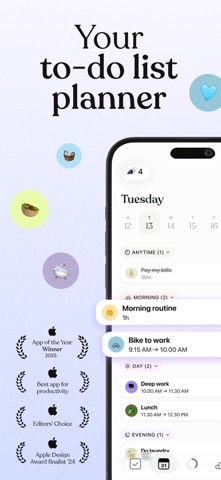
A to-do list has one predictable failure mode: it keeps getting longer until the user no longer wants to open it. Tiimo is built around that moment. The user can pour the day’s tasks into the app, and the AI does not merely answer with encouragement. It breaks work into steps, estimates how long those steps will take, and places them on a visual timeline. When the day changes, the plan can be rearranged.
That workflow helped Tiimo become Apple’s 2025 iPhone App of the Year. Inc. reported in March 2026 that the company had about 500,000 free users and about 70,000 paying users. Those figures came from the company and should not be treated as audited financial data. Still, they show that a planning problem often framed as niche can support a consumer subscription when the product sells structure rather than generic productivity advice.
Tiimo looks like a planner on the surface. The deeper job is more specific: it helps users move from “I know what I need to do” to “I know what to do next.”
The List Was Not The Hard Part
Traditional to-do apps capture tasks and leave the rest to the user. Should laundry be one task, or a sequence of finding the hamper, sorting clothes, starting the machine, and hanging things to dry? How long should each part take? What happens when a meeting at 3 p.m. collides with an errand that was supposed to happen before lunch?
None of those decisions is intellectually difficult. The problem is that they repeat all day. For people who need stronger external structure, including many neurodivergent users, those tiny planning choices can become the start of delay. The app’s value is not in proving that the user has tasks. The value is in reducing the friction between task awareness and task initiation.
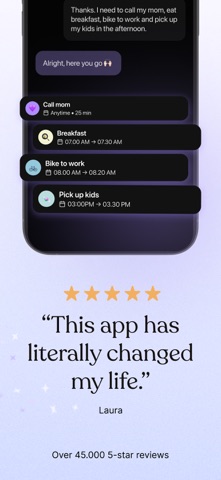
Tiimo’s AI sits at that point in the workflow. A user can do a brain dump into the co-planner. The system turns loose intentions into smaller steps, estimates duration, and places them into the day. TechRadar’s review described changing a school pickup from 15 minutes to 25 minutes and seeing Tiimo adjust the rest of the schedule. The product does not remove uncertainty from the day. It takes over the annoying act of replanning when the day becomes less orderly than the list.
AI Writes Back Into The Timeline
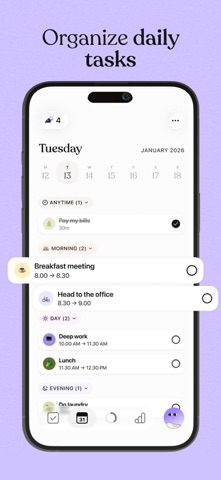
This is why Tiimo’s AI is more than a chat box at the front door. The output is written back into the execution surface: timeline, countdown, routines, reminders, focus blocks, and calendar context. The next thing the user sees is not a paragraph of advice. It is a next action that can be started or checked off.
That distinction matters for mobile AI products. A conversational interface is useful when the user’s thought is unformed. A visual timeline is useful when the user needs to execute. Tiimo uses natural language where the task is still messy, then returns the user to concrete structure when it is time to act.
Many AI productivity tools stop at “here is a plan.” Tiimo’s product shape is closer to “here is the next start point.” That may sound small, but it changes the commercial object. A one-time generated plan is easy to copy. A planning loop that catches interruptions, updates the day, and keeps prompting the next step is harder to replace with a single model response.
The Paid Layer Is Recurring Structure
The monetization follows that chain. Tiimo’s App Store page currently describes a free tier with basic planning, limited AI chat, and one profile. It also offers a seven-day trial before unlocking full Pro functionality through an annual subscription. App Store wording and regional prices can change, so the page should be read as current product packaging rather than a permanent price sheet.
Inc. reported that the premium version cost $10 per month and included unlimited AI planning, cross-device sync, and full calendar integration. That bundle is coherent because the paid value is not one clever generated answer. It is sustained external structure across the places where the user plans and executes.
Free users can feel the core loop: put a day into the system and see it arranged. Paying users buy continuity. Unlimited planning matters when the plan is not made once in the morning. Sync matters when the phone, calendar, and watch are all part of the user’s day. Calendar integration matters because real tasks compete with fixed commitments. The subscription sells the ability to keep rebuilding the plan as reality keeps changing.
The iPhone Changed The Market
Tiimo began with a sharper audience than the average productivity app. Its early focus was neurodivergent teens, where visual planning, reminders, routines, and external scaffolding are not decorative features. They address a real execution problem. The company later expanded toward adults and moved from a smartwatch-centered tool into an iPhone-first product.
That expansion is important. A watch is good at interrupting the user at the right moment. A phone is better at receiving calendar context, capturing longer inputs, rearranging plans, and showing a full-day visual timeline. The two surfaces work together. The AI can help decide what should happen next, while the mobile operating system can place that next action into notifications, widgets, calendar context, and wearable reminders.
Apple’s App of the Year recognition gave Tiimo an independent product signal and a distribution boost, but the business case should not be reduced to the award. The stronger lesson is that the iPhone made the AI planner more than a periodic chatbot. It made the plan portable, interruptible, and repeatable during the day.
The Numbers Are Useful, With Limits
The public evidence is meaningful but not complete. Inc.’s reported 500,000 free users and 70,000 paying users are company-disclosed figures, not audited metrics. They should not be converted into revenue without churn, discounts, geography, trial conversion, platform fees, and plan mix. Tiimo’s App Store page also references more than 3 million downloads globally, alongside public ratings. Download totals do not equal active users, and rating counts do not prove retention.
Even with those limits, the shape is commercially interesting. The product has a free entry point, a paid planning layer, public recognition from Apple, and a clear user pain that repeats daily. A daily planning loop gives the company more chances to prove value than a tool that waits for an occasional project.
For builders, this is the real lesson. The best consumer AI feature is not always the one that says the most. It may be the one that removes one small start cost at the exact moment the user stalls. Tiimo uses AI to decide the next step, then uses the iPhone, reminders, widgets, routines, and watch context to put that step back in front of the user. The paid product is not a smarter list. It is one less restart the user has to manage alone.