
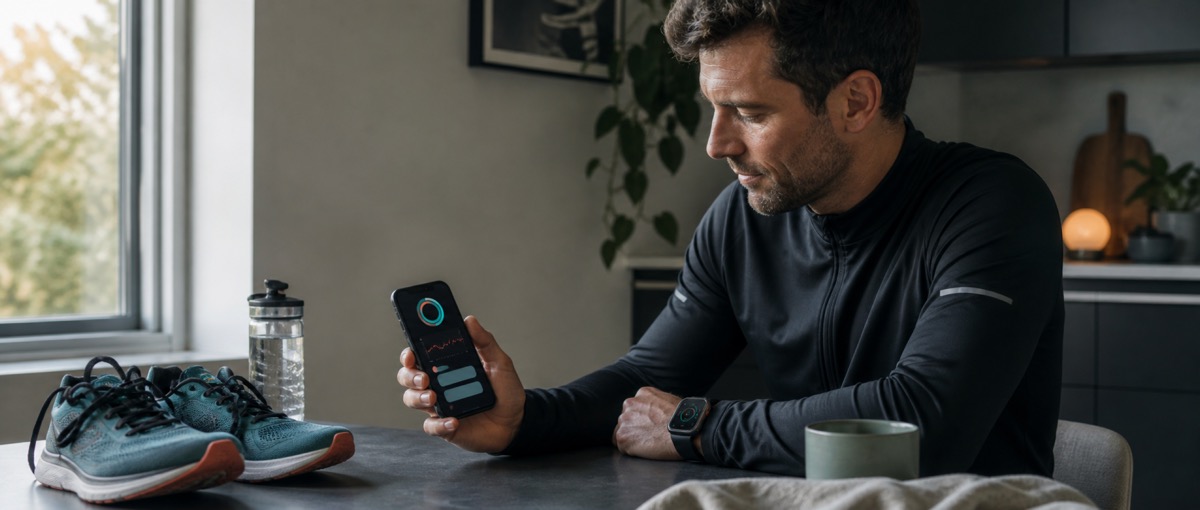
Seven hours of sleep can mean very different things depending on who is looking. One person sees a number on Apple Watch. Another sees a recovery score on a ring. A third sees a pile of disconnected trends and still does not know whether today should be a training day or a rest day.
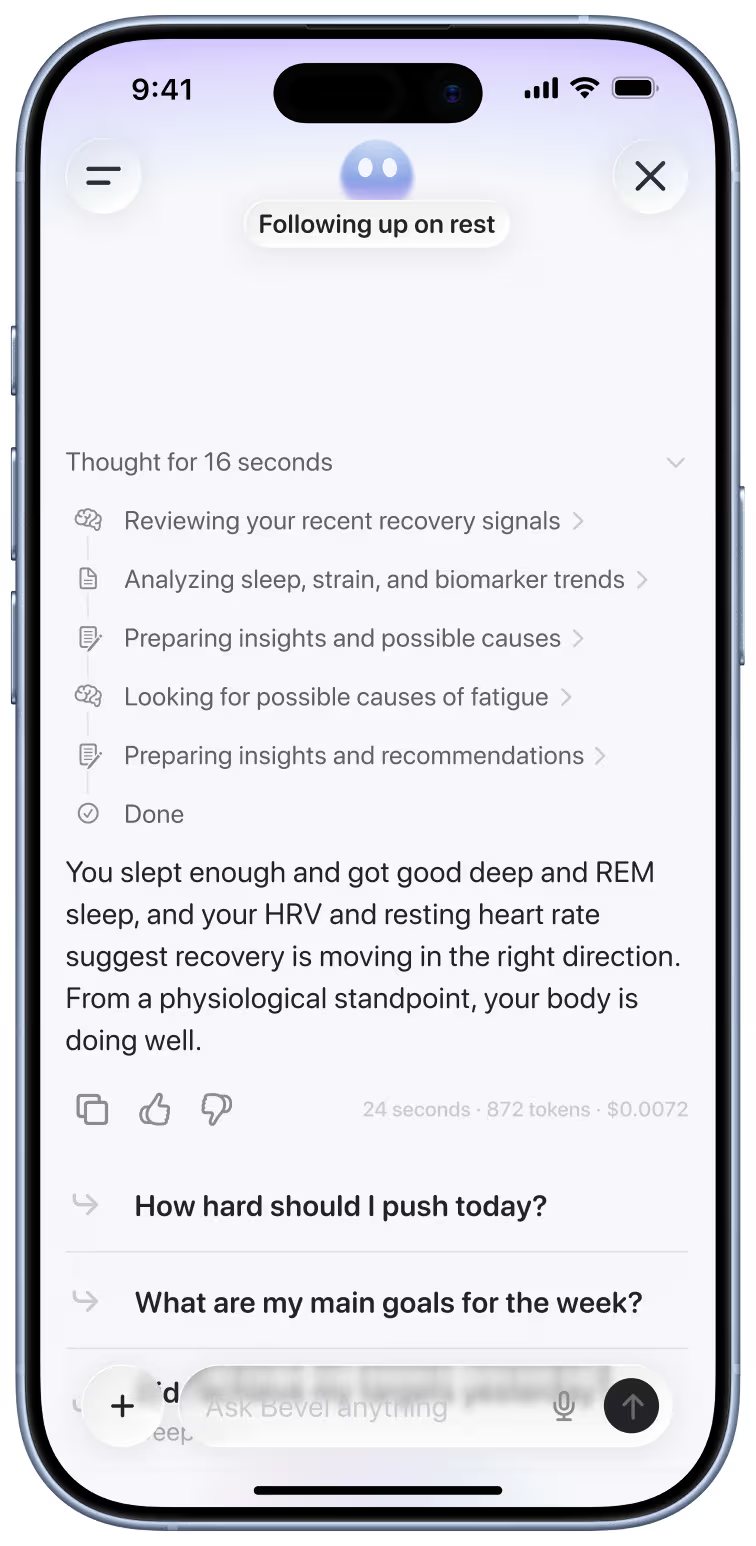
Bevel is built around that gap. The iPhone app connects to Apple Health, Apple Watch, and other wearable sources, then pulls sleep, recovery, strain, nutrition, activity, and health records into one place. Its AI layer, Bevel Intelligence, lets users ask why a recovery score fell, generate a training plan, log food conversationally, and receive proactive check-ins.
The product is not trying to sell another sensor. It is selling interpretation on top of sensors people already own. That is a sharper commercialization move than putting a subscription wall around every chart. Basic data makes the app useful. AI explanation makes it worth paying for.
The Dashboard Became The Free Layer
Bevel made a notable pricing move in late 2025. According to the company’s feature notes, after version 2.4.0 most features except Bevel Intelligence became free. Sleep, recovery, strain, nutrition, journaling, and records are exactly the kinds of modules many health apps would normally lock behind a paywall. Bevel moved much of that baseline visibility into the free experience.
Then the paid layer became more specific. Version 3.0.0 expanded Bevel Intelligence into proactive check-ins, conversational food logging, workout planning, and strength training. The user is not paying merely to see a sleep duration or activity total. The user is paying for an answer to a practical question: what do these signals mean for what I should do next?
That separation matters because health data collection has already been heavily commoditized by device makers, platform health stores, and fitness apps. A software product that tries to charge for every metric is fighting both Apple Health and the hardware vendors that generated the data in the first place. Bevel’s bet is that the more valuable layer is synthesis: connecting signals across sources and time, then turning them into a recommendation.
AI Gets Its Own Price
The App Store currently lists Bevel Pro subscriptions at $14.99 per month and $99.99 per year. It also lists separate purchases for Bevel Intelligence credits, ranging from small credit packs to larger bundles priced up to $49.99. The exact regional price and packaging can change, but the structure is visible: subscription access and AI usage are not treated as the same unit.
That is commercially important. A recovery chart can be read repeatedly at low marginal cost. A personalized AI analysis that reasons across sleep, heart rate, nutrition, training history, and follow-up questions can create additional model cost. Bevel has not publicly explained how credits map to infrastructure cost or margin. Still, by selling credits separately, it acknowledges that intensive AI interpretation is not a zero-cost bonus feature.
For consumer AI builders, this is the more realistic path. “Pro includes AI” is simple, but it hides a cost curve. If users start treating the assistant as a daily decision tool instead of an occasional novelty, usage will concentrate. A separate credit layer gives the company a way to serve heavier users without making every subscriber subsidize the most expensive behavior.
Eight Daily Opens Are A Workflow Signal
TechCrunch reported in October 2025 that Bevel said it had more than 100,000 daily active users, had grown more than eightfold over the prior year, averaged eight opens per user per day, and had more than 80% 90-day retention. Those are company-disclosed figures reported by the press, not audited third-party metrics. They should not be converted into revenue claims. But they do point to a meaningful usage shape.
Eight daily opens do not require eight intense workouts. The pattern can be much more ordinary: check recovery in the morning, log food, review stress, follow a workout, record caffeine or symptoms, and adjust sleep preparation at night. The app becomes a repeated small action inside the day.
That repeated usage is what makes the AI layer stronger. The assistant can be more relevant when it can reference yesterday’s workout, recent sleep quality, nutrition notes, and today’s heart-rate trends. The value is not just the single answer. It is the accumulating context that makes the next answer feel more personal.
This is also why Bevel’s hardware choice is notable. It does not ask the user to buy a new wearable first. It receives data from devices the user may already own, such as Apple Watch, Oura, Garmin, and other connected sources. That removes one adoption barrier, but it raises the bar for software. If the app is not better at interpreting the data than the default health surfaces, there is no reason to keep opening it.
The Medical Boundary Is Part Of The Product
Health AI products can easily slide from “understand your data” into “judge your disease.” Bevel’s App Store language states that the app is not a medical device and is not intended to diagnose, treat, cure, or prevent disease. Users should consult a doctor for medical decisions.
That boundary is not cosmetic. It defines where the AI should be trusted. Bevel can help explain relationships among recovery, training, nutrition, sleep, and routines. It can suggest practical changes and plans. Once a question becomes diagnostic or clinical, the product should stop presenting itself as the authority.
Clear boundaries can make consumer health AI more durable. Users are more likely to rely on the app for the right questions when the product is explicit about the wrong ones. In a category where anxiety and overclaiming can be dangerous, restraint is part of the business model.
What Bevel Is Really Selling
Bevel’s strongest lesson is that consumer health AI does not have to own the sensor to own the decision moment. The device collects. The user lives. The AI turns a messy bundle of signals into a sentence the user can act on today.
That sentence is the product. It is why the free dashboard and the paid AI layer can coexist. Free visibility builds habit and trust. Paid interpretation captures the moment when the user wants meaning, planning, and next-step guidance.
The unresolved questions remain important. Bevel has not disclosed paid conversion, revenue, credit consumption, acquisition cost, or audited retention. App Store privacy and health fields are developer-provided. The business still has to prove that users will keep paying for interpretation once the novelty fades.
Even with those caveats, the case is useful because the commercial logic is concrete. Bevel is not charging for “AI” in the abstract. It is charging for the translation layer between wearable data and everyday decisions.
Sources: Bevel App Store page; TechCrunch coverage; Bevel website; Bevel feature notes.