

At three in the morning, after a baby has finally fallen asleep, a new parent often has one more question instead of one more hour of rest. Was that nap too short? Was the feeding interval normal? Is the latest wake-up part of a phase, a habit, or a signal that something else is wrong?
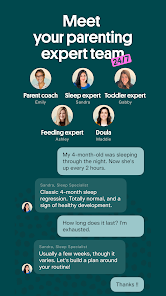
Joy turns that moment into a specific mobile workflow. Parents can track sleep, feeding, and diapers, then ask either an AI assistant or human parenting experts for help inside the same iPhone app. The product is not selling a chatbot that pretends to know everything. It is selling a support layer that accumulates the family’s daily context and can pass that context into the next interaction.
That distinction matters. Many consumer AI apps are built around a blank text box. The user asks a question, gets a fluent answer, and leaves. Parenting is a poor fit for that disposable pattern because the most anxious questions are rarely isolated. They sit inside a chain of sleep history, feeding changes, household routines, and the parent’s own tolerance for uncertainty. Joy’s commercial lesson is that AI becomes more useful when it is part of a recurring service relationship, not when it tries to replace every person in the loop.
The AI Is Not Pretending To Be The Expert
Joy introduced Intelligent Search and an AI assistant in its iOS 5.0.0 release in August 2025, then added the Joy AI Assistant in version 6.0.0 in October 2025. Its App Store language is deliberately restrained: the assistant helps surface answers connected to expert content, while users can still get direct human support.
That restraint is a product choice, not just a safety disclaimer. Parenting questions split into different levels of risk and context. Some are repetitive and time-sensitive: a parent wants an explanation of a sleep pattern, a feeding rhythm, or a common behavior. Others require follow-up questions, emotional calibration, or a clear instruction to contact a pediatrician. A fluent generated answer can be helpful for the first category and dangerous or unsatisfying for the second.
Joy does not publicly describe an automatic routing system that decides exactly which question goes to AI and which goes to a human. What is visible is the product architecture: AI assistance and human experts coexist. For this category, that architecture is more credible than the promise of a fully automated parenting advisor.
The Subscription Sells Ongoing Presence
The App Store lists Joy subscriptions at $18 per month, $36 per quarter, and $99 per year. Joy’s website also offers one-to-one video consultations, and Forbes reported that some 30-minute human video consults require extra payment.
Those price points reveal what the company is really charging for. A single answer to “why will my baby not sleep?” is not enough to justify a durable subscription. Ongoing access can. Parents face small questions repeatedly, often at inconvenient hours, and the value of support increases when the product already knows what happened yesterday and last week.
Forbes reported in November 2025 that Joy had 50,000 paid members and planned to double that number by early 2026. That is company-disclosed media data, not an audited revenue figure, so it should not be treated as proof of ARR. Still, it is a meaningful commercialization signal: a real group of families appears willing to pay for recurring parenting support. The iOS App Store also showed a 4.6 rating across 813 ratings, which is a lighter platform signal but still helps confirm that the product has more than a demo audience.
The Real Asset Is The Family Context
Joy’s 2026 updates were not only about chat. The app kept adding and improving sleep tracking, feeding tracking, diaper tracking, 28-day reviews, and family sharing. Those features may look like ordinary baby-app infrastructure, but they are what make the AI and expert layer more defensible.
“My baby did not sleep well today” is a weak input. “Nap length shortened for three days, night waking increased, and the feeding rhythm changed this week” is a much stronger one. The first prompt leads to generic advice. The second can support a more specific conversation, whether the next response comes from software or from a human expert.
This is also why the mobile surface is important. Parents are not going to open a laptop after every feeding, nap, or diaper change to maintain a perfect record. The phone is near the moment of care. If the app can capture small events when they happen, the later support interaction starts with context instead of memory.
In that sense, Joy is not only competing with AI chat apps. It is also competing with fragmented notes, search results, family group chats, and exhausted memory. The product’s advantage comes from connecting the record of care with the question that follows it.
The Boundary Creates Trust
Joy does not position itself as a medical replacement. In Forbes’ reporting, the team explicitly said that situations such as fever should still go to a pediatrician. That boundary is not a small footnote. It is part of the trust model.
Consumer AI products often try to sound expansive because breadth makes a demo more impressive. Parenting support benefits from the opposite move. The user needs to know what the product is for, what it is not for, and when to leave the app. AI can handle fast, repetitive, low-stakes explanation. Human experts can handle nuance, reassurance, and follow-up. Medical questions should move into the medical system.
Clear boundaries can make the product more usable, not less. A parent who knows where the line is can rely on Joy for the right class of questions without wondering whether the app is quietly overclaiming.
Why The Case Matters
Joy’s lesson for AI builders is not “add humans to a chatbot.” The deeper pattern is to find a life workflow where context accumulates naturally, then let AI and people work from the same record.
That pattern changes the economics. The product is no longer trying to monetize isolated answers. It is monetizing an ongoing relationship: tracking, asking, reviewing, escalating, and occasionally paying for deeper human consultation. The subscription is easier to understand when the customer is buying a village-like support layer that stays close to daily family life.
For mobile AI especially, Joy points to a useful rule: the strongest products will not always be the ones with the most autonomous model. They may be the ones that know when autonomy is enough, when a person should take over, and when the product should tell the user to go somewhere else entirely.
Sources: Joy App Store page and version history; Forbes coverage; Joy website.