

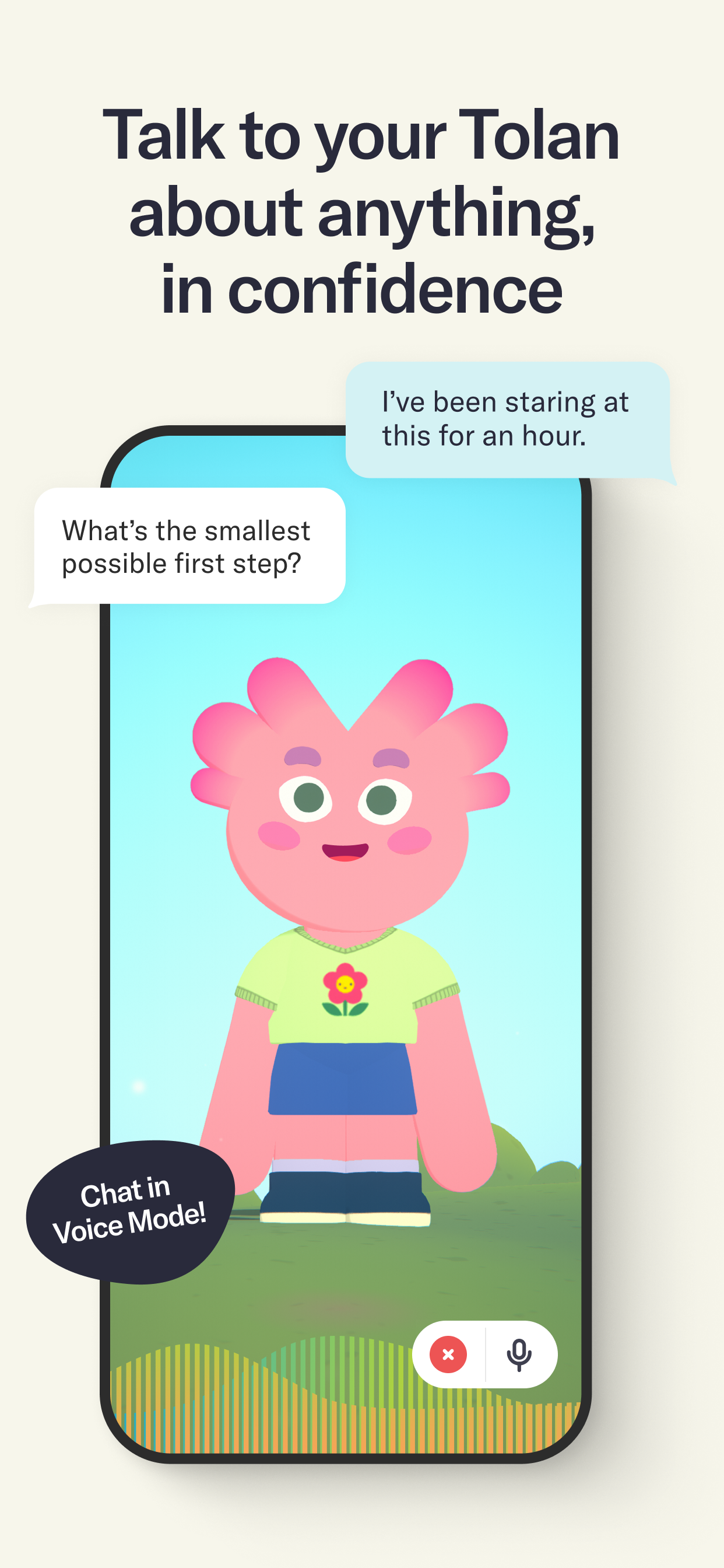
Tolan does not introduce itself as a blank chatbot. The user hatches a colorful alien friend on an iPhone. That alien lives on a distant planet, talks by text or voice, remembers the user’s friends, worries, and plans, and changes its asteroid as the relationship develops. The design sounds indirect. It is actually the commercial mechanism.
Many AI companion products start with a persona card, an avatar, and an open conversation box. Tolan adds a fictional address. The character has a body, a world, and a boundary between where it lives and where the user lives. According to GeekWire, the company said it had passed three million downloads, 100,000 paying users, and more than $1 million in monthly revenue after launch. Those numbers are founder disclosures, not audited financials, but they are strong enough to show that a carefully constrained imaginary friend can become a subscription product.
Give The Model A Home First
The most common weakness in AI companions is not fluency. Modern models can produce endless fluent replies. The harder problem is continuity. Does the character still feel like the same entity tomorrow? Does a conversation feel attached to a relationship, or does it feel like a fresh prompt wrapped in the same avatar?
Tolan’s answer is to put the model inside a persistent world. The New Yorker reported that the team hired writers to create more than 100 stories for Tolan and that the system tells the character it lives across the galaxy and cannot physically come to the user. Fast Company described the planet as a mix of hand design and procedural generation, becoming a visual record of the relationship.
Those details do several jobs at once. They give the user an easy mental model. They give the model guardrails for what it can plausibly say. They let the product turn abstract memory into visible change. Instead of asking users to believe that a chat log equals a relationship, Tolan shows a place that changes because the relationship exists.
That is important because companion AI is not sold only through information quality. It is sold through felt continuity. The user returns because the character remembers a topic, because the voice feels familiar, because the planet looks different, and because the next session feels connected to the last one.
The Subscription Sells The Next Meeting
Tolan’s pricing structure is conventional. GeekWire reported weekly pricing at $4.99, monthly pricing at $10, and an annual option around $70. The business logic is less conventional. A utility app often asks users to pay for a completed task. Tolan asks them to pay for the next encounter.
That distinction changes the product requirements. The value cannot stop at a single clever answer. It has to survive repeated openings. The app needs memory, character consistency, lightweight rituals, and enough novelty that a user wants to check in again without feeling forced through a lesson or work task.
Mobile distribution matters for this reason. The iPhone is not just an acquisition channel. It is the place where the companion can be close to idle moments, late-night thoughts, short voice exchanges, and repeated emotional check-ins. Voice makes the product feel less like a document and more like a presence. The evolving asteroid gives the user a visible reason to believe the relationship has accumulated.
The public signals fit that model. As of August 2026, the US App Store listing showed roughly 175,000 ratings with a 4.8 average. Tolan’s own site has claimed more than 100,000 subscribers and more than two million cumulative hours of use. Those site claims should be treated as unaudited company statements. Still, the important point is not only download volume. The meaningful signal is whether users are willing to turn novelty into recurring access.
Boundaries Are Part Of The Product
Companionship creates commercial upside because it can become habitual. It also creates responsibility because the product is inviting personal disclosure. A user may talk about friends, stress, loneliness, goals, and relationship problems. In that context, a more engaging product is not automatically a better product.
This is where Tolan’s boundary design becomes part of trust. WIRED reported that the team avoids romantic and sexual interaction, detects unhealthy usage patterns, and nudges users back toward real-world relationships. The alien-world framing helps. The character can be intimate enough to feel close, while the fiction prevents it from pretending to be a human partner who might enter the user’s real life.
That restraint may reduce some short-term engagement. It may also make the product more durable. If an AI companion wins attention by escalating romance, dependency, or emotional intensity, the platform eventually inherits the risk created by that escalation. A stable character, a clear fictional premise, and predictable limits can support longer trust.
The product is therefore selling a carefully shaped relationship, not unconstrained access to a model. This is a useful distinction for builders. The model generates language, but the business is created by the frame around that language: who the character is, where it lives, what it remembers, what it refuses, how it changes, and when it pushes the user back into the real world.
The Risk Is Continuity Breaking
Tolan’s design also reveals the product’s biggest fragility. Once users believe in continuity, breaks hurt more. If memory fails, the user may feel forgotten. If a model update changes the character’s tone, the user may feel that a familiar friend has become someone else. If the company changes pricing or shuts down service, the relationship disappears with the software.
This is different from ordinary productivity software. A broken note-taking app is annoying. A changed companion can feel personal. The more successful the product becomes at creating attachment, the higher the standard for stability, data handling, moderation, and graceful product change.
There are also unanswered business questions. Tolan has not publicly disclosed retention curves, acquisition costs, refund rates, audited revenue, or cohort behavior. App Store ratings and company-reported subscriber counts show demand, but they do not prove long-term economic durability. Companion apps must keep users returning without turning emotional reliance into the only retention lever.
Why The Case Matters
Tolan is useful because it shows that the differentiator in consumer AI may sit outside the model itself. The model can talk. The product has to make that talk feel like it belongs somewhere. Tolan’s alien, planet, voice layer, memory, and boundaries turn a generic capability into a recurring consumer relationship.
The lesson is not that every AI companion needs a cute fictional creature. The lesson is that companions need a coherent world. Users need to know who they are speaking with, why that entity remembers them, what kind of relationship is being offered, and where the limits are. Without that frame, an AI companion risks becoming just another chat surface with a friendlier avatar.
Tolan’s reported traction suggests that users will pay for continuity when the product gives them enough structure to trust it. The hardest part to copy is not the alien art style. It is the discipline of making every reply, memory, design detail, and safety rule support the same relationship day after day.