Promotion conversations, customer objections, upward reports, interviews, and boundary-setting talks often fail before the content fails. Many people know roughly what they want to say. The problem arrives when it is their turn to speak and their voice, pace, filler words, and pauses change under pressure.
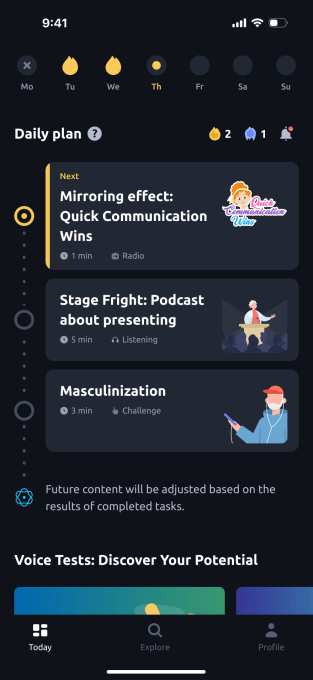
Vocal Image moves that moment into a phone. The user speaks the line first. The counterparty can be a manager, customer, interviewer, colleague, or partner played by AI. After the recording, the product does not simply return generic advice. It points to filler words, pace, clarity, confidence, and delivery problems, then turns the next practice round into part of a daily plan. The App Store description makes the product boundary clear: this is not only a course and not only chat. It is speaking practice that talks back.
The Estonia-born app disclosed meaningful scale in 2025. According to TechCrunch, the company said it had reached 4 million downloads, about 160,000 active users, 50,000 paying users, and $12 million in annual recurring revenue. Those numbers came from the founder and have not been independently audited. Still, they are enough to show that a need many people treat as awkward, private, and hard to subscribe to has become a daily consumer product.
The interesting part is not that Vocal Image teaches communication. Many products do that. The interesting part is that it sells the number of times a user actually opens their mouth before the real conversation happens.
Speak First, Diagnose Second
Traditional communication training often begins with watching, reading, or remembering rules. Avoid filler words. Slow down. Make eye contact. Project confidence. These ideas are not wrong, but they are weak at the moment of use. A person can understand the rule and still lose control of the first sentence in a salary negotiation.
Vocal Image starts from the opposite direction. It asks for the user’s voice.
A user records a short sample, often thirty to sixty seconds. The system can then evaluate qualities such as pitch, volume, clarity, pacing, and confidence. From there, the product offers tongue twisters, breathing drills, accent practice, public speaking exercises, and role-play. The newer positioning stretches into interviews, customer calls, conflict handling, feedback for coworkers, and hard personal conversations. The vague promise of “becoming more confident” becomes a concrete question: what will you practice today, what did the recording reveal, and what should you change in the next attempt?
That structure fits mobile behavior. A practice unit can be short enough for a commute, a pre-meeting break, or the end of the day. The user does not need to believe they will complete a three-month course. They only need to speak today’s line. After repeated sessions, the app can show before-and-after recordings and test results, making subjective improvement a little more observable.
Speaking improvement is hard to sell because the result feels personal and hard to measure. Vocal Image turns that subjectivity into clips that can be replayed, compared, and scored. The user is no longer only consuming advice. They are producing evidence of their own delivery.
The Subscription Is Not A Course Library
Vocal Image offers a free trial on the App Store and then charges through auto-renewing subscriptions across weekly, monthly, and annual plans. Listed in-app purchases vary by plan and market, with visible options including weekly and annual tiers. Paid access includes lessons and exercises, but the stronger paid asset is the continuing personalized plan and immediate feedback loop.
That matters because speaking is not a skill with one final lesson. A new job, a new language environment, a first management role, a sales target, or a personal relationship can all change the user’s training need. Yesterday the user may have practiced a presentation. Tomorrow they may need to decline an unreasonable request. The product can rotate scenarios inside the same subscription rather than constantly inventing a new course category.
TechCrunch previously reported that the company reached $6.5 million ARR with less than $1 million in pre-seed funding. By August 2025, the founder said ARR had grown to $12 million. Those figures still require audit-level caution, but they explain the product’s evolution. Vocal Image is no longer just a small tool for improving vocal tone. It is expanding toward work, social communication, confidence, and relationship contexts where the next real conversation gives the user a reason to practice again.
The commercial lesson is simple. A user will keep paying to “speak better” only if the next practice session feels connected to a real task. Short practice lowers the activation cost. Fast feedback makes the result legible. Specific scenarios keep the product from becoming another unused knowledge library.
The Data Loop Comes From Practice
The practice loop is also valuable to the company.
TechCrunch reported that Vocal Image processes about 35,000 recordings per day and has accumulated more than one million real voice samples. One feature, Voice Rating, lets users upload clips and rate other people’s voices on qualities such as whether they sound confident, childish, mature, or persuasive. That creates a large pool of human-labeled voice data.
This is an unusually direct consumer AI loop. Users record because they want to improve. The recording produces feedback. Users rate other voices because they want a more realistic sense of perception. Those ratings may help the model learn what listeners actually hear. A course catalog can be copied, and model access can be rented, but a steady stream of practice recordings plus perception labels is harder to recreate from scratch.
The same loop also creates risk. Voice data is sensitive. Labels such as confidence, maturity, attractiveness, and childishness are subjective and culturally loaded. A company that collects this kind of data has to make consent, storage, deletion, and model use understandable. If users begin to feel that practice clips are being turned into opaque judgment, the data advantage can become a trust problem.
Vocal Image also cannot replace speech therapy, mental health care, or professional coaching in cases where those services are needed. The company does not publicly disclose retention, acquisition cost, audited revenue, or detailed cohort behavior. The available scale metrics are useful, but they do not prove durable retention by themselves.
The Builder Lesson
For AI builders, Vocal Image is a reminder that education does not always need more content. Sometimes it needs a lower-friction rehearsal surface.
The product does not win by telling users that speaking matters. They already know. It wins by making the next attempt small enough to do now, specific enough to feel useful, and measurable enough to make progress visible. That turns an intimidating personal improvement goal into a repeatable action.
The pattern travels. A writing coach can sell drafts, not lectures. A negotiation coach can sell role-play, not frameworks. A sales coach can sell call rehearsal, not only playbooks. A language app can sell repeated speaking attempts, not static grammar explanations. In each case, the product becomes stronger when the user has to produce the behavior and the system can react to it.
Vocal Image’s strongest idea is that better speaking does not happen inside the lesson. It happens in the moment before the real conversation, when the user practices the sentence out loud and hears what needs to change.