The hardest thing to sell in journaling is not the blank text box. It is the reason to open the app again tomorrow.
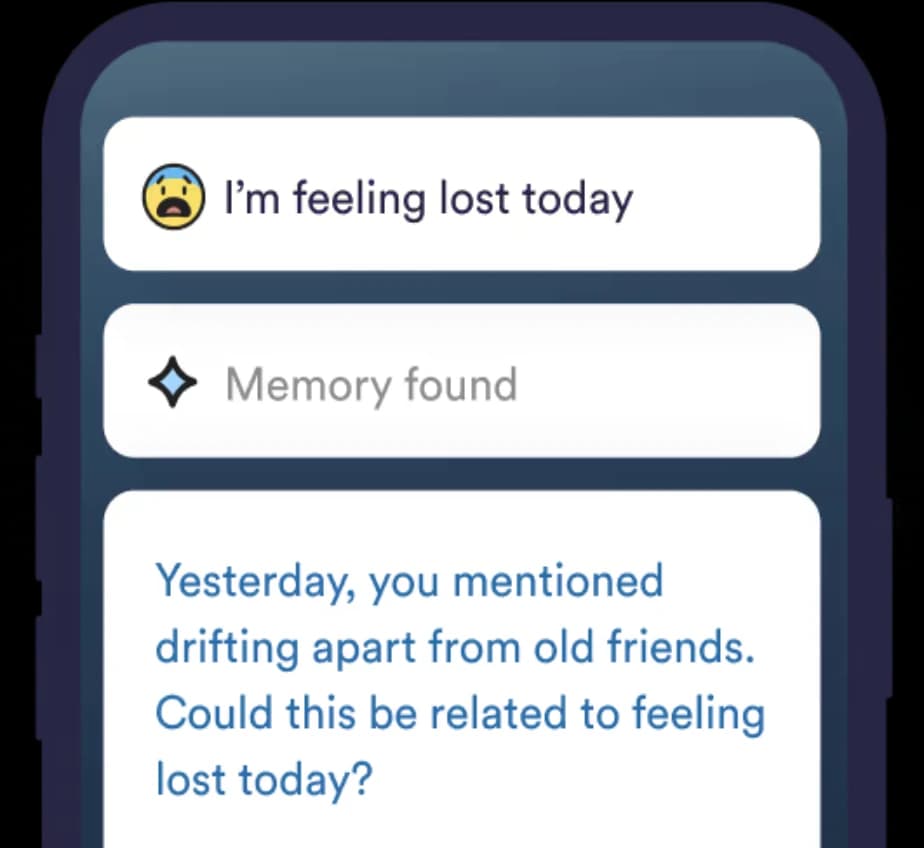
Rosebud’s answer is to make yesterday’s words come back at the right moment. The product has shown a simple interaction: a user says they feel a little lost today, and the system does not merely return a comforting paragraph. It recalls a previous note about drifting away from an old friend, then asks whether the two feelings might be connected.
That is the core of Rosebud’s product strategy. It does not treat AI as a writing assistant parked beside a diary. It puts AI inside time. A user writes a few lines, speaks a voice note, or records a small moment. The system looks for patterns across entries, then brings older material back through questions, reflections, and weekly reviews. The value is not that the model can answer a sentence. The value is that the product remembers enough to ask a better next question.
The company says that, since launching in 2023, users have written more than 500 million words in Rosebud, spent more than 30 million minutes in the product, and produced more than 7,500 paying customers. Those numbers are company-reported and not independently audited. The paid structure, however, is clear. TechCrunch reported in 2025 that basic journaling is free, while long-term memory, voice, and call mode sit behind a $12.99 monthly premium subscription. The same year, Rosebud announced a $6 million seed round.
The case is worth studying because it shows a more precise consumer AI pattern than “add a chatbot to an existing habit.” Rosebud is trying to make a tool more valuable the longer it is used.
The User Is Not Buying One Reply
Open any general-purpose model and type, “I have been anxious lately.” It will usually return a competent response. That capability is useful, but it is hard to defend as a long-term subscription by itself. The answer has little memory, little accountability, and no strong reason for the user to return to that exact product tomorrow.
Rosebud is trying to sell the missing layer: context.
The product analyzes prior journal entries and identifies recurring emotions, relationships, goals, and conflicts. It can then use those patterns inside later conversations. Its own product materials describe the mechanism as more than storage. The system attempts to notice repeated behaviors and relationship patterns, then surface them back to the user when they are relevant. The mobile app also supports voice journaling, photos, and scanned handwritten notes, while the web app is positioned as a companion experience rather than the main surface.
This links product value to accumulated use. On day one, the user may only receive a pleasant conversation. By day thirty, the product may be able to connect a recent mood, a long-delayed goal, a repeated relationship tension, and an old reflection the user forgot writing. The payment question changes. It is no longer “Was this answer worth $12.99?” It becomes “Is the understanding I have accumulated here worth keeping?”
That difference matters in consumer AI. New features can be copied quickly. A private, structured, month-long trail of personal context is harder to move. If the product earns trust, that context becomes both the retention engine and the subscription justification.
Free Journaling Creates The Paid Memory
Rosebud does not place the act of journaling behind the paywall. A user can begin for free. Premium features such as long-term memory, voice, and call mode are reserved for the subscription tier. That freemium structure is familiar, but the placement of the paywall is the interesting part.
Long-term memory is a good paid feature because its value can only be proven over time. A new user does not need to believe a marketing claim on the first session. They can write for a while, build a personal record, and then discover whether the system actually brings back older context accurately. The free layer builds the habit and the archive. The paid layer captures the anxiety of letting that archive go unused.
This is a stronger consumer AI monetization point than simply limiting message counts. Message caps sell quantity. Memory sells continuity. If Rosebud can make a person feel that their own record is getting clearer, more organized, and more actionable over time, then the subscription is attached to the user’s history rather than the model’s novelty.
The product also has a specific expansion path through therapists, coaches, and practitioners. Rosebud’s therapy and coaching page positions weekly reports and reflective material as something a user can bring into a professional session. The product is not claiming to replace a therapist. It is trying to occupy the time between sessions, when a person may have a thought, a setback, or a pattern worth writing down before the next appointment.
That is a more restrained and commercially durable position than “an AI companion is available 24 hours a day.” It sells capture, organization, and preparation. A professional may meet with a client once a week or once a month. The user’s life, however, produces context every day. Rosebud tries to package that in-between context into a consumer subscription.
Privacy Is Part Of The Product, Not A Footnote
For a product like this, the hardest question is not only whether the AI is smart. It is whether the user is willing to write honestly.
Journal entries can include insomnia, grief, arguments, sexuality, work failure, family stress, and private thoughts the user may not want attached to an ad profile, training corpus, or shared account. A productivity tool asks for work context. A personal journal asks for an intimate self-portrait. Long-term memory can become a feature only if the user believes the boundaries are real.
Rosebud says entries are encrypted, are not sold to third parties, are not used to train AI models, and can be protected with biometric locking. Users still need to evaluate those claims for themselves, and public statements are not the same as an independent security audit. But the positioning is important. Privacy is not treated as a compliance sentence below the fold. It is part of the purchase decision.
That is also why this category is different from ordinary workflow software. In a work system, the buyer often worries about leaks, permissions, and vendor risk. In an AI journal, the user worries about what happens after they are fully seen by the product. If the trust boundary is weak, better memory makes the product more frightening, not more valuable.
Rosebud’s commercial story therefore depends on a narrow balance. It has to remember enough to be useful, but not feel like a surveillance product. It has to make reflections portable enough for coaching or therapy use, but not blur into clinical promises. It has to show progress without claiming clinical proof.
The Evidence Is Useful, But Not Complete
Rosebud does not publicly disclose revenue, retention, customer acquisition cost, cohort behavior, or gross margin. The company-reported numbers are encouraging, but they do not answer the hardest business questions. We do not know how many free users become subscribers, how many subscribers remain after the first month, or whether the professional referral channel can produce repeatable acquisition.
Its self-reported mental-health improvement statistic should also be read carefully. The company has said that a large share of surveyed users felt better after thirty days. That may indicate perceived value, but it is not a clinical outcome study. Rosebud also states that it is not a replacement for therapy. For a product touching emotional health, that boundary is not a minor disclaimer. It shapes the product’s risk, copywriting, partnerships, and trust model.
Even with those caveats, the case is commercially instructive. Rosebud is not trying to win by offering the largest model or the most general chat interface. It has chosen a repeated human behavior, journaling, where context becomes more valuable as it accumulates. It then places the paid feature exactly where that accumulation matters: long-term memory, richer capture modes, and ongoing reflection.
The pattern is relevant beyond journaling. Many consumer AI products fail because they answer a prompt but do not own a habit. Rosebud’s stronger idea is to own the recurring record. If a product can make a user’s history useful tomorrow, it has a reason to exist beyond today’s answer.
The Builder Lesson
For AI builders, Rosebud suggests a practical rule: do not start with “What can the model say?” Start with “What does the user leave behind every week, and what would make that history more useful next time?”
In journaling, the input is emotional memory, personal goals, relationships, and small daily observations. In fitness, it may be meals, workouts, recovery, and excuses. In learning, it may be mistakes, questions, speaking attempts, and forgotten concepts. In personal finance, it may be spending decisions, anxieties, and intentions. The defensible consumer AI product may be the one that turns those traces into continuity.
Rosebud still has to prove retention, trust, and repeatable growth. But it has already shown a sharper answer to the consumer AI subscription problem. A diary cannot ask a follow-up question. Rosebud is betting that the right follow-up, returned at the right time, is worth paying for.