
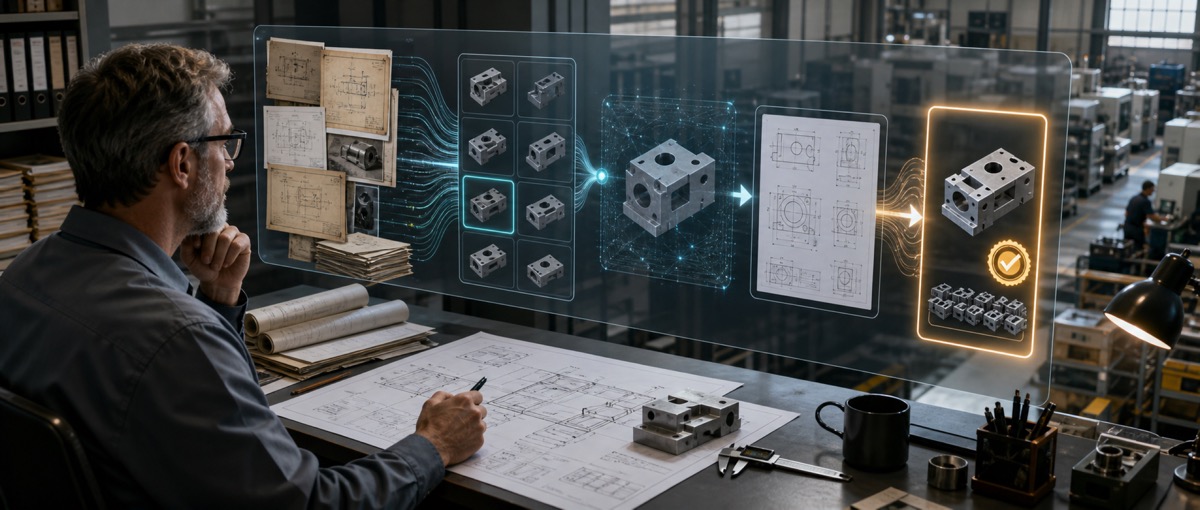
The hardest part for a manufacturer to find is often not a new part. It is the part the company already made years ago.
The drawing may sit in a folder from twenty years ago. The quote may live in another system. The supplier who made it, the reason the job ran over cost, and the later quality issue may remain inside the memory of one senior buyer or engineer. When a customer sends a new drawing, the team can end up asking, calculating, and quoting from scratch again.
CADDi turns that forgotten history into a product. It puts drawings, specifications, historical quotes, procurement records, ERP data, and quality information back into a searchable context. A sales engineer who receives a new request for quote does not have to remember the old project number or ask around the organization. After uploading a drawing, the system can find similar historical parts and connect them to old quotes, suppliers, and related records.
One CADDi customer case describes an unnamed precision-parts manufacturer that used to spend more than thirty minutes finding the old information needed for accurate quoting. With CADDi, the same lookup reportedly fell to one or two minutes. The case is vendor-published, the customer is anonymous, and the result is not independently audited. Even so, it reveals a concrete manufacturing budget problem: slow retrieval is not only wasted time. It increases the chance of losing the order or quoting it incorrectly.
A Drawing Is An Experience Network
In high-mix, low-volume, or engineer-to-order manufacturing, a drawing is never just an image.
It connects material, geometry, process choices, similar parts, suppliers, previous purchase prices, rework, and quality exceptions. The problem is that most companies store those facts by department. Engineering owns CAD files. Procurement owns orders. Finance owns price history. Quality teams keep defect reports. Each record can be found in isolation, but they are hard to call together during a quote.
CADDi’s move is not to build another document repository. Its procurement product describes a workflow that parses drawing dimensions, text, and shape, then links those drawings with purchasing, ERP, and quality data. The user can search by keyword or similarity and use one drawing to discover historical parts, prices, and supplier records.
That sounds like search, but the organizational change is larger. Before, a senior employee might know that a part with this shape appeared in an older program, or that an old quote should not be reused because the supplier later failed inspection. Now the team can at least see the old drawing, the old price, and the later records before deciding whether to reuse the precedent. Human judgment remains in the workflow, but the evidence no longer belongs to one person’s memory.
This is a better entry point for AI in manufacturing than trying to generate a brand-new answer immediately. Many factory decisions are not limited by imagination. They are limited by the inability to retrieve the right precedent at the right moment. CADDi commercializes that retrieval.
The Marketplace Taught The Software What Matters
CADDi did not begin as a pure software company.
Fortune reported that the Japanese company started in 2017 closer to a parts-matching business. Manufacturers sent drawings or specifications, and CADDi helped find suitable suppliers. To make that transaction flow faster, the team had to understand drawings, structures, cost relationships, and supplier fit. Over time, it accumulated software capabilities for interpreting this messy, non-standard manufacturing material.
Roughly three years later, CADDi shifted toward selling those capabilities as a cloud platform for manufacturers. That transition is central to the business story. A matching business earns revenue from individual procurement transactions and is limited by how many deals it touches directly. A drawing data platform can enter quoting, procurement, design, manufacturing engineering, and quality workflows. It becomes infrastructure that can be used every time a new order appears.
The company completed a $38 million Series C extension in 2025, with Fortune reporting a valuation of $470 million. Funding is not proof of commercialization by itself. The more relevant evidence is the customer use case reported in the same story: Subaru said CADDi reduced the time employees spent searching technical drawings by hundreds of hours per month. That statement came through media reporting and customer disclosure rather than a third-party audit, but it matches the product’s economic logic. If one drawing can save half an hour of search, then quoting, procurement, and engineering teams have a reason to pay for a shared data layer.
The software also benefits from a wedge that is specific enough to avoid generic AI positioning. “Manufacturing data platform” can sound abstract. “Find similar drawings and the old quote before you bid” is concrete. It ties the product to a repeated revenue motion rather than a one-time knowledge-management project.
The Reused Asset Is Not Only The Drawing
The most expensive repeated work in manufacturing is often not redrawing a part. It is repeating an old mistake.
A nonconformance record, a changed material decision, a supplier’s actual lead time, or a procurement exception can all help the next team avoid risk. Without linkage, those facts are only attachments. When they can be found, compared, and inserted into a live workflow, they start to behave like enterprise assets.
CADDi’s Dairy Conveyor case makes this easier to understand. The U.S. conveyor-equipment manufacturer reportedly saved 600 work hours after one year of using CADDi. A procurement leader said work that once took a full week could be compressed into an afternoon. This is again a CADDi-published customer case, not an independent benchmark. But it translates “data platform” into an operational result a manufacturer can evaluate: less hunting for information, fewer internal questions, and fewer decisions starting from zero.
That is also why the product can expand across functions. The first use case may be quoting or procurement. Once drawings are linked to business records, the same layer can support cost review, supplier consolidation, design reuse, quality investigation, and production planning. The valuable asset is not the scanned file. It is the relationship between the file and every consequence that followed it.
The Risk Is Data Work, Not Model Demos
CADDi has not publicly disclosed standard pricing, software revenue, customer retention, or gross margin for the cloud platform. The available customer results are mostly company or customer case materials. A manufacturing company that wants to use the system may also have to connect years of drawings, ERP entries, procurement records, and quality documents before the promised search experience becomes strong.
That data work is not a side issue. It is the product. If drawings are poorly named, historical prices are missing, supplier IDs are inconsistent, or quality records cannot be matched to parts, the model will not produce useful context. Security and permissioning matter too, because drawings and supply-chain records can be highly sensitive. A manufacturer has to trust that external software can handle core design and procurement information without turning it into uncontrolled knowledge.
These risks are real, but they also create a defensible product boundary. A generic AI assistant can summarize a drawing. CADDi is trying to know where that drawing has appeared, what the organization paid, which supplier handled it, and what happened later. That context is hard to build, hard to clean, and deeply tied to customer systems.
For AI builders, the lesson is straightforward. Do not rush to generate a new answer for professionals who already have decades of valuable answers buried in their organization. First make those old answers retrievable, comparable, and usable inside the next decision.
CADDi’s strongest idea is that the next order does not have to begin with a blank page. It can begin with the drawing the company already paid to understand.